How To Exercise At Home With Equipment Without Clutter
I remember staring at my 600-square-foot apartment living room, trying to figure out how to fit a squat rack between my sofa and the TV stand. It was completely impossible. If you want to exercise at home with equipment, you quickly realize that floor space is your most valuable commodity. You do not need a massive two-car garage to get strong. You just need a smarter approach to buying gear.
Over the years, I have helped dozens of clients transform tiny corners of their bedrooms into highly functional training zones. The secret is not buying smaller versions of commercial gym machines. It is about rethinking how equipment functions within a limited footprint.
Quick Takeaways
- Evaluate gear by its 'Space-to-Yield Ratio'—how many exercises it allows per square foot.
- Adjustable dumbbells can replace 15 pairs of fixed weights in just a 1.5-square-foot footprint.
- Protect your floors and joints with high-density matting before lifting heavy.
- Apply progressive overload through tempo and leverage when you max out your weight increments.
The Space-to-Yield Equipment Philosophy
When clients ask me how to set up a training space in a spare bedroom, the first thing I teach them is the Space-to-Yield Ratio. Think of your floor space like a strict budget. A single-use machine, like a leg extension unit, takes up roughly 15 square feet but only trains one specific muscle group. That is a terrible return on investment for a cramped room.
Instead, I look for items that offer dozens of exercise variations while occupying almost zero permanent floor space. A suspension trainer can be packed into a shoebox, yet it allows you to hit your back, chest, core, and legs from multiple angles. That is a massive space-to-yield ratio.
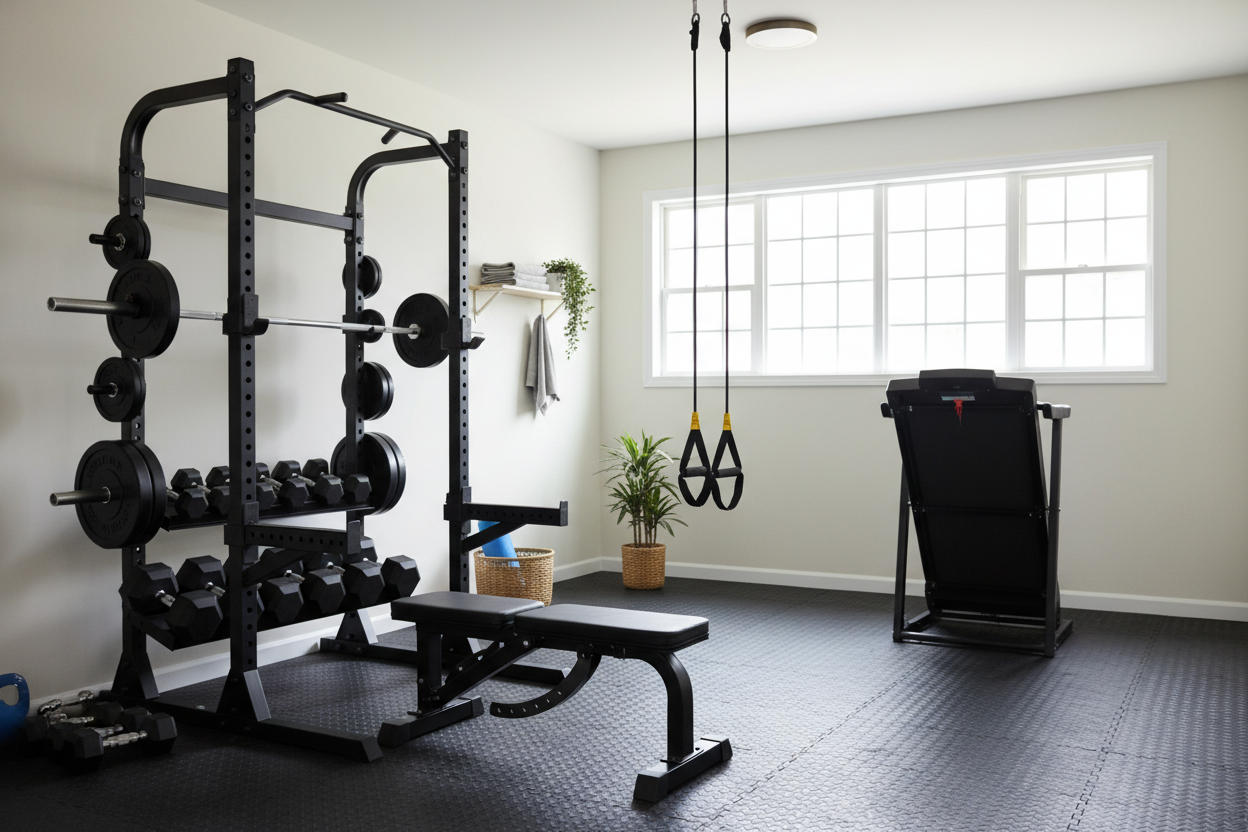
When you plan to do a home workout with equipment, every square inch matters. I have tested massive multi-station home gyms that ended up functioning as very expensive laundry racks because they were too clunky to navigate around. The goal is to build a setup that you can easily deploy in a 6x6 foot area and tuck away into a closet or under a bed when you finish. By prioritizing versatile free weights and bodyweight leverage tools, you keep your living area clean while still getting a gym-quality pump.
Selecting Gear for a Home Workout With Equipment
The foundation of any compact setup starts with adjustable dumbbells. I highly recommend a pair that ranges from 5 to 52.5 pounds. They replace an entire rack of fixed weights, saving you massive amounts of storage space. I have used dial-based adjustables for over five years in my own programming. The only honest downside is that they are slightly bulkier and longer than traditional hex dumbbells, which can make movements like goblet squats feel a bit awkward at first. However, the space savings make them entirely worth the slight learning curve.
Next, add a suspension trainer to your kit. You can anchor it to a sturdy, closed door frame. It safely supports up to 350 pounds of body weight and allows for horizontal pulling movements—something that is notoriously hard to replicate without a bulky cable machine.
If you are just starting out, you do not need to buy everything at once. Focusing on basic at home workout equipment like resistance bands and a simple pull-up bar will give you enough resistance to stimulate muscle growth for months. A set of loop resistance bands offers varying tensions (from 10 to 150 pounds) and takes up less space than a folded towel. They are perfect for isolation work and stretching.
Creating a Safe Training Surface
Before you lift a single weight, you need to address the floor. Hardwood and carpet are not designed to handle the impact of dropped dumbbells or the sheer friction of high-intensity interval training. Sweat destroys hardwood finishes, and carpet absorbs odors while offering zero stability for heavy squats.
I learned this the hard way after permanently denting my apartment floor with a dropped 40-pound dumbbell. Now, I always tell clients to invest in durable gym flooring for home workouts. A high-density, 7mm thick mat provides the necessary shock absorption to protect your joints during plyometrics and shields your property from accidental drops. It also defines your workout zone, psychologically separating your relaxing living space from your active training space.
Structuring Your Workout At Home With Equipment
Having the right gear is only half the battle. To see real hypertrophy and strength gains, you need a structured plan. A common mistake I see with an at home workout with equipment is treating it like a randomized, frantic circuit class. If you want to build muscle, you need to lift with intention, track your progress, and rest adequately between sets.
I prefer an upper/lower split or a full-body routine performed three to four days a week. Start your session with your heaviest compound movement. For example, if you have 50-pound dumbbells, use them first for Bulgarian split squats or flat floor presses. Do 3 to 4 sets of 8 to 12 reps, resting 90 seconds to two minutes between sets.
Because you might not have access to a 300-pound barbell, you will need to push closer to muscular failure on your working sets. If 50 pounds feels light for a squat, increase your reps to 15 or 20 per set, ensuring the last few reps are a genuine struggle. Once you finish the heavy compound lifts, move on to isolation exercises using your resistance bands or suspension trainer. Finish your session with 3 sets of 15 to 20 reps of bicep curls, triceps extensions, or lateral raises. Keep your rest periods shorter here—around 45 to 60 seconds—to maximize metabolic stress. This structure ensures you exhaust the target muscles completely, even if your absolute load is lighter than what you would use in a commercial facility.
Best Exercises For Home Gym Equipment Modalities
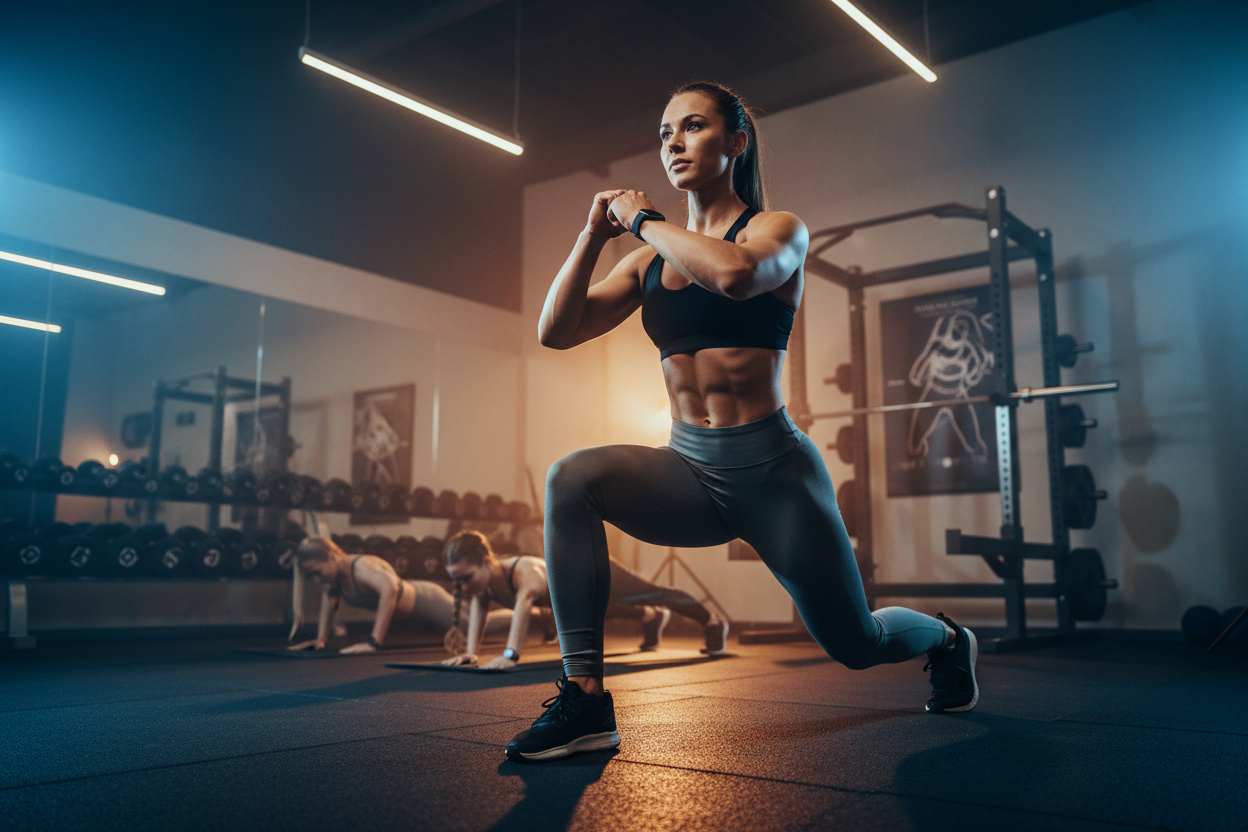
Let's map out the actual exercises for home gym equipment that deliver the best results. For the lower body, adjustable dumbbells shine with goblet squats, Romanian deadlifts, and walking lunges. If you struggle to feel your legs working with lighter weights, try pre-exhausting them. I often have clients run through short bodyweight leg routines to fatigue the quads and glutes before picking up the dumbbells for their main working sets.
For the upper body push, floor presses and overhead dumbbell presses are staples. The floor press naturally limits your range of motion, which protects your shoulder joints while still heavily taxing the triceps and chest. You do not even need a bench to get started.
For the upper body pull, the suspension trainer is unmatched. Inverted rows and face pulls will build a thick, resilient upper back. You can easily adjust the difficulty by changing your foot position—stepping closer to the anchor point increases the resistance, while stepping back makes the movement lighter.
Progressing Your At Home Workout With Equipment
Eventually, you will max out the weight on your adjustable dumbbells. When a workout at home with equipment stops feeling challenging, you have to manipulate other variables to force adaptation.
The simplest method is tempo training. Try a 3-1-3-1 tempo: lower the weight for three seconds, pause for one second at the bottom, lift for three seconds, and squeeze for one second at the top. A 30-pound dumbbell feels like 60 pounds when you completely remove momentum. You can also manipulate leverage. If standard push-ups are too easy, elevate your feet on a chair to shift more body weight onto your chest and front delts. Mechanical drop sets—moving from a harder variation to an easier one without resting—are another brutal but highly effective way to stimulate growth with limited weight.
Cost-Effective Upgrades Over Time
You do not need to buy everything on day one. Start with the mat, the adjustable dumbbells, and the resistance bands. After six months of consistent lifting, you might decide you want an adjustable bench to unlock incline presses and seated curls. A solid folding bench usually takes up about 4 to 5 square feet, so ensure your space can handle it before purchasing.
Keep an eye out for seasonal sales to expand your setup. Browsing home gym equipment deals around major holidays is a smart way to grab a heavy kettlebell or a weighted vest without breaking the bank. Buy gear that solves a specific training problem you are currently facing, rather than buying shiny objects that will just gather dust in the corner of your bedroom.
Frequently Asked Questions
Can I build muscle with just dumbbells at home?
Yes. Muscle tissue responds to tension and fatigue, not the specific brand of equipment. By pushing your sets close to failure, controlling the eccentric portion of the lift, and eating in a caloric surplus, adjustable dumbbells are more than enough for significant hypertrophy.
How much space do I really need for a home workout?
A 6x6 foot clear area is sufficient for 95% of dumbbell, kettlebell, and suspension trainer exercises. As long as you can lie flat on your back and extend your arms to the side without hitting furniture, you have enough room to train effectively.
Is it safe to lift weights on a second-floor apartment?
Yes, provided you use control. Avoid exercises that require dropping weights, like heavy Olympic lifts. Use a thick, high-density exercise mat to dampen sound and protect the subfloor from the hard edges of your dumbbells.