How to Build Real Muscle Using Only Weight Machines
Stop listening to the purists who insist you can't build a formidable physique without a barbell. While free weights have their place, modern weight machines offer a unique advantage: the ability to isolate muscles with surgical precision and take them to absolute failure safely.
Whether you are outfitting a garage gym or navigating a crowded commercial fitness center, understanding the mechanics of these tools changes the game. It isn't about choosing the easy route; it's about choosing the stable route to maximize mechanical tension.
Key Takeaways
- Stability Equals Output: Machines remove the need to stabilize the load, allowing 100% of your effort to go toward the target muscle.
- Safety at Failure: You can push a workout weight machine to absolute failure without needing a spotter, which is critical for hypertrophy.
- Constant Tension: Unlike some free weight movements where gravity takes a break at the top, many cable-based machines keep tension on the muscle throughout the full range of motion.
- Adjustability is King: Proper seat and pivot point alignment is the difference between a great workout and a joint injury.
Why Machines For Strength Training Work
There is a misconception that an exercise weight machine is only for rehabilitation or beginners. This is false. The science of hypertrophy (muscle growth) relies heavily on mechanical tension. When you use free weights, a significant amount of your energy goes into balancing the weight.
Fitness weight machines solve this. By providing a fixed path of motion, they stabilize the load for you. This allows your nervous system to stop worrying about balance and fully recruit the high-threshold motor units responsible for growth. If you want to grow your quads, a hack squat machine often allows for more direct loading than a barbell squat because your lower back is no longer the limiting factor.
Navigating the Gym Floor: Types of Equipment
Selectorized vs. Plate-Loaded
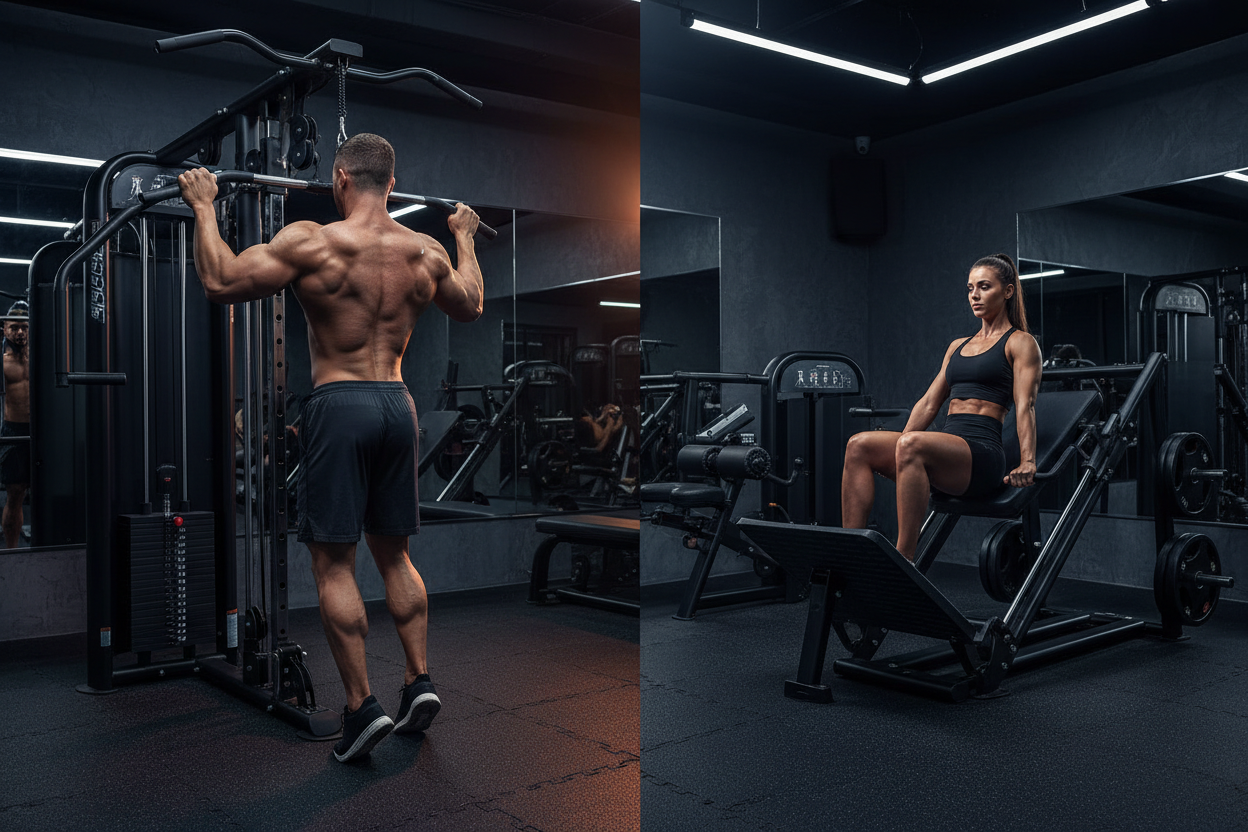
Most commercial facilities feature two main types. Selectorized units are the standard gym weight machine with a pin and a weight stack. They are incredibly fast to set up, making them ideal for drop sets and circuit training.
Plate-loaded equipment (often called Hammer Strength) requires you to load iron plates onto the machine. These generally offer a smoother movement curve that mimics natural body mechanics better than older cable stacks. If you see a weight machine for gym use that moves on an arc rather than a straight line, it is likely designed to match the natural rotation of your joints.
The Rise of the Home Weights Machine
Ten years ago, a home weights machine meant a flimsy, all-in-one contraption that wobbled every time you sneezed. Today, the market has shifted. High-quality weights machine for sale listings now often include functional trainers and compact leverage arms that rival commercial gear.
When looking for a machine for lifting weight at home, prioritize the "footprint to versatility" ratio. A functional trainer (dual cable column) occupies a small corner but allows for hundreds of movements, whereas a dedicated chest press machine takes up huge space for a single movement.
How to Train Effectively
Control the Eccentric
The biggest mistake lifters make on exercise machines with weights is letting the stack slam down. The machine reduces friction, which makes it easy to cheat. You must control the negative (lowering phase) for at least 2-3 seconds. If the plates clang, you lost tension.
Align Your Pivot Points
Every weight training machine has a pivot point (usually a red dot or a bolt). This pivot must align with your body's joint. For a leg extension, the machine's pivot should be right next to your knee. If you are misaligned, you create shearing force on the joint rather than tension on the muscle.
Body Weight Machines
Don't neglect body weight machines like the assisted pull-up or dip station. These are fantastic for high-volume finishers. They allow you to maintain perfect form even when you are too fatigued to handle your full body weight.
My Training Log: Real Talk
I want to be honest about the user experience here. I’ve spent years training, and there is a specific frustration with weight machines that manuals don't mention: the "one-inch gap."
I was recently testing a seated row machine where the chest pad had notches about two inches apart. Notch 4 was too tight—I felt like I was being crushed before I even grabbed the handles. Notch 5 was too loose—I had to over-reach, rounding my shoulders just to start the rep.
This happens. When it does, I don't force the machine. I usually grab a yoga block or a folded gym towel and wedge it between my chest and the pad. It sounds low-tech, but that extra inch of padding provided the bracing I needed to pull heavy without compromising my lower back. Also, let's talk about the friction on older cable machines. If you feel a "gritty" vibration coming through the handle during a tricep pushdown, drop the weight by 10% and slow down. That grit creates inconsistent resistance that can irritate your elbows if you try to power through it explosively.
Conclusion
Weight machines are not a crutch; they are a tool for targeted intensity. By removing the stability requirement, you can safely push your muscles to failure and spark new growth. Whether you are browsing a weights machine for sale for your garage or stepping into a high-end health club, the principles remain the same: align your joints, control the negative, and never let the stack slam.
Frequently Asked Questions
Are weight machines safer than free weights?
Generally, yes. A workout weight machine restricts the path of motion, reducing the risk of dropping weights or moving into a dangerous position. However, injury can still occur if the seat is adjusted incorrectly or if you use too much weight with poor form.
Can I build muscle using only machines?
Absolutely. Your muscles do not know if you are holding a barbell or a machine handle; they only detect tension. As long as you apply progressive overload (adding weight or reps over time) on an exercise machine weight stack, you will build muscle.
What is the best weight machine for home use?
For most people, a "functional trainer" (cable machine with adjustable pulleys) is the best investment. It serves as a comprehensive home weights machine that allows you to train every body part, unlike a fixed chest press or leg extension unit.