Exercise Mat Size Guide: Stop Buying Mats Too Short for Your Flow
There is nothing quite as frustrating as being in the middle of a deep stretch or a high-intensity set, only to have your hands or feet slide off the edge onto the cold, hard floor. It breaks your focus and, in some cases, can lead to injury. While most people obsess over material or grip, the **exercise mat size** is actually the most critical factor for a functional home gym setup.
Many beginners assume one size fits all. It doesn’t. If you have ever felt cramped during a burpee or found your head resting on the floor during Savasana, you are using the wrong equipment. Let’s break down the dimensions you actually need based on your biomechanics and training style.
Key Takeaways: Quick Sizing Rules
- The "Standard" Trap: Most mats are 68 inches long (173 cm). If you are taller than 5'8", this is likely too short for you.
- The Golden Rule of Length: Your mat should be at least 6 inches longer than your height to accommodate full-body extension.
- Width Matters for HIIT: Standard width is 24 inches. For lateral movements or broad shoulders, seek out 26-30 inch widths.
- Thickness vs. Stability: Thicker isn't always better. Go for 1/16" (1.5mm) for travel, 1/8" (3mm) for balance, and 1/4" (6mm) for joint protection.
Why Length is About More Than Just Height
The industry standard for a yoga or exercise mat is roughly 68 inches long. This dates back to when average height statistics were lower and manufacturing costs dictated smaller molds. Today, that length is insufficient for a large portion of the population.
When you perform a plank, a downward dog, or a lying chest press, your body elongates. If your mat is exactly your height, you have zero margin for error. You need buffer space at the top and bottom. Without it, you subconsciously contract your movements to stay "inside the lines," which compromises your form.
The Tall Sizing Bracket
If you stand 5'10" or taller, ignore standard mats immediately. Look for "Extra Long" or "Tall" classifications, which usually start at 72 inches (6 feet) and go up to 84 inches (7 feet). This ensures that when you lie flat, both your head and heels remain cushioned.
Width: The Overlooked Dimension
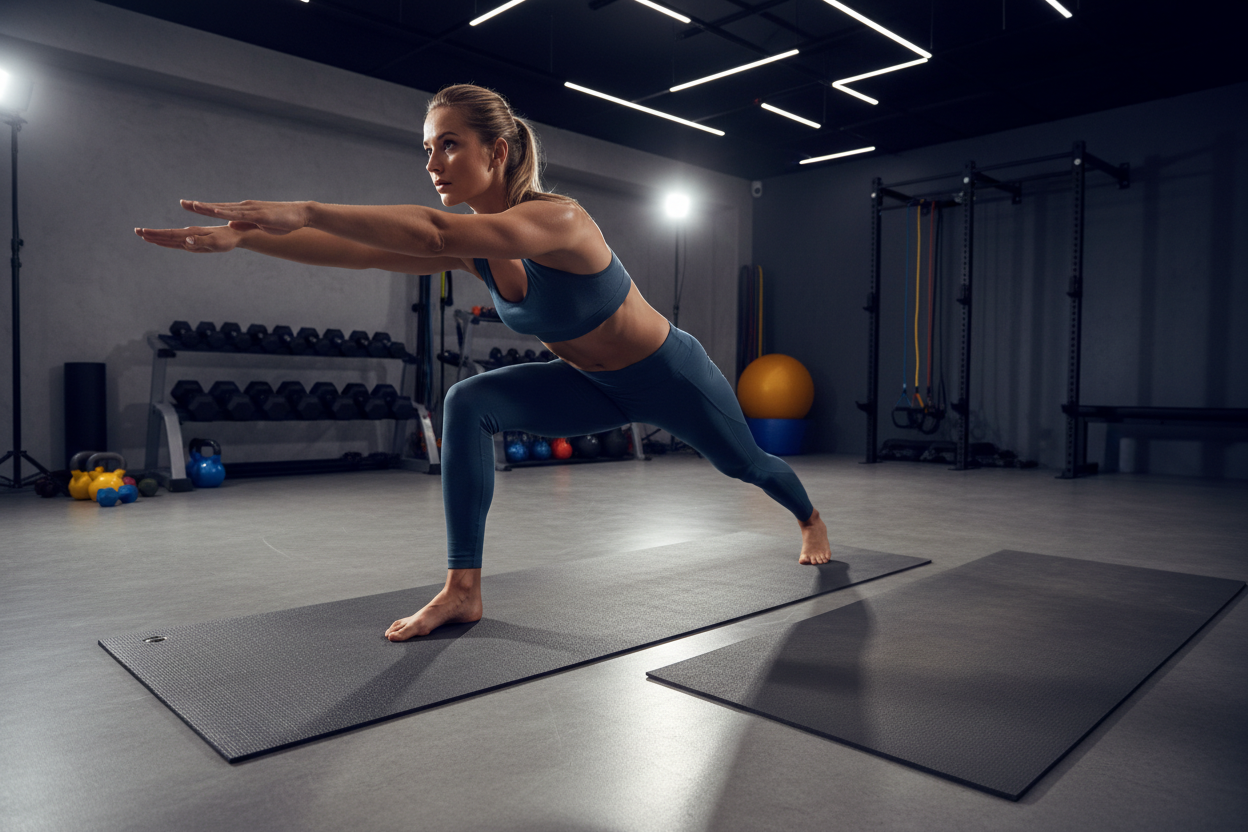
Length gets the attention, but width dictates your freedom of movement. The standard 24-inch width is designed strictly for linear movements—think walking lunges or sun salutations.
However, if your training involves plyometrics, lateral skaters, or wide-stance squats, 24 inches feels like a tightrope. A narrow mat forces you to check your footing constantly. For general fitness and functional training, stepping up to a 30-inch or 36-inch wide mat changes the game. It allows you to sprawl without touching the floor, keeping your sweat contained and your grip consistent.
Thickness: The Third Dimension of Size
While we are discussing dimensions, thickness (volume) plays a massive role in performance. This is a trade-off between proprioception (feeling the ground) and comfort.
- 1/16 inch (1-2mm): Paper thin. Great for travel and solid balance poses, but brutal on the knees.
- 1/8 inch (3-4mm): The sweet spot for most lifters and yogis. You get stability for heavy lifts without the "sinking" feeling.
- 1/4 inch to 1/2 inch (6-12mm): Essential for Pilates or ab work where your spine grinds against the floor. However, avoid these for standing single-leg movements, as the foam compression will destabilize your ankle.
My Personal Experience with exercise mat size
I learned this lesson the hard way back when I was setting up my first garage gym. I bought a standard 68" x 24" mat because it was on sale, thinking it wouldn't make a difference. I'm roughly 6'0".
The issue wasn't just the length; it was the transition during burpees. Every time I kicked my feet back, my toes would land on the concrete just past the mat's edge. Because of the height difference between the 6mm mat and the floor, my toes would clip the edge on the way back in, causing the mat to bunch up underneath my shins.
It was infuriating. I spent more time flattening the mat back out than actually exercising. But the worst part was the width. When doing wide-grip pushups, my palms were half-on, half-off. One particularly sweaty session, my left hand slipped on the slick concrete while my right hand stuck to the grippy mat, tweaking my shoulder. I upgraded to a 72" x 30" high-density rubber mat the next week. The difference in confidence when you know you aren't going to slip off the edge is immediate.
Conclusion
Don't treat your mat as an afterthought. It is the foundation of your movement. Before you buy, take a tape measure to your training space and your own body. If you are tall, go for 84 inches. If you have broad shoulders or do HIIT, prioritize width. Getting the size right means you stop thinking about the floor and start focusing entirely on your performance.
Frequently Asked Questions
What is the standard size of an exercise mat?
The most common standard size is 68 inches long by 24 inches wide (approx. 173cm x 61cm). This fits most people under 5'8", but is often too small for taller individuals or dynamic workouts involving lateral movement.
Does a thicker mat affect balance?
Yes, significantly. A mat thicker than 6mm (1/4 inch) introduces instability. While it cushions joints, the material compresses under your weight, making it difficult to hold balance poses or generate force during heavy lifts. For stability, stick to 3mm or 4mm mats.
How do I know if my exercise mat is too small?
If your head or feet touch the floor when lying supine (flat on your back), the mat is too short. If you find yourself constantly repositioning the mat during a workout because you moved off of it, or if you feel restricted in wide-stance movements, the mat is likely too narrow.