How to Build Massive Quads With Just Barbell Leg Extensions
You have a squat rack, a bench, and plenty of plates, but your home gym is missing one crucial piece of machinery: the leg extension. For years, lifters have believed that quad isolation is impossible without cables or a dedicated machine. That is simply not true.
If you are looking to torch your quadriceps without investing in bulky equipment, barbell leg extensions are the functional workaround you need. While awkward at first, this movement provides the direct rectus femoris stimulation that squats and lunges often miss. It requires balance, a high pain tolerance, and strict attention to form, but the payoff in quad definition is worth the effort.
Key Takeaways
- Equipment Needs: You need a high bench (or box) and a barbell. Padding (like a squat pad or towel) is non-negotiable for foot comfort.
- Muscle Focus: This move isolates the quadriceps, specifically the rectus femoris, which is unique because it crosses both the hip and knee joints.
- Load Management: Do not go heavy. This is a mechanical disadvantage exercise; high reps and control trump heavy loads every time.
- Safety: Keep the weight centered on the instep of the foot and maintain dorsiflexion (toes up) to prevent the bar from rolling.
Why Bother With the Leg Extension With Barbell?
Compound movements like squats are king for mass, but they engage the glutes, hamstrings, and lower back heavily. Sometimes, your quads aren't fully fatigued even when your systemic energy is drained. That is where isolation comes in.
The barbell leg extension mimics the machine version by locking the hips in place and forcing the knee to extend against resistance. This targets the "teardrop" muscle and the upper quad. For home gym owners, this variation is a lifesaver for bringing up lagging legs without spending thousands on a single-use machine.
The Setup: Getting It Right
This is not a grab-and-go exercise. The setup is the biggest barrier to entry, so pay attention.
1. The Bench Height
You need to sit high enough that your feet hang freely without touching the floor. If your standard flat bench is too low, place it on stable rubber mats or bumper plates. If your heels drag on the floor at the bottom of the rep, you lose tension.
2. Padding the Bar
Do not attempt this with a bare metal bar. The barbell sits directly on the instep of your foot (the shoelace area). Without a squat pad, yoga mat, or thick towel wrapped around the center, the knurling will grind against your tendons and bone. Comfort allows you to focus on the contraction rather than the pain.
How to Perform the Movement
Once you are seated and the bar is padded, follow these cues for the perfect rep:
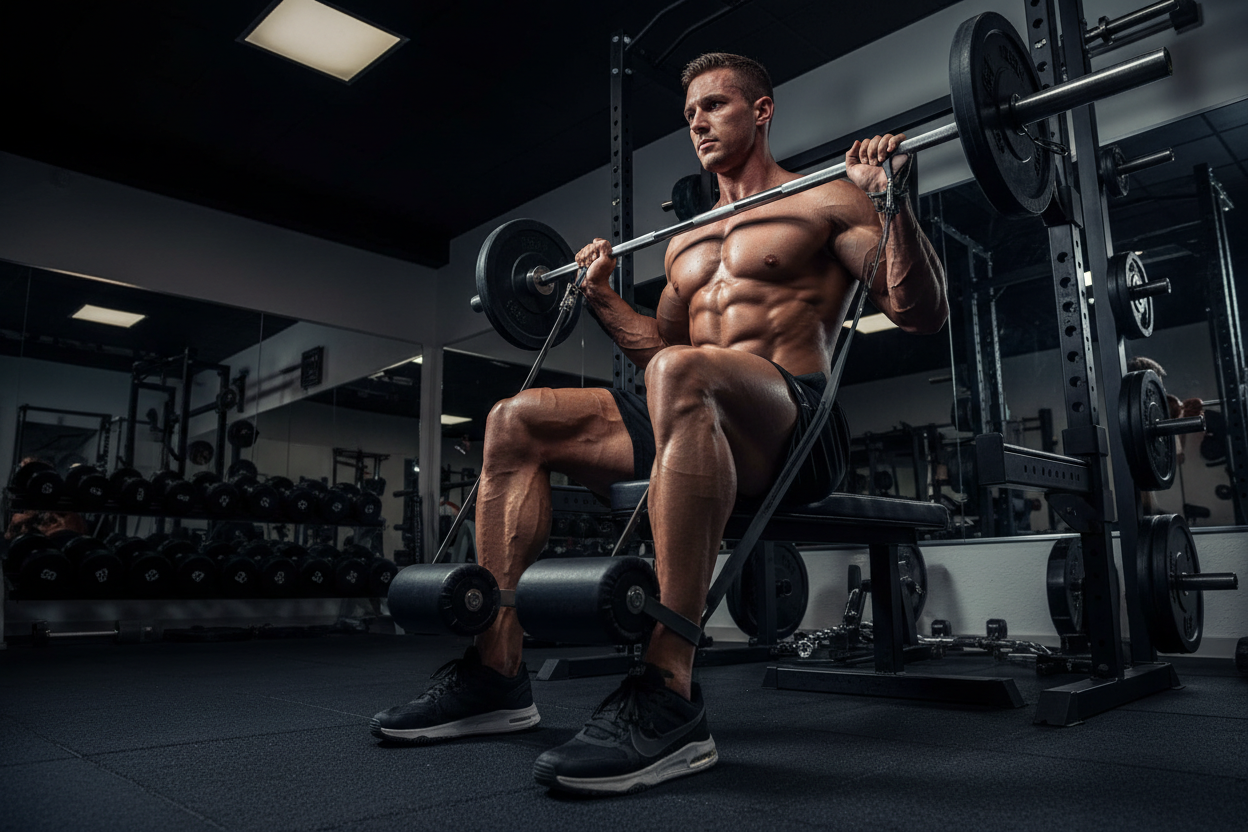
- Positioning: Sit on the edge of the bench. Place the barbell on the floor in front of you.
- The Hook: Slide your toes under the bar. You want the bar resting right where your ankle meets your foot.
- The Lock: Dorsiflex your feet hard. This means curling your toes upward toward your shins. This "hooks" the bar and prevents it from rolling off mid-rep.
- The Extension: Grip the sides of the bench for stability. Extend your knees to lift the bar until your legs are straight.
- The Squeeze: Pause at the top for one second. Squeeze your quads hard.
- The Descent: Lower the bar slowly. Do not let gravity take over, or the bar will crash into your shins.
Common Mistakes to Avoid
Ego Lifting
The lever arm here is long, meaning the weight feels much heavier than it actually is. Using a standard 45lb (20kg) bar might be too heavy for some beginners to control strictly. If you swing the weight, you place dangerous torque on the knee ligaments rather than tension on the muscle.
Losing Foot Tension
If you relax your ankles, the bar rolls down the shins. This shifts the center of gravity and can cause injury to the ankle joint. Keep those toes pointed to the ceiling throughout the entire set.
My Training Log: Real Talk
I want to be transparent about my first experience with this move. I read about it online and thought, "How hard can it be?" I grabbed a standard Olympic bar and sat on my flat bench.
First mistake: My bench was too low. Every time I lowered the weight, the plates clanged against the floor, killing the tension immediately. I had to stack two 45lb bumper plates under the bench legs just to get clearance.
Second mistake: I didn't use a pad. I was wearing thin running shoes, and the moment I reached full extension, the center knurling dug straight into the top of my foot bone. It was a sharp, biting pain that made me drop the weight instantly. Now, I never do these without a thick squat pad wrapped around the bar. Also, be prepared for the "wobble." Unlike a machine that moves on a fixed track, the barbell requires you to balance the left and right sides. Your stabilizers will be screaming by rep eight.
Conclusion
The barbell leg extension isn't the most comfortable exercise you will ever do, but it is one of the most effective for home gym isolation. It bridges the gap between heavy squats and refined muscle shaping. Start with just the bar (or even a lighter technique bar), focus on the squeeze at the top, and respect the mechanics of the movement.
Frequently Asked Questions
Are barbell leg extensions bad for your knees?
They are generally safe if performed with light weight and controlled tempo. However, because the load is placed distally (at the foot) without the cam mechanics of a machine to smooth out the resistance curve, going too heavy can place excessive shear force on the knee joint. If you have pre-existing knee issues, proceed with caution.
Can I do this exercise on the floor?
No, you cannot effectively perform a seated leg extension on the floor because you need ground clearance for your feet. However, there is a variation called a "lying leg extension" (or reverse leg curl) done lying face up, but the mechanics are different and often harder to setup solo.
How many reps should I do for leg extension with barbell?
Aim for high volume. Because heavy weight is risky and difficult to balance, stick to the 15 to 25 rep range. This ensures you are targeting metabolic stress and hypertrophy (muscle growth) rather than pure strength, while keeping your joints safe.