
How to Build Massive Legs With A Leg Day Machines Only Routine
There is a persistent myth in the fitness industry that you cannot build impressive wheels without a barbell on your back. This is simply untrue. In fact, for pure hypertrophy (muscle growth), a leg day machines only approach can often yield superior results compared to free weights.
When you remove the need to balance a heavy load, you increase stability. Higher stability allows your nervous system to recruit more motor units, leading to greater mechanical tension directly on the target muscle. Whether you are working around a lower back injury or simply prefer the safety of a selectorized stack, this guide covers how to grow without the barbell.
Key Takeaways: The Machine Advantage
- Stability Equals Output: Machines remove the balance factor, allowing you to push closer to failure safely.
- Isolation is Key: A machine leg day workout allows you to target the quads or hamstrings specifically without systemic fatigue limiting your performance.
- Foot Placement Matters: On leg presses and hack squats, moving your feet up or down shifts the bias between glutes and quads.
- Intensity Techniques: Machines are ideal for drop sets and partial reps since you don't need a spotter.
Why Choose a Leg Workout With Machines Only?
The primary benefit of a machine-based session is the ability to take muscles to true mechanical failure safely. In a free-weight squat, your lower back or core often fails before your quads do. In a leg workout machines only scenario, you eliminate the weak links.
Furthermore, the setup time is minimal. You aren't loading plates onto a bar or setting up safety racks. You get in, adjust the pin or load the sled, and work. This density of training keeps your heart rate up and maximizes the pump.
The Ultimate Machine Leg Day Workout
To make this effective, we need to replicate the movement patterns of free weights: a squat pattern, a hinge pattern, and isolation movements.
1. The Heavy Compound: Hack Squat
This is your barbell squat replacement. The Hack Squat provides a fixed path of motion, which means you can sink deep into the hole without worrying about falling backward.
Form Tip: Place your feet lower on the platform to emphasize the quads. Ensure your lower back stays glued to the back pad throughout the movement. Do not cut the depth short; the bottom position is where the most growth occurs.
2. The Volume Builder: Leg Press
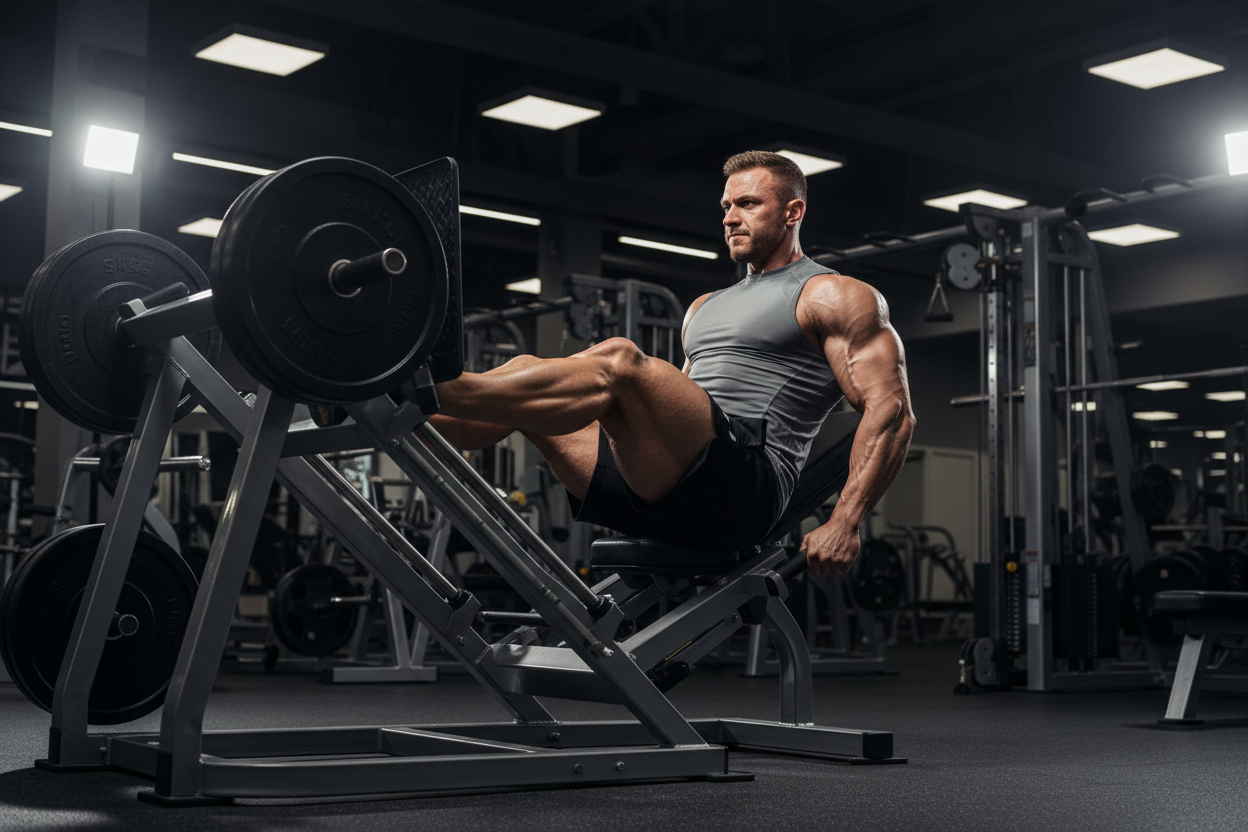
The leg press allows for the heaviest loads in a leg day workout machines only routine. However, it is also the most commonly botched exercise.
The Science: Avoid "ego lifting." If your knees are not coming close to your chest (or at least 90 degrees), drop the weight. Shallow reps do very little for muscle growth.
3. Posterior Chain: Seated Leg Curl
Many lifters neglect the hamstrings when they ditch deadlifts. The seated leg curl is actually biomechanically superior to the lying leg curl for hamstring development. Sitting flexes the hip, which puts the hamstrings in a stretched position, allowing for a harder contraction.
4. The Finisher: Leg Extensions
This is pure isolation. To get the most out of this, control the eccentric (lowering) phase. Don't kick the weight up; squeeze it up.
Progressive Overload Without Barbells
A common criticism of the leg workout with machines only is that you eventually run out of weight. While true for advanced bodybuilders, most people aren't maxing out the stack with proper form.
If you do max out the machine, switch your progression method. Instead of adding weight, improve your execution. Slow your rep speed down to a 3-second negative. Pause for two seconds at the hardest part of the rep. This increases time under tension and makes the same weight feel twice as heavy.
My Training Log: Real Talk
I switched to a machine-only split for three months last year after tweaking my L4 vertebrae on a deadlift. I went in skeptical, thinking I'd lose size.
The first thing I noticed wasn't the pump—it was the nausea. When you do a Hack Squat truly to failure, there is nowhere to hide. On a barbell squat, your form breaks down and you rack it. On the machine, the safety stops are there, so you can grind through three or four reps that would be impossible with free weights.
I specifically remember the friction on the leg press at my local commercial gym. It wasn't smooth. I had to push explosively just to overcome the initial stickiness of the sled. That accidental "feature" forced me to be more aggressive out of the hole. By the end of the block, my pants were tighter in the thighs, and my back pain was non-existent. The only downside? The distinct feeling of the hack squat shoulder pads digging into my traps, leaving bruises that looked like I'd been in a street fight.
Conclusion
You do not need to be a powerlifter to have big legs. By utilizing a machine leg day workout, you can isolate target muscles, reduce injury risk, and push your intensity to new levels. The key is treating the machines with the same respect you treat the iron—control the weight, maximize the range of motion, and embrace the burn.
Frequently Asked Questions
Can I really build mass with leg workout machines only?
Absolutely. Your muscles do not know if resistance comes from a barbell or a cable stack; they only understand tension. As long as you apply progressive overload (adding weight or reps over time) and eat enough protein, you will grow.
How often should I do this machine routine?
Because machines cause less systemic fatigue and central nervous system stress than heavy free weights, you can often train legs more frequently. Twice a week is the sweet spot for most natural lifters.
Is the Smith Machine considered a machine or free weight?
For the purpose of this routine, the Smith Machine counts as a machine. It follows a fixed vertical path and stabilizes the load for you, making it an excellent addition for squats or lunges in this program.

,%20a%20le...)