How to Build a Bulletproof Core With V Leg Lifts
You might think you have a strong core because you can crank out fifty crunches, but v leg lifts are the great equalizer. This movement strips away the ability to use momentum and forces your abs to work in coordination with your hip flexors. It is an exercise that demands strict mechanical tension, not just rep counting.
If you have been looking for a way to target that stubborn lower abdominal region while improving your overall stability, this is the move to master. However, most people execute this incorrectly, turning a premier core builder into a recipe for lower back strain.
Key Takeaways
- Core Compression: The goal is to compress your ribs toward your hips, not just lift your legs aimlessly.
- Hip Flexor Management: If your quads cramp immediately, your abs aren't taking enough of the load.
- Control Over Speed: The lowering phase (eccentric) should take twice as long as the lifting phase.
- Progression: Start with knee tucks before advancing to full straight-leg v leg raises.
The Mechanics of the V Leg Raise
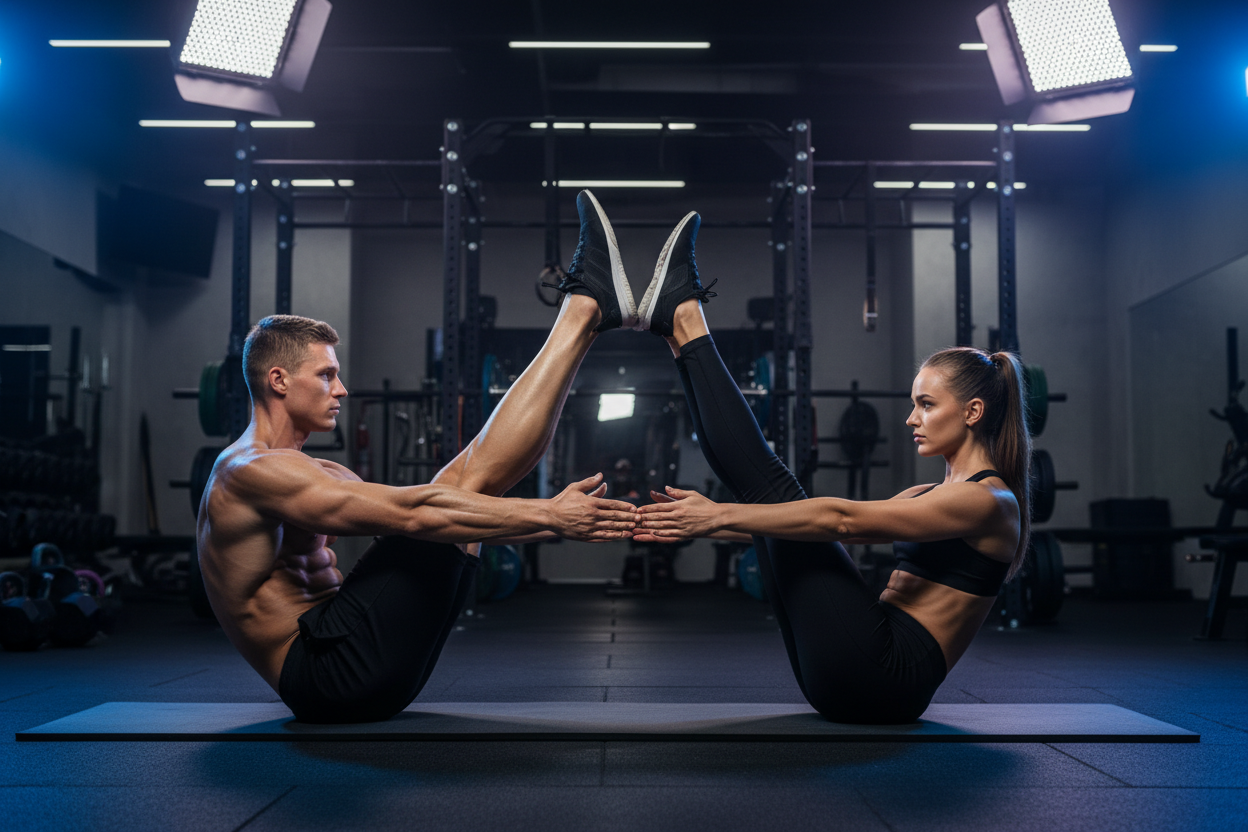
The v leg raise (often used interchangeably with v leg raises) is distinct from a standard lying leg lift. In this variation, you are typically seated, balancing on your glutes, creating a 'V' shape with your torso and legs.
This positioning changes the leverage. Gravity is acting directly against your lever length (your legs) while your core fights to maintain an upright torso position. It is an isometric hold for the upper abs and a dynamic movement for the lower abs and hip flexors.
Proper Execution Step-by-Step
To perform this safely, forget about speed. We are looking for time under tension.
- The Setup: Sit on the floor (preferably on a mat) with your legs extended straight out and your hands resting on the floor beside your hips for stability.
- The Lean: Lean your torso back slightly, about 45 degrees, while keeping your spine neutral. Do not round your shoulders forward.
- The Lift: Engage your core to lift your legs off the ground. Your body should form a V shape.
- The Modification: If straight legs are too difficult, bend your knees slightly.
V-Sit Leg Raise vs. Standard Leg Lifts
The terminology gets messy here. A standard leg lift is usually done lying flat on your back. The v-sit leg raise requires you to balance on your sit bones. This balance component recruits the deep stabilizing muscles—the transverse abdominis—that standard crunches miss entirely.
When you perform a v-sit leg raise, you aren't just flexing the spine; you are stabilizing the entire trunk against gravity. This carries over significantly better to athletic movements like running or squatting, where core stiffness is required while limbs are moving.
Common Mistakes That Kill Progress
The "Lower Back Rounding" Trap
If you feel this in your lumbar spine (lower back), stop immediately. This usually happens when the core is too weak to support the weight of the legs, causing the pelvis to tilt anteriorly. To fix this, place your hands further back behind you for support or reduce the range of motion until your strength improves.
Momentum and Bouncing
I see this constantly in group classes. Athletes bounce their heels off the floor to generate force for the next rep. You are robbing your muscles of the work. Your heels should hover an inch off the floor at the bottom of the movement, or lightly touch without resting.
My Training Log: Real Talk
I want to be transparent about my history with v leg lifts. The first time I programmed these into my routine, I thought I was strong. I could squat double my body weight, so I assumed a bodyweight ab exercise would be a warm-up.
I was wrong. The first thing I noticed wasn't the ab burn—it was the intense, almost sharp cramping in my hip flexors (specifically the TFL). It felt like a knot tightening right where my leg meets my hip. I also realized quickly that doing these on a thin yoga mat on a concrete garage floor is a mistake; the pressure on the tailbone is excruciating if you don't have adequate padding.
I had to regress. I spent three weeks doing single-leg variations and knee tucks before I could hold a strict V-sit without my quads taking over completely. If you feel that hip cramp, don't push through it blindly. It usually means your abs have checked out and your hips are doing overtime.
Conclusion
Mastering v leg raises isn't about hitting high reps; it's about high-quality contraction. By focusing on the v-sit leg raise technique and avoiding momentum, you build a core that is functional, stable, and resilient. Start slow, protect your lower back, and respect the difficulty of the movement.
Frequently Asked Questions
What is the difference between V-ups and V leg lifts?
A V-up involves lying flat and lifting both your torso and legs simultaneously to meet in the middle. A V leg lift typically involves keeping the torso stationary (often in a seated, leaning back position) while only the legs move up and down.
Why do my hips pop during v leg raises?
Hip popping is often caused by a tight tendon snapping over a bony prominence in the pelvis. It is usually painless but annoying. Stretching your hip flexors before the exercise and reducing your range of motion can often stop the clicking.
Are v leg lifts bad for your back?
They are not inherently bad, but they are high-risk if performed with poor form. If your core is not strong enough to keep your spine neutral, your lower back will arch, leading to strain. Always prioritize form over repetition count.