How to Build a Bulletproof Core With Around the World Leg Raises
Standard leg raises are a staple for lower ab development, but if you stick strictly to up-and-down movements, you are ignoring a massive component of core function: rotation. Your core isn't just designed to flex the spine; it's designed to stabilize against rotational forces. Enter around the world leg raises.
This movement breaks you out of the sagittal plane (forward and backward) and forces your abs to work through a full 360-degree range of motion. It’s humbling, it exposes weak links in your obliques, and quite frankly, it burns in a way that standard crunches never will. If you want a midsection that performs as well as it looks, you need to master the circle.
Quick Summary: Why This Move Works
- Multi-Planar Tension: Unlike standard raises, this hits the rectus abdominis and the internal/external obliques simultaneously.
- Hip Mobility: It actively mobilizes the hip socket while demanding core stability, a rare combination in ab training.
- Time Under Tension: The circular path keeps muscles under tension longer than a linear rep.
- Injury Prevention: Strengthening the core through rotation protects the lower back during dynamic sports.
The Mechanics of the Around the World Leg Exercise
The geometry of this movement is what makes it effective. You aren't just lifting a load; you are managing a lever arm (your legs) as it changes leverage points throughout the circle.
The Setup
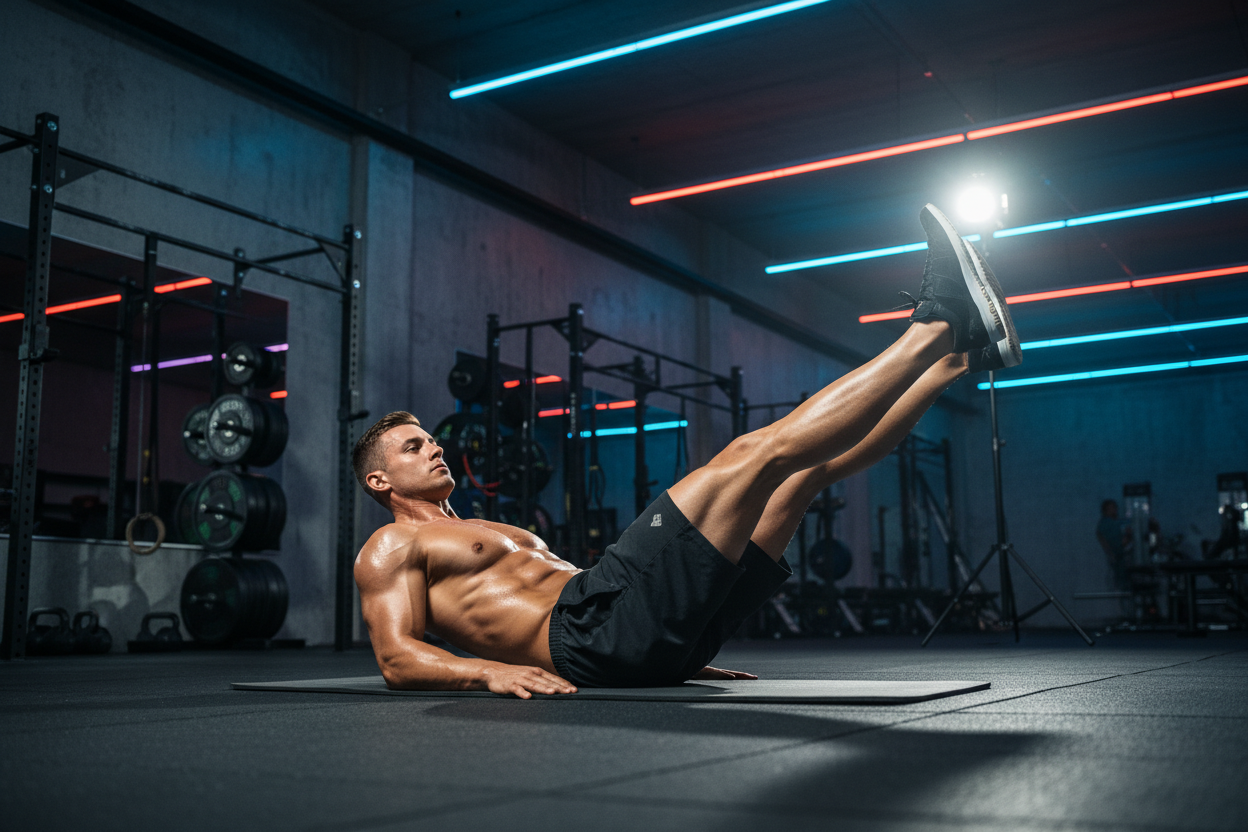
Lie flat on your back on a mat. Hand placement is your first major decision. Beginners should place their hands under their glutes, palms down. This creates a mechanical wedge that helps tilt the pelvis posteriorly (flattening the lower back). More advanced athletes should extend their arms out to the sides in a T-shape for stability, removing the assistance under the hips.
The Execution
Start with your legs extended straight up toward the ceiling. Keep your feet together. Slowly lower your legs to the right side, tracing a large circle down toward the center, then up the left side, returning to the start position. That is one rep.
The goal isn't speed. The goal is to maximize the radius of the circle without your lower back peeling off the floor.
Why Most People Fail at This Lift
I see athletes butcher this move constantly because they prioritize the size of the circle over the stability of the spine.
The Lumbar Arch
The moment your lower back arches off the mat, you have disengaged your abs and shifted the tension entirely to your psoas (hip flexors) and lumbar spine. This is the danger zone. If you feel a gap form between your back and the floor, your circle is too wide. Shrink the range of motion until you can maintain contact.
Momentum Over Muscle
Swinging your legs creates momentum. Momentum is the enemy of hypertrophy. You want to grind through the movement. Imagine moving your legs through water or wet cement. If you can pause at the bottom of the circle (the hardest point), you own the weight.
My Training Log: Real Talk
I want to be honest about the learning curve here. When I first added the around the world leg exercise to my rotation, I thought I was strong because I could rep out hanging leg raises. I was wrong.
The first thing I noticed wasn't muscle failure—it was an annoying "clunking" sound in my left hip. Every time I passed the 7 o'clock position on the circle, my hip flexor would snap over the bone. It wasn't painful, but it was uncomfortable and distracting.
I realized I was forcing a range of motion my hip mobility couldn't support yet. I had to regress. I started doing these with my knees slightly bent (reducing the lever arm) and shrunk the circle by about 20%. The clicking stopped immediately. Also, the burn is different. In a standard crunch, the burn is central. With these, I feel a distinct, deep ache right where the obliques tie into the hip bone—a spot that is notoriously hard to target.
Another specific detail: avoid doing these on a slick floor without a yoga mat. I found that without the friction of a mat, my upper body would slide counter-clockwise while my legs went clockwise, looking ridiculous and killing the leverage.
Conclusion
Around the world leg raises are not a finisher; they are a primary strength builder. They teach your hips and core to communicate in a way that linear movements simply cannot. Start with smaller circles, keep your lower back glued to the floor, and prioritize control over rep count. Your lower back will thank you, and your core strength will skyrocket.
Frequently Asked Questions
What muscles do around the world leg raises work?
This exercise primarily targets the rectus abdominis (six-pack muscles) and the obliques. However, it also heavily recruits the hip flexors (iliopsoas) and the rectus femoris (quadriceps) to manage the weight of the legs.
Are around the world leg raises bad for your back?
They can be if performed with poor form. If your lower back arches off the floor, it places excessive compressive force on the lumbar spine. Maintaining a "hollow body" position with the lower back pressed flat makes the movement safe and effective.
Should I do this exercise hanging or lying down?
Start lying down (supine). The floor provides tactile feedback for your spine, ensuring you aren't arching. Hanging around the world raises are an advanced variation that requires significant grip strength and shoulder stability.