Workout Exercise Names With Pictures: The Complete Visual Guide
We've all been there: you download a new training program, step into your home gym, and stare blankly at the first movement. What exactly is a 'Pallof Press' or a 'Romanian Deadlift'? If you find yourself constantly pausing your session to search the internet for a visual reference, you are not alone. Having clear workout exercise names with pictures is one of the fastest ways to bridge the gap between a written fitness plan and actual, sweat-inducing execution.
Understanding the vocabulary of strength training does more than just save you time. It ensures you are targeting the correct muscle groups, optimizing your equipment setup, and keeping yourself safe from injury. In this guide, we will break down how to visually identify key movements so you can train with absolute confidence.
Key Takeaways
- Visual references drastically reduce setup time and keep your heart rate up during training sessions.
- Matching names to proper biomechanics helps prevent common home gym injuries.
- Categorizing movements by push, pull, squat, and hinge makes programming much easier.
- Always prioritize proper exercise form pictures over heavy weights when learning a new movement.
Decoding the Movements: Visualizing Your Routine
When you start equipping your garage or basement gym, the sheer volume of potential movements can feel overwhelming. By breaking down the different kinds of exercise with pictures, you can start to see patterns in how the body moves and how your equipment is meant to be used.
Push vs. Pull Mechanics
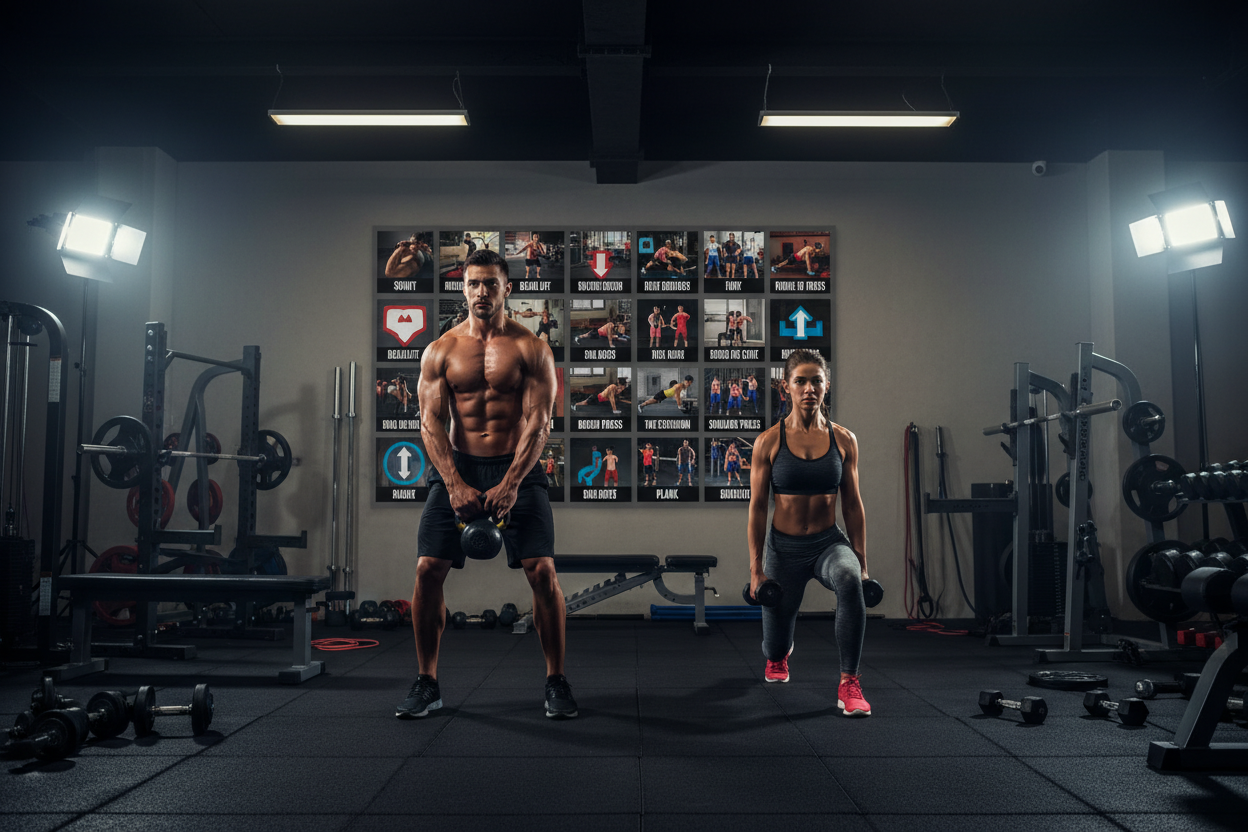
Most upper-body movements fall into these two categories. A 'push' involves moving weight away from your center, such as a Barbell Bench Press or an Overhead Dumbbell Press. Conversely, a 'pull' brings the weight toward you, like a Lat Pulldown or a Barbell Row. Having a reliable gym exercise name with pictures cheat sheet on your gym wall ensures you are balancing these mechanics to avoid posture issues and shoulder imbalances.
Lower Body: Squat and Hinge
Lower body training is fundamentally split between knee-dominant (squats, lunges) and hip-dominant (deadlifts, glute bridges) movements. When reviewing types of exercise with pictures, pay close attention to the hip and knee angles. A proper visual guide will show you that a squat requires an upright torso, while a hinge demands a flat back and pushed-back hips.
Why Visual Guides Matter for Home Gym Safety
Training alone in a home gym means you don't have a coach standing by to correct your posture. This makes referencing proper exercise form pictures absolutely critical. A slight deviation in your spinal alignment during a heavy deadlift or an improper elbow flare during a bench press can lead to serious setbacks.
Setting Up Your Equipment Correctly
Visuals don't just show the human body; they show how the body interacts with the gear. A good picture will demonstrate exactly where the J-hooks should be set on your power rack for a squat, or how high the safety pins should be during a bench press. This spatial awareness is vital for an effective exercices workout in a confined space.
From Our Gym: Honest Take
When I first built out my garage gym, I thought I knew every movement in the book. But when I switched to a complex hypertrophy program, I found myself getting frustrated. I was wasting five minutes between sets trying to figure out the difference between a 'Skull Crusher' and a 'JM Press'.
I finally printed out a comprehensive visual chart and taped it right next to my power rack. Seeing the exact elbow positioning in the photos changed everything. My triceps engagement skyrocketed because I wasn't just guessing the mechanics based on a text description. The only downside? I had to admit to myself that my form on certain rows had been sloppy for years. Sometimes, a clear picture is the harsh truth your training needs.
Frequently Asked Questions
Why is it important to learn gym exercise names?
Knowing the correct terminology allows you to easily follow structured programs, track your progress accurately in a logbook, and research form tips when you hit a plateau.
Where should I keep visual exercise references in my home gym?
We recommend hanging a laminated poster near your main lifting area (like your power rack or dumbbell rack) or keeping a digital tablet mounted on a wall bracket for quick, hands-free reference.
Can I build a full routine just using pictures?
While pictures are excellent for form and identification, a complete routine also requires understanding sets, reps, and progressive overload. Use visuals as a tool alongside a well-structured written program.