How to Actually Isolate Delts During a Shoulder Raise Exercise
I recently watched a guy at my local gym grab a pair of 50-pounders and perform what I can only describe as a standing seizure. He was swinging his hips, arching his back, and using every muscle in his body except his shoulders to move the weight. If you want caps that actually pop, you have to stop treating the shoulder raise exercise like a power clean.
Quick Takeaways
- Drop your weight by 50% immediately; if you can't hold the top for a split second, it's too heavy.
- Work in the scapular plane (30 degrees forward) to save your rotator cuffs.
- Control the eccentric phase for a full 3-count to maximize muscle fiber recruitment.
- Maintain ground stability to prevent the 'hip-swing' cheat.
The Flapping Bird Syndrome: Why Your Delts Aren't Growing
Most home gym owners suffer from what I call 'Flapping Bird Syndrome.' You see it every day: someone picks up a pair of dumbbells that are way too heavy for their side delts to handle, so they use a violent hip hinge to catapult the weight upward. By the time the weight reaches shoulder height, the momentum has done 90% of the work. Your delts are just along for the ride.
The lateral delt is a relatively small muscle. It doesn't have the leverage of your quads or lats. When you swing heavy weights, your traps and lower back take over. I've been there—clinging to 45-lb dumbbells because I didn't want to be the guy holding the 'tiny' weights. But my shoulders didn't grow an inch until I swallowed my pride and went back to the 15-lb pair. Strict form beats sloppy ego-lifting every single time.
If you find yourself rocking back and forth or 'shrugging' the weight up, stop. You aren't building shoulders; you're just practicing a bad clean. To fix this, imagine you are pushing the weights *out* toward the walls, rather than *up* toward the ceiling. This mental cue helps keep the tension where it belongs.
Deconstructing the Perfect Shoulder Raise Exercise
To master the shoulder raise exercise, you need to understand the scapular plane. Your shoulder blades don't sit flat on your back; they sit at an angle. Moving your arms directly out to your sides (the frontal plane) can lead to impingement. Instead, bring your arms about 30 degrees forward. This is the 'sweet spot' for joint health and muscle engagement.
Finding the right angle, often referred to as a shoulder strengthening exercise in its own right, keeps the joint safe while allowing for a peak contraction. When you reach the top of the movement, your pinky should be slightly higher than your thumb—think of it like pouring out two pitchers of water. This slight internal rotation ensures the lateral head is doing the heavy lifting.
The real growth happens on the way down. Most people let the weights drop like stones. If you want real results, fight the gravity. Take three full seconds to lower the dumbbells back to your sides. This eccentric control creates micro-tears in the muscle fibers that lead to actual hypertrophy. If you can't control the descent, the weight is too heavy. Period.
Building a Full Shoulder Raise Workout Without Heavy Weights
You don't need a rack full of 100-lb dumbbells to build a massive shoulder raise workout. In fact, you're better off with a few pairs of light-to-midrange weights and a focus on constant tension. A complete routine should target the front, side, and rear heads of the deltoid using variations of the raise.
I like to start with lateral raises to pre-exhaust the side delts, followed immediately by front raises for the anterior head. If you are short on time, I often recommend the 2 Way Shoulder Raise to hit multiple heads in one go. It’s an efficient way to keep the heart rate up while ensuring no part of the shoulder is left behind.
The key to this workout is the lack of rest. Because we are using lighter loads, we need to use metabolic stress to drive growth. Move from one variation to the next without putting the weights down. By the time you reach the rear delt flyes, your shoulders should feel like they are filled with hot lead. That pump is a sign that you're actually hitting the muscle, not just moving a load from point A to point B.
Why Ground Stability Dictates Your Upper Body Power
You can't fire a cannon from a canoe. If your feet are sliding or you're standing on a squishy, uneven surface, your brain will subconsciously dial back the power output to keep you from falling over. This is why I'm a stickler for flooring. I personally use a 6X8Ft Exercise Mat Yoga Mat because it provides enough grip to stop my heels from sliding during heavy sets.
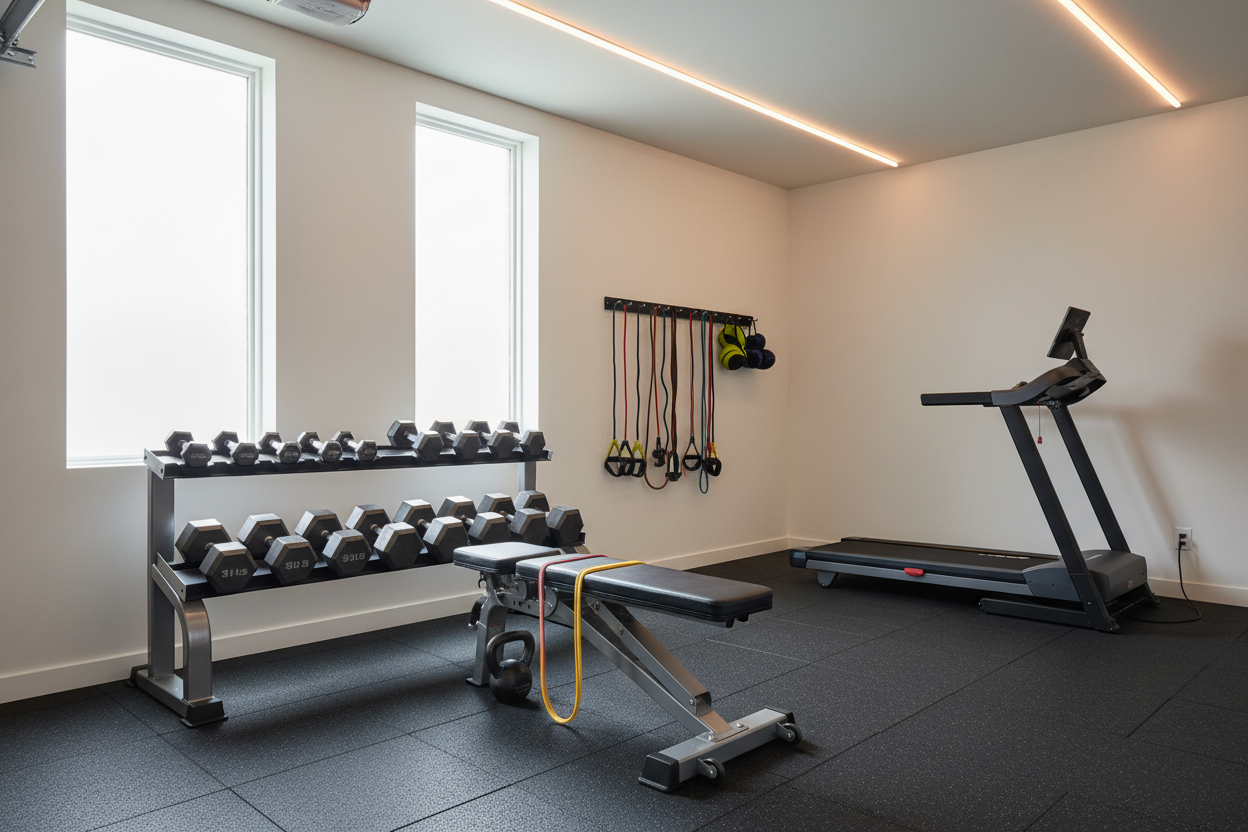
Setting up a Large Exercise Mat in your garage creates a dedicated zone where you can't rely on momentum. When you stand barefoot or in flat shoes on a high-density surface, you can 'root' your feet into the ground. This stability allows you to keep your torso perfectly still, forcing your shoulders to do 100% of the work. If you're lifting on bare concrete or thin carpet, you're leaving gains on the table.
The 10-Minute Strict Form Delt Finisher
Try this at the end of your next upper body day. Grab a pair of dumbbells that are about 50% of what you usually 'swing.' Perform 15 lateral raises with a 3-second negative. Immediately go into 15 front raises. Finish with 15 bent-over rear delt raises. Rest for 60 seconds and repeat three times.
The goal here isn't to move the world; it's to create an unbearable burn. No swinging, no shrugging, and no cheating. If you find your form breaking down, drop to even lighter weights. I’ve seen guys with 20-inch arms use 10-lb plates for this, and they were struggling by the final set. It’s about the quality of the contraction, not the number on the side of the dumbbell.
Personal Experience: My Ego vs. My Shoulders
For the first three years I trained, I was obsessed with the 40-lb lateral raise. I thought it made me look strong. In reality, my traps were huge, my neck always hurt, and my shoulders looked like they belonged on a distance runner. It wasn't until I had a minor rotator cuff tear that I was forced to use 10-lb dumbbells. Within two months of strict, slow raises, my shoulders actually started to round out. I realized I hadn't been training my delts at all—I had been training my ego.
FAQ
Should I keep my arms perfectly straight?
No. A slight bend in the elbows (about 10-15 degrees) reduces the strain on the joint and allows you to focus more on the delt contraction. Just make sure the bend stays constant throughout the move.
How high should I raise the weights?
Stop when your arms are parallel to the floor. Going higher shifts the tension from your delts to your traps, which defeats the purpose of an isolation exercise.
Can I do these every day?
The delts recover quickly, but they still need rest. I find that 2-3 times a week is the sweet spot for most people training in a home gym environment.