How Much Is 2 Plates on Smith Machine? The Real Math Explained
Walking into the gym and loading up the bar is a ritual. But when you step away from the free weights and into the rack, the math changes. You might be wondering how much is 2 plates on smith machine compared to a standard barbell. It feels lighter, the movement is smoother, and the numbers don't seem to add up.
If you are chasing the elusive "225 lb club" (two 45lb plates on each side), the Smith machine can be a deceptive tool. The bar doesn't weigh what you think it weighs, and the mechanics alter the load. Let's break down exactly what you are lifting so you can track your progress accurately.
Key Takeaways: The Quick Math
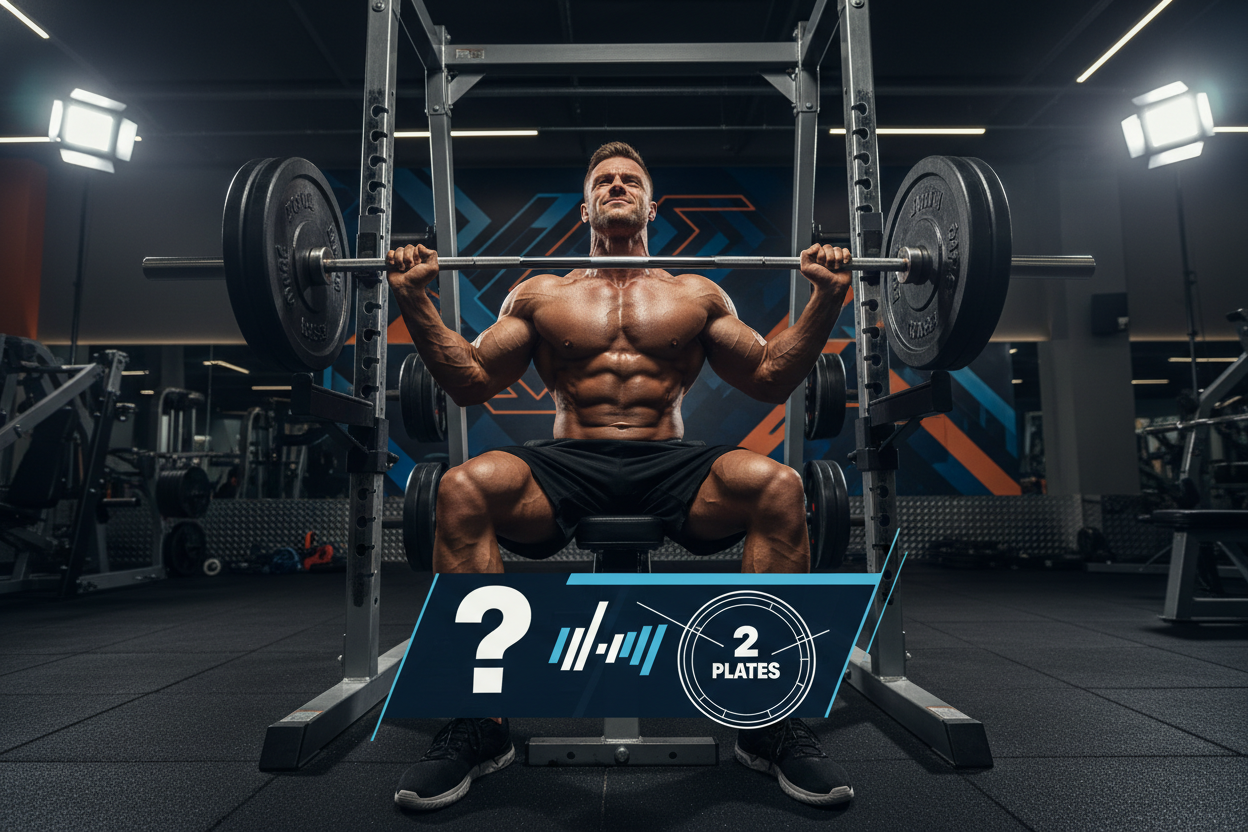
- The "2 Plates" Standard: In gym slang, "2 plates" usually means two 45lb (20kg) plates per side. That is 180 lbs of plate weight.
- The Bar Variable: Unlike a standard 45lb Olympic bar, a Smith machine bar usually has a starting resistance of 15 to 20 lbs due to counterbalances.
- The Total: If you load two 45s per side on a standard commercial Smith machine, you are likely lifting 195–200 lbs, not 225 lbs.
- The Friction Factor: Guide rod friction can make the eccentric (lowering) phase feel easier and the concentric (pushing) phase feel harder depending on maintenance.
The "2 Plates" Misunderstanding
First, we need to clarify the terminology. When a lifter asks about "2 plates," they are almost always referring to two 45-pound plates on each side of the bar.
On a standard free-weight barbell, the math is simple:
- 4 Plates (180 lbs) + 1 Bar (45 lbs) = 225 lbs.
However, if you apply this same logic to the Smith machine, your training log will be inaccurate. The machine assists you in ways a free bar does not, primarily through the starting weight of the bar itself.
Analyzing Smith Machine Bar Weight
The reason you can't just add 45 lbs to your plate total is the counterbalance system. If you look at the top of the Smith machine frame, you will usually see a pulley and cable system connected to the bar.
The Counterbalanced Machine
Most commercial gyms (like Planet Fitness, LA Fitness, or Gold's) use counterbalanced machines. Weights hidden inside the frame pull the bar upward to neutralize its weight.
While the physical metal bar might weigh 40+ lbs, the counterweights reduce the starting resistance to roughly 15 to 20 lbs.
The Non-Counterbalanced Machine
Some older gyms or home gym setups use Smith machines without a pulley system. In this specific case, you are lifting the true dead weight of the bar and the hooks.
On these machines, the bar usually weighs between 35 and 55 lbs. If the bar drops like a stone when you unhook it, it’s likely not counterbalanced.
Calculating Your True Load
Let's look at the specific scenarios for "2 plates" based on the most common equipment found in gyms.
Scenario A: 2 Plates Total (1 per side)
If you are a beginner and you put one 45lb plate on each side:
- Plates: 90 lbs
- Average Smith Bar: ~20 lbs
- Total Load: 110 lbs (vs. 135 lbs on free weights)
Scenario B: 4 Plates Total (2 per side)
This is the benchmark lift most people ask about:
- Plates: 180 lbs
- Average Smith Bar: ~20 lbs
- Total Load: 200 lbs (vs. 225 lbs on free weights)
The Verdict: If you hit 2 plates on the Smith machine, you are generally lifting about 25 lbs less than the free weight equivalent.
Why You Can't Equate the Two
Even if you add extra weight to the Smith machine to match the 225 lb total, the lift is still fundamentally different. You cannot claim a 225 lb bench press max just because you moved 225 lbs on a Smith machine.
Stability Removal
The Smith machine stabilizes the weight for you. On a free bar, your smaller stabilizer muscles (shoulders, triceps, core) work overtime to keep the bar from swaying. On a Smith machine, those muscles check out. This allows you to push more raw weight with the prime movers (pecs), but it doesn't translate 1:1 to a real bench press.
The Fixed Path
A natural bench press moves in a slight "J" curve—starting over the shoulders, touching the lower chest, and pressing back toward the face. The Smith machine forces a rigid vertical or slightly angled line. This unnatural path changes the mechanical advantage, often making the lift easier at certain sticking points.
My Training Log: Real Talk
I remember clearly the first time I transitioned from a Planet Fitness Smith machine to a proper power rack at a bodybuilding gym. I had been rep-ing "2 plates" (two per side) on the Smith machine for sets of eight. I walked over to the flat bench, full of confidence, loaded up 225 lbs, and asked for a spot.
I nearly decapitated myself.
The weight didn't just feel heavier; it felt alive. On the Smith machine, the most annoying part was always the friction—that gritty, scraping feeling when the guide rods hadn't been oiled in a week, or the way the bar lock would clip my wrist if I rotated my hands too much. I was used to just pushing up. On the free bench, I had to push up while fighting the bar from falling forward onto my stomach.
That 25-pound difference in bar weight is real, but the stability deficit is what really humbles you. My advice? If you track Smith machine lifts, mark them strictly as "Smith Bench" in your log. Don't trick yourself into thinking it's the same number as the barbell.
Conclusion
So, how much is 2 plates on smith machine? In most commercial gyms, it is roughly 200 lbs. It is a fantastic exercise for hypertrophy and isolating muscles safely, but it is not a direct substitute for the barbell bench press.
Use the machine for what it is good for: safely pushing to failure without a spotter. Just make sure you know the math so you don't get a rude awakening when you switch to free weights.
Frequently Asked Questions
Does a Smith machine bench press count as my max?
Generally, no. In powerlifting and strength standards, a "max" refers to a free-weight barbell lift. The Smith machine removes the need for stabilization, inflating the numbers. It is a valid lift, but it is a separate category from a standard bench press.
How do I know the exact starting weight of my gym's machine?
Look for a sticker on the side of the frame. Manufacturers like Matrix, Hammer Strength, or Life Fitness usually list the "Starting Resistance." If there is no sticker, assume it is 20 lbs. If you need to be exact, use a portable luggage scale to hook onto the bar and lift it.
Is the Smith machine safer for heavy lifting?
It can be safer for solo lifters because of the safety hooks that allow you to re-rack the weight at any point in the movement. However, the fixed path can sometimes put unnatural stress on shoulder joints if your form isn't adjusted to fit the machine's angle.