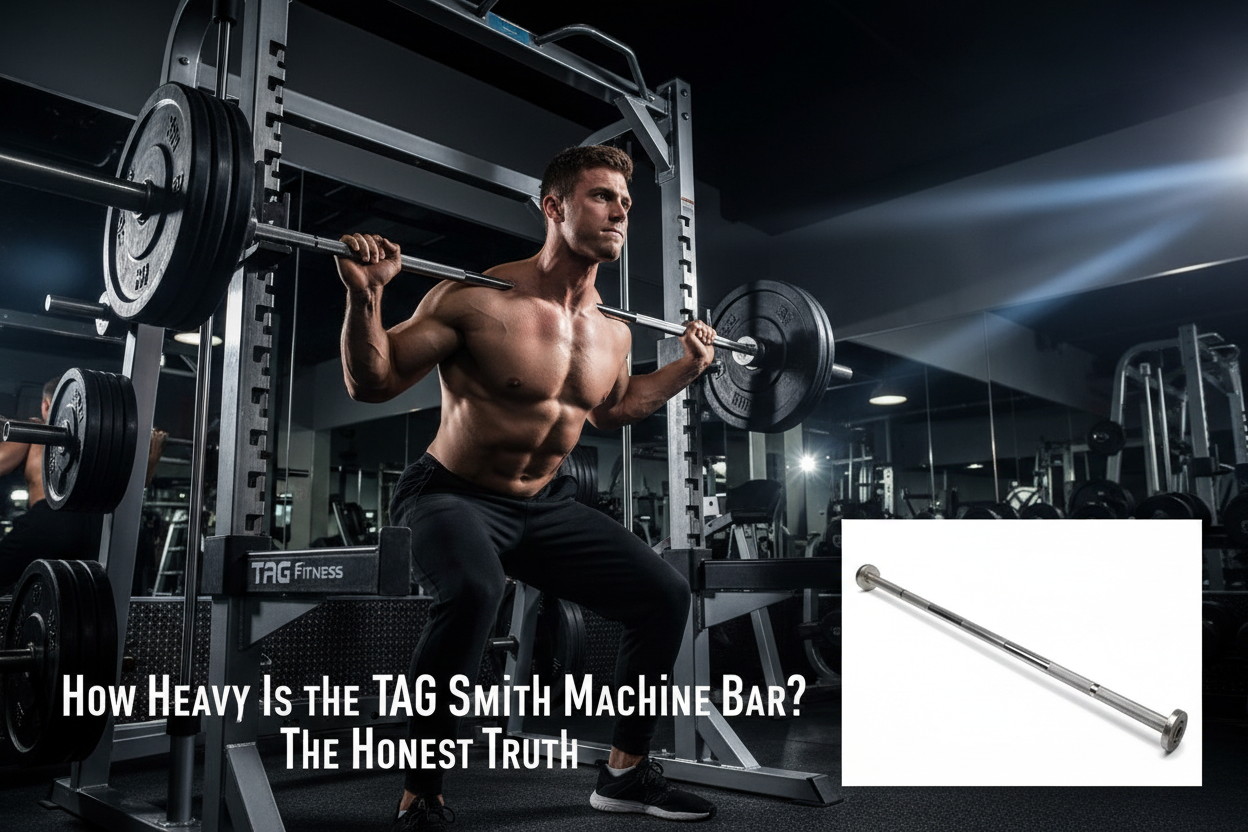
How Heavy Is the TAG Smith Machine Bar? The Honest Truth
You just finished a heavy set of squats. You look at the plates, do the mental math, and write down a new personal record. But there is a nagging question in the back of your mind: Did you calculate the total load correctly?
If you are treating the bar as a standard 45-pound Olympic barbell, your numbers are likely wrong. Understanding the specific tag smith machine bar weight is crucial for accurate tracking, yet most gyms fail to label this clearly. Unlike free weights, the physics here are different.
Here is the breakdown of what that bar actually weighs and how to adjust your training logs accordingly.
Quick Summary: TAG Bar Weight Facts
- Standard Starting Weight: Most TAG Fitness Smith Machines have a starting resistance of 20 to 25 lbs (9-11 kg).
- It is NOT 45 lbs: Never calculate a counterbalanced Smith machine bar as a standard 45 lb Olympic bar.
- The Mechanism: TAG machines use a counterbalance system (pulleys and weights hidden in the frame) to offset the steel bar's actual weight.
- Verification: Look for a manufacturer sticker on the side frame, usually near the safety stop instructions.
The Real Weight of TAG Smith Machines
TAG Fitness (The Amazing Gym) manufactures commercial-grade equipment found in many functional training centers and box gyms. The construction is solid steel, which leads many lifters to assume the bar is heavy.
However, the TAG smith machine is almost always counterbalanced. If you were to detach the bar from the machine, it might weigh 45 or even 55 pounds due to the hooks and linear bearing housing. But you aren't lifting that dead weight.
Because of the pulley system integrated into the columns, the effective starting weight is typically 20 lbs. Some older models or specific "heavy duty" commercial variants may sit closer to 25 lbs. This makes the bar light enough for rehabilitation work or beginners, but it means you need to add 25 lbs of plate weight just to match an empty Olympic bar.
Why The "Feel" is Deceptive
You might argue, "It feels heavier than 20 pounds." That sensation is often friction, not gravity.
Linear Bearings vs. Bushings
TAG machines utilize linear bearings—ball bearings that glide along the steel guide rods. When these are well-maintained and greased, the bar floats. If the machine is older or the rods are dusty, the drag creates artificial resistance.
This friction works against you on the way up (concentric) and works for you on the way down (eccentric). This is why Smith machine math is rarely 1:1 with free weights. You are fighting the mechanics as much as the weight.
How to Test Your Specific Machine
If you want to be 100% precise without relying on manufacturer specs that might be outdated, use the "Scale Test."
Bring a portable luggage scale to the gym. Loop the strap around the center of the bar and pull upwards until the bar just unhooks from the safety latches. Read the measurement. This accounts for the counterbalance and the current friction level of that specific unit.
My Training Log: Real Talk
I’ve spent a lot of time under a TAG Smith machine, specifically during a period when I was rehabbing a lower back tweak and wanted to avoid the instability of a free squat.
The first thing I noticed wasn't just the weight—it was the knurling. On the TAG bars, the knurling tends to be a bit more passive than a rogue power bar. It doesn't bite into your traps or hands as hard, which tempts you not to squeeze as tightly. That's a mistake.
I remember loading up what I thought was 225 lbs. I assumed the bar was 45 lbs. The movement felt suspiciously fast. When I finished, I checked the sticker faded near the bottom of the left upright: "Starting Resistance: 20 lbs."
I wasn't squatting 225; I was squatting 200. That 25-pound difference is massive when you are chasing a specific percentage of your 1RM. Also, unlike some cheaper machines that rattle, the TAG unit has a very distinct, dull thud when you re-rack it because of the heavy-duty springs at the bottom. If you don't twist your wrists aggressively to clear the hooks, you'll clip them on the way down—a rhythm you have to learn the hard way.
Conclusion
Precision is the key to progressive overload. If you are tracking your lifts, you cannot guess the weight of the equipment. For a standard TAG Smith machine, calculate the bar as 20 lbs unless a sticker says otherwise. Adjust your plate loading to compensate, and you will ensure your strength gains are legitimate.
Frequently Asked Questions
Does the TAG Smith machine bar count toward my PR?
Technically, yes, you count the total weight moved. However, because the machine stabilizes the weight for you, a Smith machine PR is generally not considered equivalent to a free-weight squat or bench press PR.
Why is the bar much lighter than a standard barbell?
The bar is attached to a counterbalance system involving cables and weights inside the vertical columns. This offsets the weight of the steel bar, allowing for lower starting weights suitable for rehab and beginners.
How much weight can a TAG Smith machine hold?
TAG Fitness Smith machines are commercial grade and typically have a weight capacity of 700 to 1,000 lbs. The linear bearings are designed to handle heavy loads without compromising the smoothness of the glide.