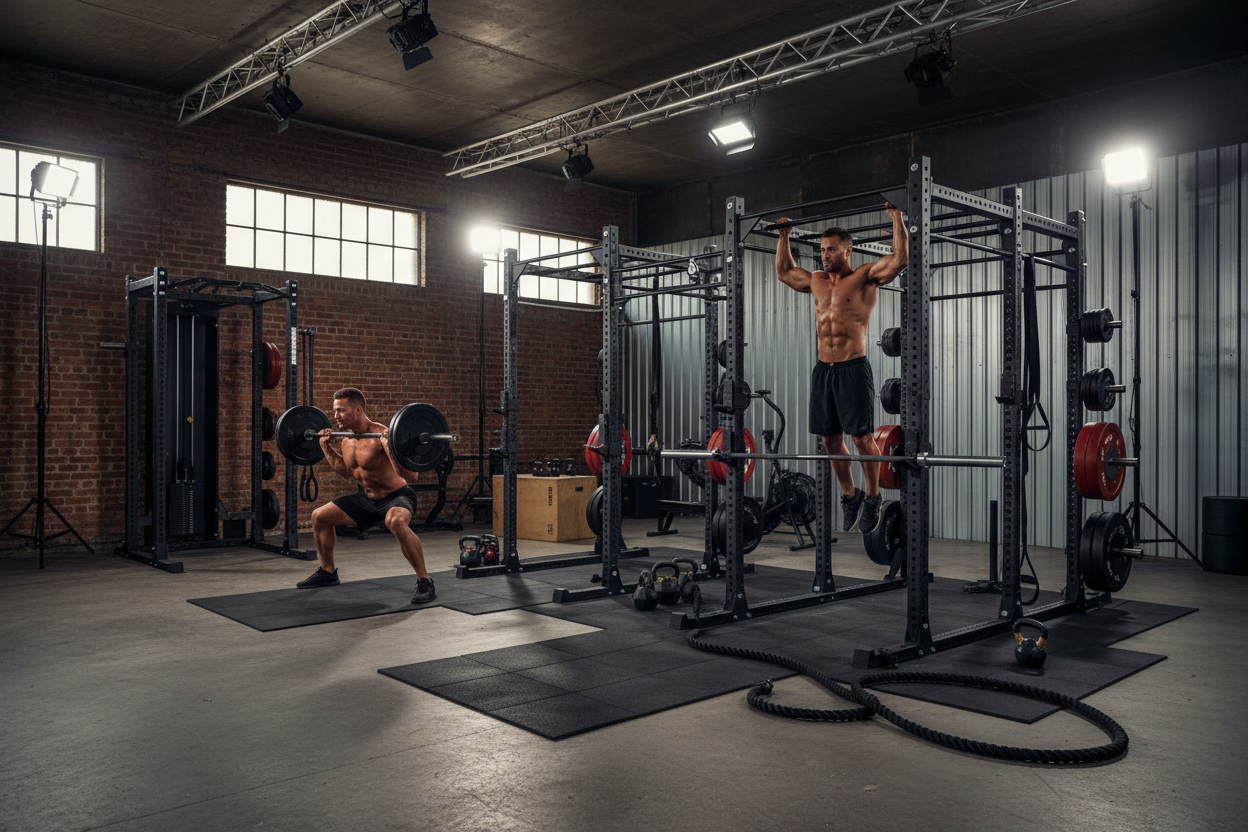
Home Gym Rigs: The Ultimate Blueprint for Your Garage Setup
You finally cleared out the garage. You sold the old lawnmower, organized the tool chest, and now you are staring at a blank concrete canvas. You know you want a serious lifting setup, but a massive, enclosed power rack feels claustrophobic in a tight space. This is where home gym rigs shine.
Unlike the cage-style power racks found in commercial facilities, a rig offers an open-concept design that maximizes floor space without sacrificing heavy lifting potential. But buying one isn't as simple as clicking "add to cart." You are dealing with structural integrity, floor anchoring, and modularity. Let's break down exactly what you need to know to build a station that outlasts your mortgage.
Key Takeaways
- Space Efficiency: Rigs use an open-upright design, making them ideal for multi-use spaces like garages where you need room for Olympic lifting or metabolic conditioning.
- Anchoring is Mandatory: Unlike four-post power racks, almost all rigs require bolting into concrete or a stringer for safety.
- Modularity: Rigs are designed to grow; you can add uprights, pull-up bars, and storage sections as your budget allows.
- Steel Quality: Look for 3x3-inch, 11-gauge steel uprights to ensure commercial-grade stability at home.
Rig vs. Power Rack: What's the Real Difference?
Most people use the terms interchangeably, but the distinction matters for your wallet and your workout experience.
The Structural Philosophy
A power rack is a cage. You step inside it. It is inherently stable because it has four (or six) posts and crossmembers connecting them all. You rarely need to bolt a heavy rack down unless you are moving serious weight.
A rig, conversely, is usually open. It might be wall-mounted (two uprights connected to the wall) or freestanding (four uprights, but often without lower crossmembers). The science here is about footprint efficiency. Because there is no lower cross-member frame to step over, a rig allows for a seamless transition from squatting to stepping out for box jumps or double-unders. It creates a flow in the gym that cages often block.
The Airflow Factor
In a cramped garage, a massive power rack can block light and airflow. Rigs feel less intrusive. Psychologically, looking at an open rig makes a small 10x10 room feel significantly larger than it actually is. This matters when you are three sets deep into a squat session and gasping for air.
Anatomy of a Bomb-Proof Rig
Don't get distracted by flashy colors. When assessing home gym rigs, you are looking for three specific specs.
1. Gauge and Dimensions
The gold standard is 3x3-inch steel tubing with 11-gauge thickness. Anything thinner (like 2x2 or 14-gauge) will wobble. When you rack a 300lb barbell, you want a dull "thud," not a vibrating rattle. That vibration kills confidence under heavy loads. The 11-gauge steel provides the rigidity necessary to handle dynamic movements like kipping pull-ups or muscle-ups.
2. Hole Spacing (Westside)
Look for "Westside" hole spacing through the bench zone. This means the holes are spaced 1 inch apart (rather than 2 inches) near the bottom of the uprights. Why? Because the difference between a successful bench press un-rack and a shoulder injury is often just one inch. Precise safety arm placement is non-negotiable for solo training.
3. The Finish
Powder coating isn't just aesthetic; it's grip. Cheap gloss finishes get slippery when you sweat. Look for a textured black powder coat on the uprights and, more importantly, the pull-up bar. It holds chalk better and prevents your hands from tearing during high-volume work.
Installation Realities: The Concrete Question
Here is the hard truth: You probably need to drill into your floor. While some massive freestanding rigs are stable enough on their own, wall-mounted rigs must be anchored.
This scares people off, but it shouldn't. You need a hammer drill, a masonry bit, and concrete wedge anchors. The connection creates a monolithic structure. When a rig is bolted to the foundation, it becomes part of the house. The stability surpasses even the most expensive unbolted power racks.
Note: If you are renting, you can build a "lifting platform" out of plywood and bolt the rig to that, but the platform needs to be heavy enough to act as a counterweight.
My Training Log: Real Talk
I want to share something the product descriptions won't tell you. I switched from a full cage to a wall-mounted rig about three years ago to save space for my car.
The first time I used it, I was terrified. I had just spent an afternoon inhaling concrete dust while drilling the anchor holes. I racked a heavy squat, and I was waiting for the whole thing to rip out of the wall studs. It didn't budge. But here is the specific detail that threw me off: Depth perception.
When you squat inside a four-post cage, you have visual cues all around you. You know exactly where you are in space. With an open rig, you are staring out into the open garage. The first few weeks, I found myself walking the bar out too far or hitting the uprights on the way back in because I lost that spatial reference. Also, if you don't bolt it perfectly level (I used a cheap bubble level and missed by a hair), the J-cups will sit slightly uneven. I had to shim the bottom of the left upright with a thin piece of rubber to stop the bar from rolling to one side. Check your floor slope before you drill.
Conclusion
Building a setup with home gym rigs is a commitment. It requires tools, sweat, and a bit of DIY spirit to install. But the payoff is a professional-grade training environment that fits in a residential space. You get the stability of a commercial gym with the freedom of a garage setup. Measure your space, check your concrete, and buy the heaviest steel you can afford.
Frequently Asked Questions
Do I absolutely have to bolt a wall-mounted rig to the floor?
Yes. A wall-mounted rig relies on the floor anchors for vertical load support and the wall stringers for horizontal stability. If you don't bolt it to the floor, the uprights can kick out during a racked lift, leading to catastrophic failure. Do not skip this step.
Can I install a rig on a sloped garage floor?
Garages are usually sloped for drainage. You can install a rig, but you may need to shim the down-slope uprights to ensure the pull-up bar and J-cups are level. Metal shims are preferred over wood, which can compress over time under the weight of the rig.
What is the minimum ceiling height for a home gym rig?
Ideally, you want at least 9 feet to perform pull-ups without hitting your head. However, many manufacturers sell "short" versions of their uprights (usually around 7.5 to 8 feet) for standard residential ceilings. Just remember to measure the height of your head at the top of a pull-up, not just the bar height.