Hamstring Machine Name: The Definitive Gym Equipment Guide
You walk into the gym, ready to crush leg day, but you find yourself staring at a sea of padded seats and metal stacks. You know what you want to train, but you don't actually know the specific hamstring machine name to put in your workout log or search for tutorials.
It is a common frustration. Knowing the difference between a seated curl and a GHD isn't just about vocabulary; it is about understanding how different equipment targets the muscle fibers based on hip position. This guide cuts through the confusion so you can identify the right tool for the job.
Quick Summary: What Is That Machine Called?
If you are looking for the quick answer to identify the equipment in front of you, here are the technical names for the most common hamstring builders:
- Seated Leg Curl: You sit upright with legs extended in front of you. Best for training hamstrings in a stretched position.
- Lying Leg Curl (Prone Leg Curl): You lie face down on a bench. Best for peak contraction and isolating the knee flexion function.
- Glute-Ham Developer (GHD): A stationary apparatus where you lock your ankles and raise your torso. Focuses on the entire posterior chain.
- Standing Leg Curl: You stand on one leg and curl the other. Great for unilateral (single-leg) correction.
The Isolation Machines: Curls
When most people search for hamstring exercise machine names, they are usually looking for the leg curl variations. These machines isolate the hamstring by focusing purely on knee flexion (bending the knee).
1. The Seated Leg Curl
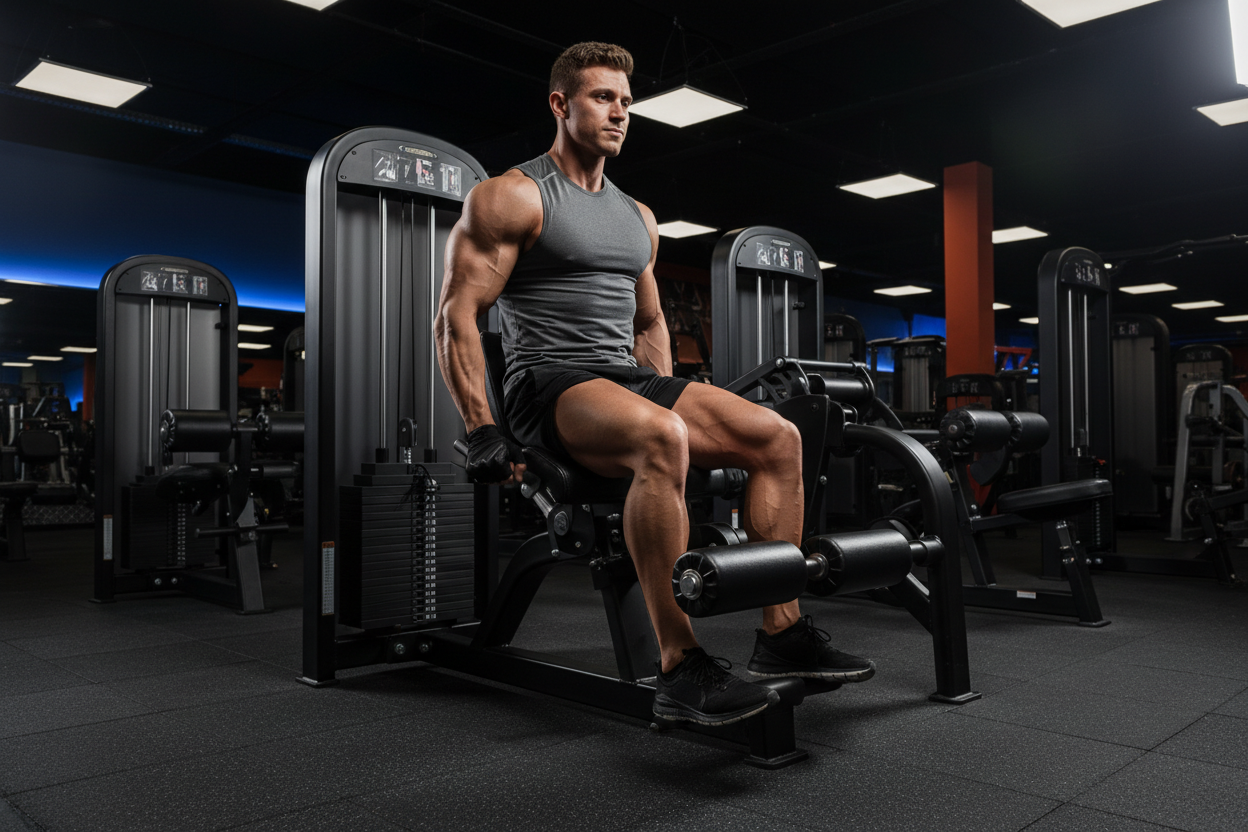
This is likely the most common machine in commercial gyms. You sit with a pad clamped down over your thighs. Because your hips are flexed at 90 degrees, your hamstrings are in a lengthened position at the start.
The Science: Recent hypertrophy research suggests the seated variation might be slightly superior for muscle growth because training a muscle at long lengths creates more mechanical tension.
2. The Lying Leg Curl
Often called the Prone Leg Curl. You lie on your stomach and curl a padded lever toward your glutes. This machine places the hips in an extended (flat) position.
While the seated version offers a better stretch, the lying version allows for a harder peak contraction. It is harder to cheat on this machine, provided you keep your hips pressed firmly into the bench.
The Posterior Chain Machines
These machines are less about isolation and more about integrating the glutes, lower back, and hamstrings working together.
The Glute-Ham Developer (GHD)
This looks like a half-moon pad with ankle rollers. It is brutal but effective. Unlike the curl machines, the GHD works the hamstrings at both the knee and the hip.
If you see a machine that looks similar but involves swinging your legs backward while your torso stays still, that is a Reverse Hyperextension. It is fantastic for lower back health but puts less direct emphasis on the hamstrings compared to the GHD.
Don't Confuse It: The Quad Machine Name
A common mistake for beginners is mixing up the leg curl with the leg extension. If you are looking for the quad machine name, that is the Leg Extension machine.
How to tell them apart:
- Leg Extension (Quads): The pad is in front of your ankles. You kick up against resistance.
- Leg Curl (Hamstrings): The pad is behind your ankles (or calf). You pull down or back against resistance.
My Personal Experience with Hamstring Machines
I have spent years grinding out reps on every variation of these machines, and I want to share a specific detail about the Lying Leg Curl that manuals don't tell you. It's about the "pivot point" alignment.
There is usually a red dot or a bolt on the side of the machine acting as the axis of rotation. If you don't line your knee up exactly with that bolt, the movement feels awful. I remember doing a heavy set on an older Cybex machine where I sat too far forward. Halfway through the rep, the ankle pad started rolling up my calf toward my knee.
It wasn't just annoying; it completely killed my leverage. The pad ended up sitting on the meat of my calf rather than the Achilles tendon, and I lost all tension in the hamstring. Now, I spend a solid 30 seconds adjusting the back pad before I even touch the weight stack. If that pivot point isn't aligned with your knee joint, you are just fighting the machine, not building muscle.
Conclusion
Knowing the correct hamstring machine name allows you to program your workouts effectively. Whether you are using the Seated Leg Curl for stretch-mediated hypertrophy or the GHD for athletic power, using the right tool matters. Stop guessing, check the setup, and focus on the contraction.
Frequently Asked Questions
Is the seated or lying leg curl better?
The seated leg curl is generally considered better for muscle growth (hypertrophy) because it trains the hamstrings in a lengthened position due to hip flexion. However, the lying leg curl is excellent for a full contraction. A complete program should ideally include both.
What is the machine called where you kneel and lift your legs?
That is typically called a Kneeling Leg Curl or a Single-Leg Kneeling Curl. It is a rarer variation found in specialized bodybuilding gyms that allows for extreme isolation of one leg at a time.
Can I build hamstrings without machines?
Yes. While machines are great for isolation, you can build massive hamstrings using free weights. Romanian Deadlifts (RDLs) and Nordic Hamstring Curls are two of the most effective exercises that do not require a specific weight stack machine.