Hack Squat vs Smith Machine: Which Builds Bigger Legs?
You walk into the gym on leg day, and the squat racks are taken. You scan the floor and see two options open: the angled sled of the hack squat and the vertical rails of the Smith machine. Both promise massive quad growth. Both offer stability that free weights can’t match. But when it comes to the hack squat vs smith machine showdown, which one actually deserves your energy?
It is not just about preference; it is about biomechanics. Choosing the wrong machine for your specific goal—whether that's hypertrophy, strength, or working around an injury—can leave gains on the table or, worse, strain your lower back.
Let’s break down the mechanics, muscle recruitment, and safety profiles to see who wins this battle of the machines.
Key Takeaways
- Quad Isolation: The Hack Squat generally wins for pure quad development due to the fixed back support and ability to achieve deeper knee flexion safely.
- Versatility: The Smith Machine allows for a wider variety of stances (sumo, narrow, split squats) targeting glutes and hamstrings more effectively.
- Stabilization: The Hack Squat requires zero balance, allowing you to push to absolute failure safely. The Smith Machine requires slight stabilization.
- Injury Risk: Smith Machine squats can impose unnatural shearing forces on the knees if foot placement isn't perfect; Hack Squats are generally safer for the lower back.
The Mechanics: How They Differ
To understand the hack squat vs smith machine squat debate, you have to look at the path of motion.
The Hack Squat
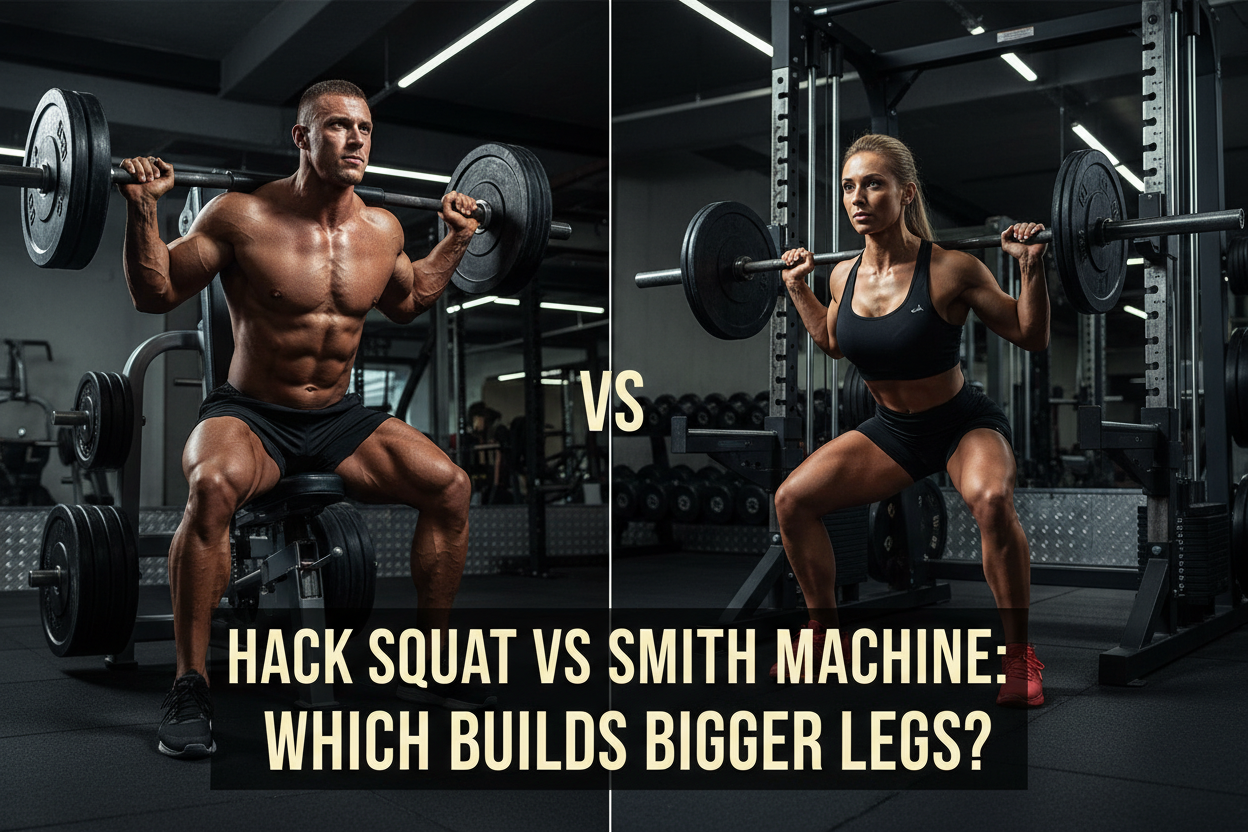
The traditional hack squat machine places you on a sled that moves on guide rails, typically set at a 45-degree angle. You have shoulder pads and a backrest. Crucially, your hips and back are braced against the pad throughout the entire movement.
Because your center of mass is supported, you can place your feet further forward. This eliminates the need for ankle mobility and allows for extreme knee flexion (bending) without your heels lifting off the platform.
The Smith Machine Squat
The Smith machine consists of a barbell fixed within steel rails, allowing only vertical (or near-vertical) movement. Unlike the hack squat, there is no back support. You must stabilize your torso, similar to a barbell squat, but without the side-to-side wobble.
While you can mimic a hack squat by placing your feet far forward in a Smith machine, the bar path remains vertical. This creates a different torque on the knees and hips compared to the angled descent of the sled.
Muscle Activation: Quads vs. Glutes
If your primary goal is sweeping, teardrop quads, the hack squat is the superior tool. The fixed back pad removes the glutes and lower back from the equation almost entirely. This forces the quadriceps to handle the load, especially at the bottom of the movement where the stretch is greatest.
In the smith machine squat vs hack squat comparison, the Smith machine engages more of the posterior chain (glutes and hamstrings). Because you have to stabilize your torso upright without a backrest, your core and spinal erectors work harder here than in the hack squat, though still less than with a free-weight barbell.
Safety and Joint Stress
This is where most lifters get it wrong. The Smith machine has a reputation for safety, but it can be deceptive.
Because the bar moves in a fixed vertical line, it does not account for the natural arc your body wants to travel in during a squat. If your feet are directly under the bar, you risk jamming your hips. If your feet are too far forward, the shearing force on the knees can be aggressive.
The hack squat is generally safer for the lower back. Since you are pushing back into the pad, spinal compression is minimized. However, you must be careful not to lock your knees at the top, as the 45-degree angle places immense stress on the joint if the muscles disengage.
My Training Log: Real Talk
I’ve cycled both of these heavily over the last decade, and here is the unpolished truth about the experience.
On the Smith machine, there is a specific, annoying friction you have to deal with. If the rails aren't greased perfectly, or if you push slightly forward rather than straight up, the locking mechanism can catch. I’ve had moments near failure where I tried to rack the weight, but my wrist angle was slightly off due to fatigue, and I missed the hook. That split second of panic—where the weight drops another three inches before catching—is terrifying.
With the hack squat, the pain is different. It’s the shoulder pads. When you go heavy, those pads dig into your traps in a way that feels like a vice grip. But the psychological safety is unmatched. I recall a leg session last month where I aimed for 12 reps and failed at 9. I didn't have to worry about falling forward or missing a hook. I just engaged the safety handles by the seat and stepped out. My quads were fried, but my lower back felt fresh. That’s a feeling the Smith machine rarely gives me.
Conclusion
So, which machine wins? If you are a bodybuilder looking to isolate the quads and take your legs to absolute failure without a spotter, the hack squat is your best bet. It removes the stability factor and protects the lower back.
However, if you have limited equipment or want a movement that bridges the gap between machine isolation and free-weight coordination, the Smith machine is a valid contender. Just be mindful of your foot placement to protect your knees.
Frequently Asked Questions
Can I replace barbell squats with the Smith machine?
You can, but expect different results. The Smith machine removes the need for lateral stabilization, meaning your core and stabilizer muscles won't develop as much as they would with free weights. It is better used as an accessory lift rather than a direct 1:1 replacement for strength athletes.
Is the hack squat bad for your knees?
Not inherently. In fact, because it allows you to position your feet further forward, it can actually reduce knee strain compared to a traditional squat where knees travel far past toes. However, heavy loading with poor form (bouncing at the bottom) can irritate the patellar tendon.
Which allows for lifting more weight: Hack Squat or Smith Machine?
Most lifters can move more weight on the Hack Squat. The 45-degree angle means you aren't lifting 100% of the load against gravity (due to friction and vectors), and the back support allows you to drive purely with your legs without core limitation.