Functional Trainer Home Gyms: The Ultimate Owner’s Guide
Building a garage gym usually involves a trade-off: you sacrifice floor space for equipment variety. You want a lat pulldown, a seated row, and a crossover station, but you only have room for a rack. This is where functional trainer home gyms change the calculus entirely.
Unlike fixed-path machines that lock you into a specific movement pattern, these units offer freedom of motion. They bridge the gap between free weights and machines, providing constant tension without the stability risks of heavy dumbbells. If you are serious about hypertrophy and athletic performance in a limited footprint, this is the single most valuable piece of kit you can own.
Key Takeaways
- Versatility is King: A single functional trainer cable machine can replace a pec deck, lat tower, row station, and bicep curl machine.
- Pulley Ratios Matter: A 2:1 ratio is standard for functional training, offering longer cable travel for dynamic movements compared to a 1:1 ratio.
- Space Efficiency: Modern corner units and compact designs fit easily into garage gyms or spare bedrooms.
- Safety: Cables allow you to train to failure safely without a spotter, unlike heavy barbells.
The Mechanics: Why It Works
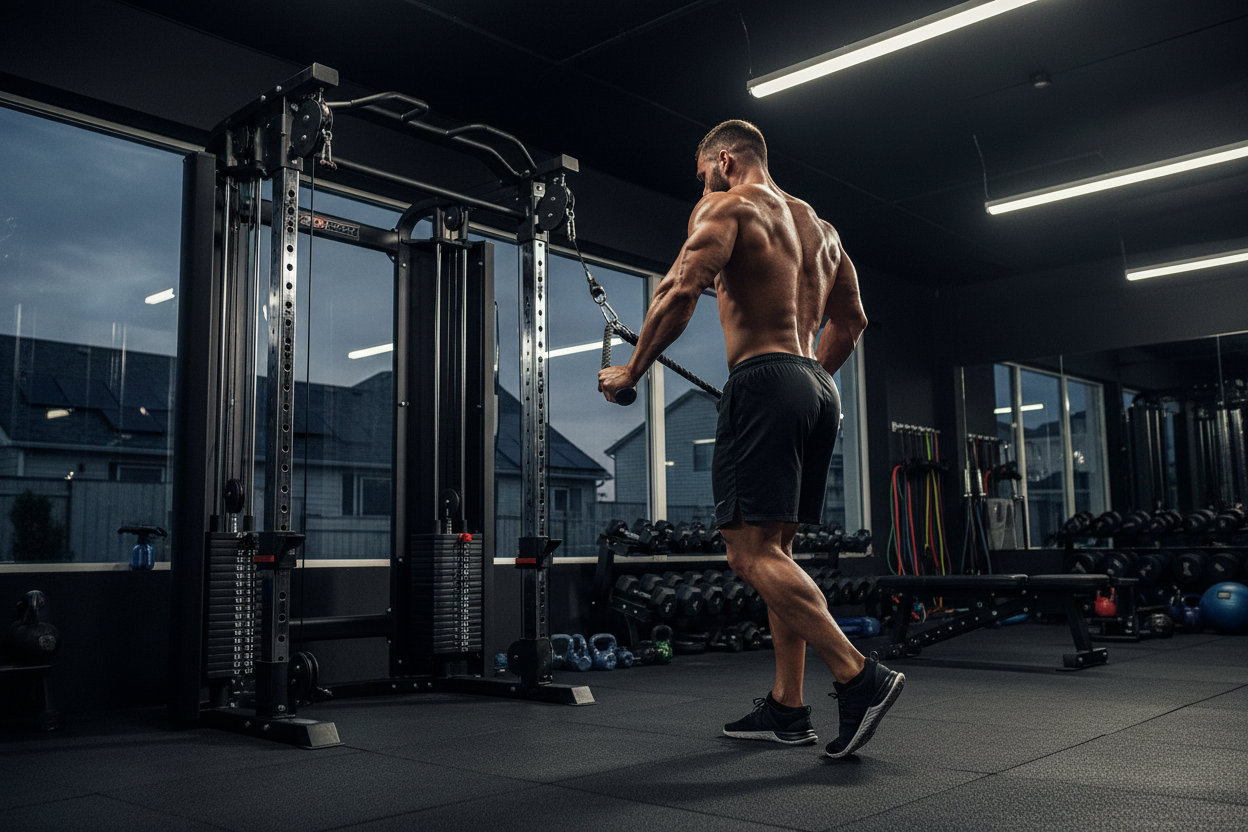
At its core, a cable machine functional trainer is a system of pulleys and weights designed to provide resistance in any direction. The magic lies in the lack of a fixed plane.
When you use a chest press machine, the machine dictates the arc. When you use multi functional trainers, you dictate the path. This recruits stabilizer muscles that lay dormant during fixed-machine work. It mimics real-world pushing, pulling, and twisting forces, which is why it's termed "functional."
The Critical Spec: 2:1 vs. 1:1 Ratios
Before buying, you must understand the pulley ratio. Most best home functional trainers utilize a 2:1 ratio. This means moving the weight 10 pounds effectively feels like 5 pounds of resistance, but the cable travels twice as far.
Why do you want this? Velocity. If you are training for sports or explosive power, you need that long cable travel to perform woodchoppers or sprints without the weight stack slamming into the top of the frame.
Selecting the Best Functional Trainer for Your Space
Space is the enemy of the home gym owner. Fortunately, the market has adapted.
The Garage Gym Setup
If you are outfitting a garage gym functional trainer setup, you likely have height but limited width (due to parked cars). Look for "tall" variants that allow for full-stretch lat pulldowns but have a narrower footprint.
Compact Solutions
For bedroom setups, a functional trainer compact model is essential. Wall-mounted cable towers are gaining popularity. These bolt directly into the studs, protruding only a few inches from the wall. They lack the stability of a full cage but save massive amounts of square footage.
Budgeting: From Premium to Affordable
A high-end functional trainer gym equipment piece can cost upwards of $3,000, but you don't always need to spend that much.
Affordable and Used Options
Finding an affordable functional trainer often means looking at plate-loaded options rather than selectorized weight stacks. You load your own bumper plates onto the carriage. It takes longer to change weights, but it cuts the cost in half.
Alternatively, hunting for a used functional trainer cable machine on marketplaces can yield commercial-grade steel for residential prices. Just check the cables for fraying—that is the first thing to go.
Regional Availability
Availability varies by location. For those searching for the best functional trainer Canada or UK-based options, shipping heavy freight is a major factor. Domestic brands often offer better warranty support and cheaper shipping than importing heavy steel from overseas.
My Personal Experience with Functional Trainer Home Gyms
I’ve spent years lifting in commercial facilities, but transitioning to a home setup taught me things specs sheets don't mention. I currently run a mid-range functional trainer in my garage, and here is the reality.
The first thing I noticed wasn't the weight—it was the drag. On cheaper machines with nylon pulleys, there is a specific "grit" you feel during the eccentric (lowering) phase of a rep. It’s not smooth. It stutters. I eventually swapped my stock pulleys for aluminum ones, and the difference was night and day. It felt like cutting through warm butter.
Another detail is the maintenance. No one tells you that in a non-climate-controlled garage, the guide rods get sticky when humidity spikes. I have to wipe them down with silicone spray every two weeks. If I don't, the weight stack doesn't just clank; it actually "floats" for a millisecond on the way down, killing the tension. If you're buying one, buy a can of silicone lubricant immediately. You will need it.
Conclusion
Investing in functional trainer equipment is an investment in training longevity. It allows you to hit muscles from angles that free weights simply cannot replicate. Whether you choose a high-end cross functional trainer or a budget-friendly wall-mount, the ability to maintain constant tension on the muscle will elevate your physique development.
Frequently Asked Questions
Is a functional trainer worth it for a home gym?
Absolutely. It is arguably the most versatile piece of equipment you can own. It allows for isolation work, rehabilitation exercises, and compound movements, effectively replacing 5-6 bulky commercial machines.
Can you build muscle with just a functional trainer?
Yes. Muscle growth requires mechanical tension and metabolic stress. A functional trainer provides constant tension throughout the entire range of motion, which is excellent for hypertrophy, often superior to dumbbells where tension drops off at the top of the movement.
How much space do I need for a functional trainer?
A standard unit typically requires a width of 5 to 6 feet and a depth of 4 feet. However, you must account for an additional 2 to 3 feet of clearance in front of the machine to actually perform exercises like cable flys or lunges.