
Full-Body Workout Routine: Compound Movement Architecture, Core Integration, and Home Floor Staging
Designing an effective home training regimen requires balancing movement selection, time efficiency, and environmental safety. A structured full-body workout routine activates major muscle groups in coordinated patterns, delivering a complete muscular stimulus without demanding hours of isolated exercises. When programmed correctly with dedicated core integration and stable flooring, an at-home session provides consistent physical challenge while protecting residential subfloors.
Fundamental Movement Architecture for a Full-Body Workout Routine
A balanced training session is built around foundational multi-joint movement patterns: the squat, the hinge, the upper-body push, the upper-body pull, and loaded carries or core stabilization drills. Rather than targeting individual muscles in isolation, organizing workouts around these human movement patterns engages multiple kinematic chains simultaneously. For a wider perspective on session planning, consult our comprehensive exercise full body guide.
Multi-Joint Sequencing Across Major Kinematic Chains
Compound exercises recruit large muscle volumes across several joints, stimulating both structural balance and general conditioning. Grouping primary patterns into complementary pairings—such as matching a knee-dominant squat with an upper-body horizontal pull—ensures balanced tension across the anterior and posterior chains. This sequencing keeps overall workout volume compact and manageable within small home spaces.
Dedicated Core and Abdominal Integration Strategy
Abdominal training delivers optimal stability when woven directly into compound circuits rather than left as a brief afterthought. Emphasizing anti-extension exercises (such as planks), anti-rotation drills (such as Pallof presses or bird-dogs), and controlled spinal flexion allows the trunk musculature to function as a unified stabilizer for heavier compound movements.
Structuring the 30-Minute At-Home Training Blueprint
Time-efficient training relies on organized pairing systems that maintain training density without inducing excessive localized muscular failure. By alternating upper- and lower-body demands, trainees can maintain steady pacing throughout a focused thirty-minute window.
Non-Competing Compound Supersets and Flow
Non-competing supersets pair exercises targeting opposing or non-overlapping muscle groups, allowing one region to recover while another works. Consider structuring a basic home circuit around the following movement blocks:
- Block A: Lower-body knee-dominant pattern (e.g., goblet squats or split squats) paired immediately with an upper-body vertical or horizontal pull (e.g., resistance band rows or doorway rows).
- Block B: Lower-body posterior hinge (e.g., dumbbell Romanian deadlifts or single-leg glute bridges) paired with an upper-body push (e.g., standard floor push-ups or overhead dumbbell presses).
- Block C: Integrated core and carry complex (e.g., dead bugs, side planks, or farmer walks across the mat).
Progression and Modular Scaling for Diverse Fitness Levels
A modular structure allows seamless adjustments across different experience levels, whether programming for beginners, advanced lifters, or individuals returning after a break. Bodyweight tempos, elevation adjustments (such as hands-elevated push-ups), and micro-load additions with dumbbells or resistance bands allow progressive scaling without altering the overarching movement architecture.
Home Gym Floor Staging and Environmental Protection
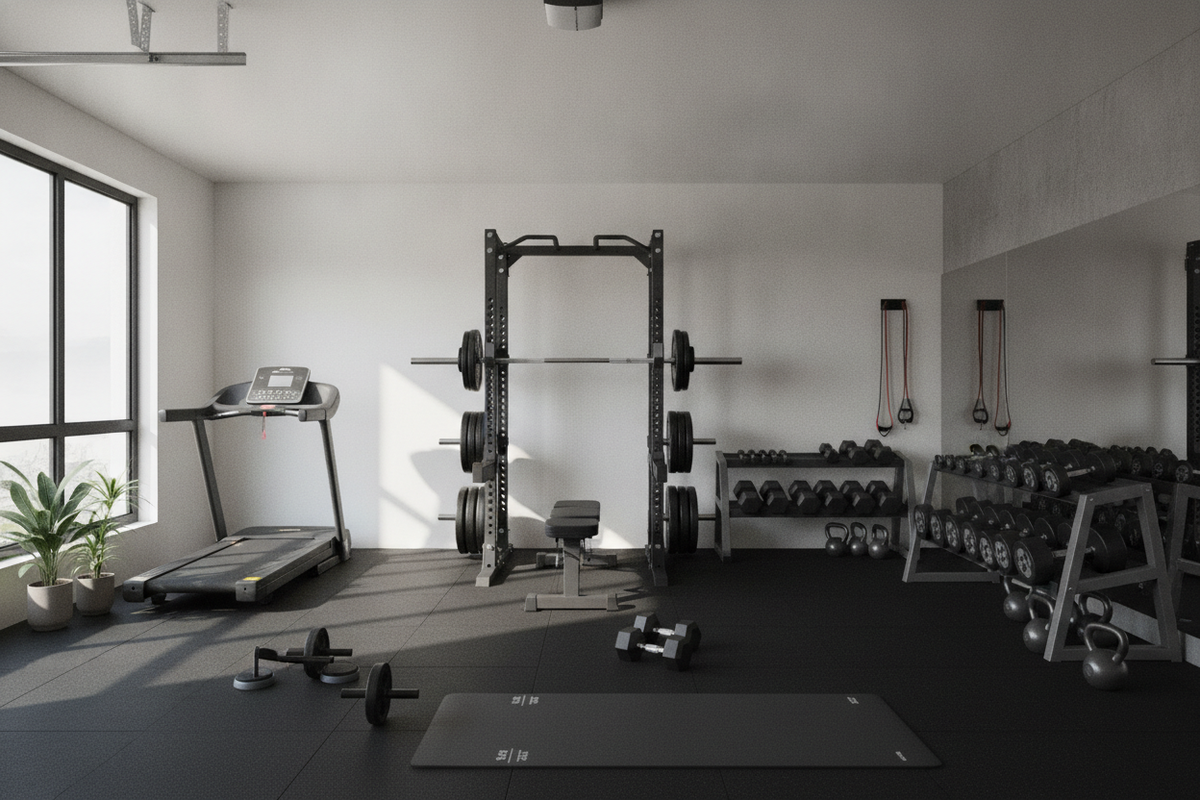
Executing dynamic lunges, floor-based presses, and bodyweight core drills requires a dedicated, slip-resistant surface. Setting up a large exercise mat for home gym spaces creates a defined training boundary that preserves hardwood, tile, or carpet from sweat and dropped equipment.
Subfloor Cushioning and Dynamic Stability for Multi-Directional Drills
Ground-based work and explosive lower-body movements place concentrated pressure on feet, wrists, and residential subfloors. Utilizing a dedicated 6x10ft exercise mat gym flooring setup provides uniform traction for lateral movements while absorbing acoustic vibration during high-cadence sessions.
Station Layout Configurations and Gear Placement
Organizing equipment strategically minimizes transit time between supersets and prevents trip hazards. Keep compact weights, bands, and water bottles aligned along the perimeter of the primary mat zone. This ensures that the central training footprint remains unobstructed for wide-stance squats, lunges, and prone core exercises.
Mat Maintenance, Surface Durability, and Long-Term Progression
Maintaining home training gear and tracking progressive overload are equally vital for long-term consistency and surface hygiene.
Cleaning Protocols for High-Traffic Home Workout Mats
Regular maintenance preserves mat traction and surface integrity over extended periods of heavy use. Implement simple hygiene habits to protect your workout space:
- Wipe down high-contact zones with a mild soap-and-water solution or non-abrasive household cleaner after intense sessions.
- Allow the surface to air dry completely before rolling or storing modular equipment.
- Avoid wearing coarse outdoor footwear on indoor matting to minimize abrasive wear.
Systematic Progression and Recovery Frameworks
Long-term training adaptations depend on structured progression rather than random daily workouts. Adjust training variables—such as adding repetitions, slowing eccentric tempos, or decreasing rest periods—in measured weekly cycles. For advanced periodization concepts, refer to our detailed full body workout guide to continually refine your at-home routine.


