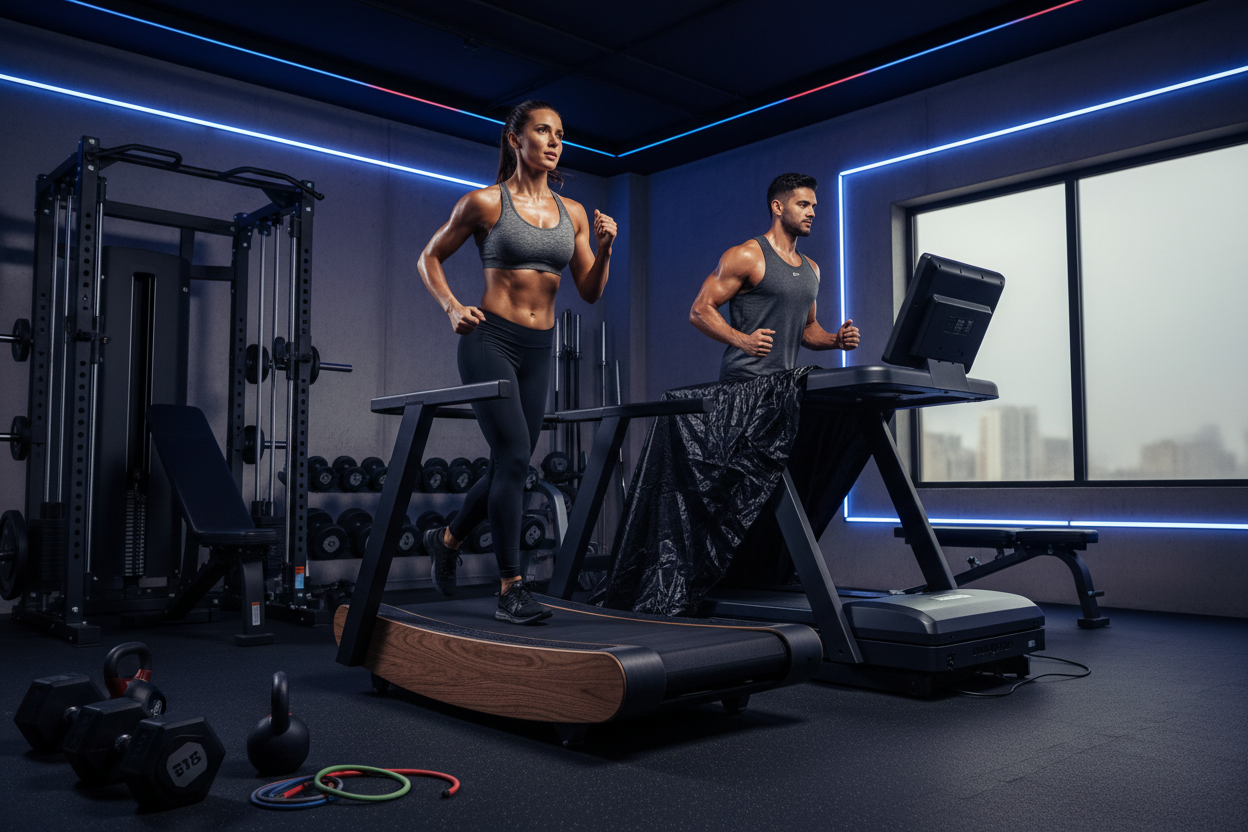
Free Electric Treadmill Guide: Ditch the Motor
Setting up a home gym often comes down to a frustrating battle of logistics: mapping out floor space and hunting down available wall outlets. If you are tired of tripping over heavy extension cords, worrying about expensive motor burnouts, or dealing with equipment that spikes your energy bill, you are not alone.
Enter the free electric treadmill—a growing category of manual and curved runners designed to be powered entirely by your own two feet. Whether you are outfitting a rugged garage setup or a minimalist basement gym, opting for a treadmill that doesn't use electricity can completely transform how you train, offering a more intense workout with zero reliance on the grid.
Key Takeaways
- Zero Power Required: Place your treadmill anywhere in your home without worrying about outlet proximity or cord management.
- Higher Calorie Burn: Manual treadmills recruit more muscle fibers, burning up to 30% more calories than motorized counterparts at the same speed.
- Virtually Maintenance-Free: No motors, no complex motherboards, and no electrical shorts mean a significantly longer lifespan.
- Instant Pacing: The belt moves only as fast as you do, making it the ultimate tool for High-Intensity Interval Training (HIIT).
Why Ditch the Motor? The Mechanics of Manual Running
True Self-Paced Training
Unlike traditional machines where you press a button and wait for the belt to catch up to your desired speed, a motorless runner responds instantly to your footfall. When you sprint, it flies; when you stop, it stops. This creates a highly organic running experience that closely mimics outdoor road running. You dictate the pace through your stride length and cadence, which naturally improves your running mechanics over time.
Space Planning and Placement Freedom
Perfect for Garages and Basements
One of the biggest headaches of North American home gym design is the lack of conveniently placed electrical outlets, especially in unfinished basements or standard two-car garages. A motor-free treadmill completely eliminates this hurdle. Because there are no power cords, you can position the machine in the exact center of your room, facing a window, or tucked away in a corner without needing to snake wires across your lifting platform.
Weight and Floor Protection
Keep in mind that commercial-grade curved treadmills are heavy. They rely on thick, slatted rubber belts and heavy-duty steel bearings to create smooth momentum. You will absolutely want a high-density horse stall mat or a dedicated 3/4-inch rubber gym tile underneath it to protect your flooring and dampen the acoustic rumble of the belt.
From Our Gym: Honest Take
We've had a premium curved manual treadmill in our testing facility for over a year now, and it has completely changed our conditioning days. At 6'1", I used to feel cramped and restricted by the preset speeds of standard motorized decks. The first time I stepped onto the curved slat belt, there was definitely a learning curve—literally. I had to learn how to strike the front third of the curve to accelerate and drift back to the center to jog.
The honest caveat? It is significantly harder work. A casual 3-mile recovery jog feels like a grueling tempo run because you are the sole engine driving a heavy rubber belt. However, after 14 months of daily use in a dusty, un-climate-controlled garage, we haven't had to lubricate a deck or replace a single frayed wire. The durability is unmatched.
Frequently Asked Questions
Is a free electric treadmill harder to run on?
Yes. Because you have to manually overcome the friction and weight of the belt, studies show you expend up to 30% more energy compared to a motorized treadmill. It is excellent for conditioning but can be taxing for long-distance recovery runs.
How much space do I need for a treadmill that doesn't use electricity?
While the footprint is similar to motorized treadmills (roughly 70 to 80 inches long and 30 to 35 inches wide), you need to account for height. Curved treadmills elevate the runner higher off the ground. Ensure you have at least 8 to 9 feet of ceiling clearance so you don't bump your head.
Are manual treadmills bad for your knees?
No, they can actually be better for your joints. The curved design encourages a mid-foot or forefoot strike rather than a heavy heel strike. Combined with the shock-absorbing rubber slats, this naturally reduces the impact forces traveling up your shins and knees.