Fixing Weakness With External Rotation of Shoulder: The Protocol
You likely know the feeling: you go to unrack a barbell for a press, or maybe just reach into the backseat of your car, and your shoulder feels unstable. It doesn't feel 'packed' tight. If you are struggling with **weakness with external rotation of shoulder** stability, you are dealing with one of the most common, yet ignored, issues in modern movement.
Most lifters and desk workers spend their lives internally rotated (typing, driving, bench pressing). This causes the internal rotators (pecs and lats) to become short and stiff, while the external rotators (infraspinatus and teres minor) lengthen and shut down. Ignoring this doesn't just limit your strength; it invites impingement and rotator cuff tears.
Key Takeaways: Quick Summary
- The Root Cause: Excessive internal rotation from daily posture and chest-dominant training inhibits the external rotators.
- The Muscles Involved: The Infraspinatus and Teres Minor are the primary stabilizers responsible for this movement.
- The Fix: You must release the tight internal rotators (pec minor/lats) before attempting to strengthen the external rotators.
- Best Exercises: Side-lying dumbbell wipers, face pulls with external rotation bias, and band pull-aparts.
- The Test: If you cannot keep your wrist stacked over your elbow during an overhead press, you likely have an external rotation deficit.
The Anatomy of the Problem
To fix shoulder external rotation weakness, you have to understand the imbalance. Your shoulder joint is a ball-and-socket, but it relies heavily on a balance of tension to stay centered.
Think of your shoulder like a tent pole held up by guy wires. If the front wires (pecs) are too tight and the back wires (rotator cuff) are loose, the pole (the humerus) gets pulled forward. This creates a rounded posture.
When you try to rotate the arm outward against resistance, the weak rear muscles simply cannot overcome the tension from the tight front muscles. This isn't just about lack of strength; it is about mechanical disadvantage.
Why You Can't Just "Train Through It"
I see athletes try to fix weak shoulder external rotation by just adding more weight to the bar. This is a mistake. When the external rotators are weak, larger muscle groups try to take over to stabilize the joint.
Your upper traps will shrug, or your lats will flare. This compensation pattern reinforces the dysfunction. You cannot strengthen a muscle that your brain has forgotten how to activate. You need isolation before integration.
The Step-by-Step Correction Protocol
1. Release the Brakes (Pec Minor & Lats)
Before you strengthen, you must loosen the antagonists. If your pecs are glued shut, your external rotators are fighting a losing battle. Use a lacrosse ball against a wall specifically targeting the insertion point of the pec minor near the shoulder joint. Spend 90 seconds here.
2. Isometric Activation
We need to wake up the Infraspinatus without the upper traps taking over. Stand with your elbow at 90 degrees by your side. Place a towel roll between your elbow and ribs. Squeeze the towel (to inhibit the deltoid) and push the back of your hand into a wall. Hold for 30 seconds. You should feel a deep burn behind the shoulder blade.
3. The "Side-Lying Wiper"
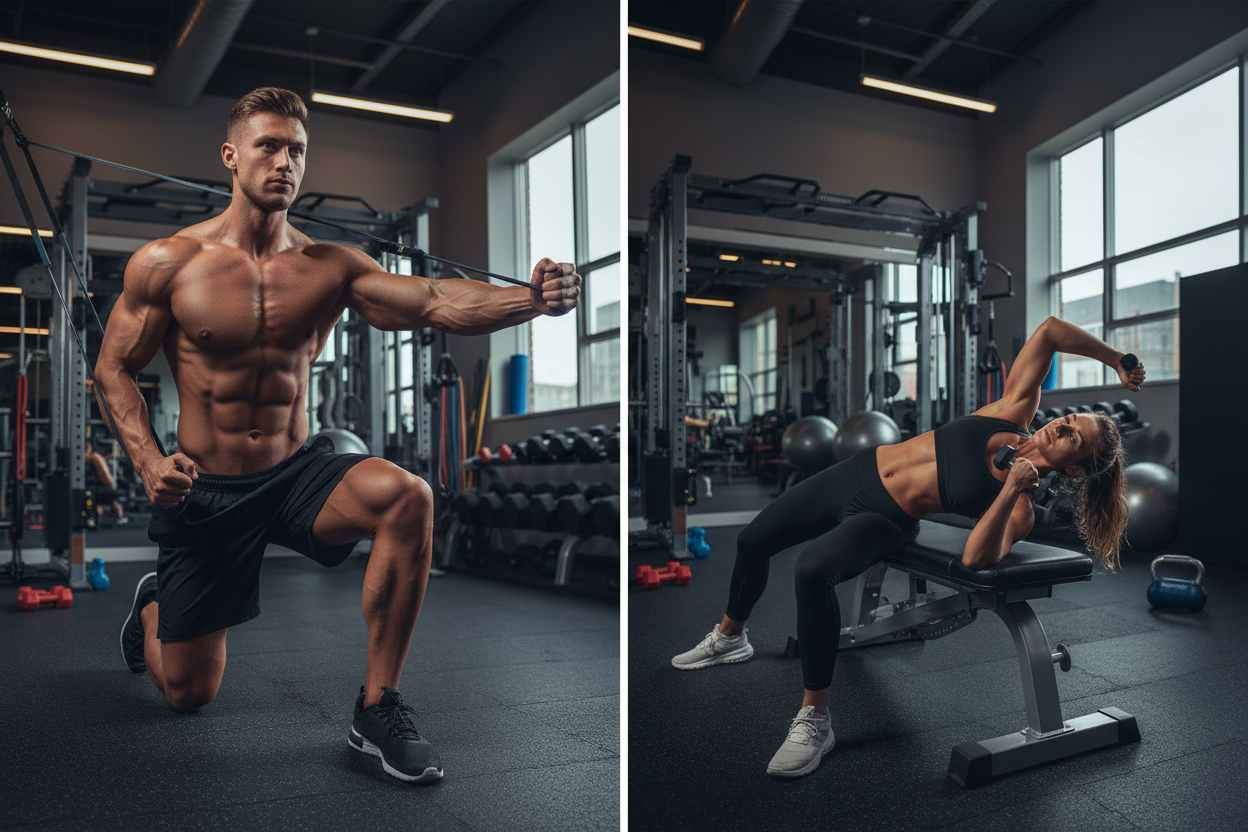
This is the gold standard for fixing weakness external rotation shoulder issues. Lie on your side. Place a towel under the elbow of your top arm. With a very light dumbbell (start with 2-5 lbs), rotate the arm upward toward the ceiling.
The towel is crucial—it prevents you from cheating by using your deltoids. Control the descent for a 4-second count. The eccentric (lowering) phase is where the tendon strength is built.
My Training Log: Real Talk
I distinctly remember when I realized my external rotation was shot. I was trying to break a plateau on my overhead press, but every time the bar passed my forehead, my elbows would flare out uncontrollably. I ignored it until I woke up with a dull, toothache-like pain deep inside the front of my delt.
My physical therapist handed me a pink 2-pound dumbbell. I laughed. I was benching over 225 lbs at the time; what was a 2-pound weight going to do?
He told me to lie on my side and do the "wiper" motion I described above. By the eighth rep, my shoulder was trembling. It wasn't muscle fatigue like a bicep curl; it was a nervous system failure. The shake was violent. It was humbling to realize that despite my "gym strength," the tiny stabilizers holding my joint together were atrophied. That specific, deep burn—almost like heat radiating under the shoulder blade—is something you never feel during a heavy bench press. That was the missing link. Six weeks of looking silly with the pink dumbbell, and my overhead press finally moved up without pain.
Conclusion
Addressing weakness with external rotation of shoulder mechanics isn't the most exciting part of training. It doesn't look cool on Instagram, and it requires using weights that hurt your ego. But if you want shoulders that function pain-free for decades rather than years, this work is mandatory. Release the front, wake up the back, and respect the stabilizers.
Frequently Asked Questions
How do I test for shoulder external rotation weakness?
A simple test is the "Wall Slide." Stand with your back flat against a wall. Put your arms up like a goalpost (90-degree angles). Try to press the backs of your hands and wrists flat against the wall without arching your back. If your wrists can't touch the wall, or you have to arch your spine to get them there, you likely have a deficit.
Can weak external rotation cause neck pain?
Absolutely. When the rotator cuff fails to stabilize the shoulder, the Upper Trapezius and Levator Scapulae muscles often overwork to compensate. This leads to chronic tightness in the neck and headaches, all stemming from the unstable shoulder.
How often should I do external rotation exercises?
Because these are endurance stabilizers, they respond best to high frequency and low load. You can perform the isometric holds or band pull-aparts every day. For the weighted side-lying wipers, aim for 3 times a week, performing 2-3 sets of 15-20 repetitions.