Fitness Routines for Home: Mastering Tempo
I remember staring at my dusty pair of 20-pound dumbbells in my cramped one-bedroom apartment a few years ago. I could easily crank out 30 goblet squats, and my floor presses felt like a light warm-up. If you have hit this wall, you know the frustration of outgrowing your limited weights. You do not need to drop a thousand dollars on a massive rack and barbell setup. To fix broken fitness routines for home, you just need to learn how to manipulate time.
When you cannot add more physical plates to a bar, you have to change the stimulus. By altering the speed at which you lift and lower the weight, you can force your body to adapt as if you were lifting significantly heavier loads. This method saves space, saves money, and saves your joints.
Quick Takeaways
- Manipulating tempo increases time-under-tension, making light weights feel heavy.
- Slowing down the eccentric (lowering) phase causes the micro-tears necessary for muscle growth.
- High-rep, fast-paced home workouts often lead to joint wear rather than actual strength gains.
- Proper traction and breathing mechanics are critical when performing slow, isometric holds.
Why Standard Home Workouts Stop Working
When clients tell me they stopped seeing results, it usually boils down to load adaptation. You buy a 10-pound and 20-pound dumbbell set. For the first two months, it feels incredibly heavy. Then, your muscles adapt. To compensate for the lack of heavier gear, most people just add more reps.
Suddenly, you are doing sets of 40 lunges or 50 rapid-fire push-ups. Doing endless fast reps shifts the stimulus away from muscle hypertrophy and places massive sheer stress on your joints and connective tissues. It becomes an endurance test that wears down your knees and elbows rather than building thicker muscle fibers.
Your body needs mechanical tension to grow. If you just bounce through reps using momentum, the working muscle barely experiences any tension. You need a specific strategy to make that 20-pound dumbbell feel like a 60-pound dumbbell, forcing the muscle to work at maximum capacity without requiring a trip to a commercial gym.
The Science of Tempo in Exercise Plans to Do at Home
Enter tempo training. When evaluating effective exercise plans to do at home, understanding the four-digit tempo code is critical. You will usually see it written on a program sheet like this: 4-1-1-1.
The first number is the eccentric (lowering) phase. The second is the stretch pause at the bottom. The third is the concentric (lifting) phase. The fourth is the contraction pause at the top. By extending the time-under-tension, you force the muscle to recruit more motor units without adding physical weight.
A standard fast push-up might take 1.5 seconds from start to finish. A 4-1-1-1 push-up takes 7 seconds per rep. Ten reps of that tempo variation will set your chest on fire and stimulate mechanical tension equivalent to bench pressing a heavy barbell. The muscle does not know how much weight is in your hand; it only knows how much tension it is being forced to overcome.
Eccentric Overload on a Budget
The magic really happens in that first number: the eccentric phase. When you lower a weight slowly, you create micro-tears in the muscle fibers. This targeted muscle damage is a primary driver of hypertrophy.
A 4-second descent on a split squat forces your quads and glutes to stabilize the load through the entire range of motion. You are no longer relying on momentum or the elastic bounce at the bottom of the rep. By focusing on eccentric overload, you can exhaust a muscle completely using a fraction of your normal working weight.
Building Your Exercise Program to Do at Home With Tempo
When you sit down to write an exercise program to do at home, you have to apply tempo strategically to foundational movement patterns. Let's take the overhead press. Pushing a pair of 15-pound dumbbells overhead is easy for most trained individuals.
But if you take 4 seconds to lower them, pause for 2 seconds at your shoulders, and explode up, those 15s will feel agonizingly heavy by rep eight. This is exactly how I program an at home exercise for shoulders to isolate the deltoids without requiring heavy iron. The slow eccentric phase eliminates all body English, forcing the shoulder muscles to do 100 percent of the work.
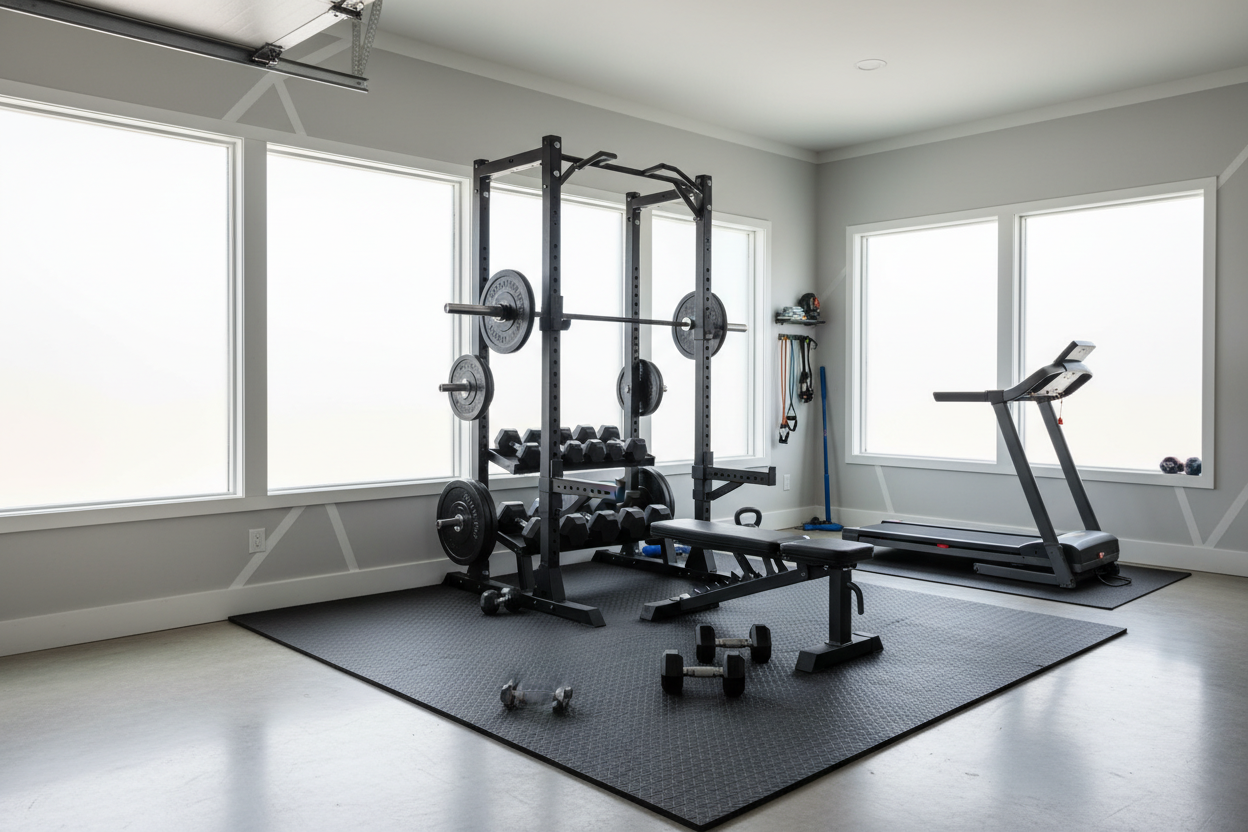
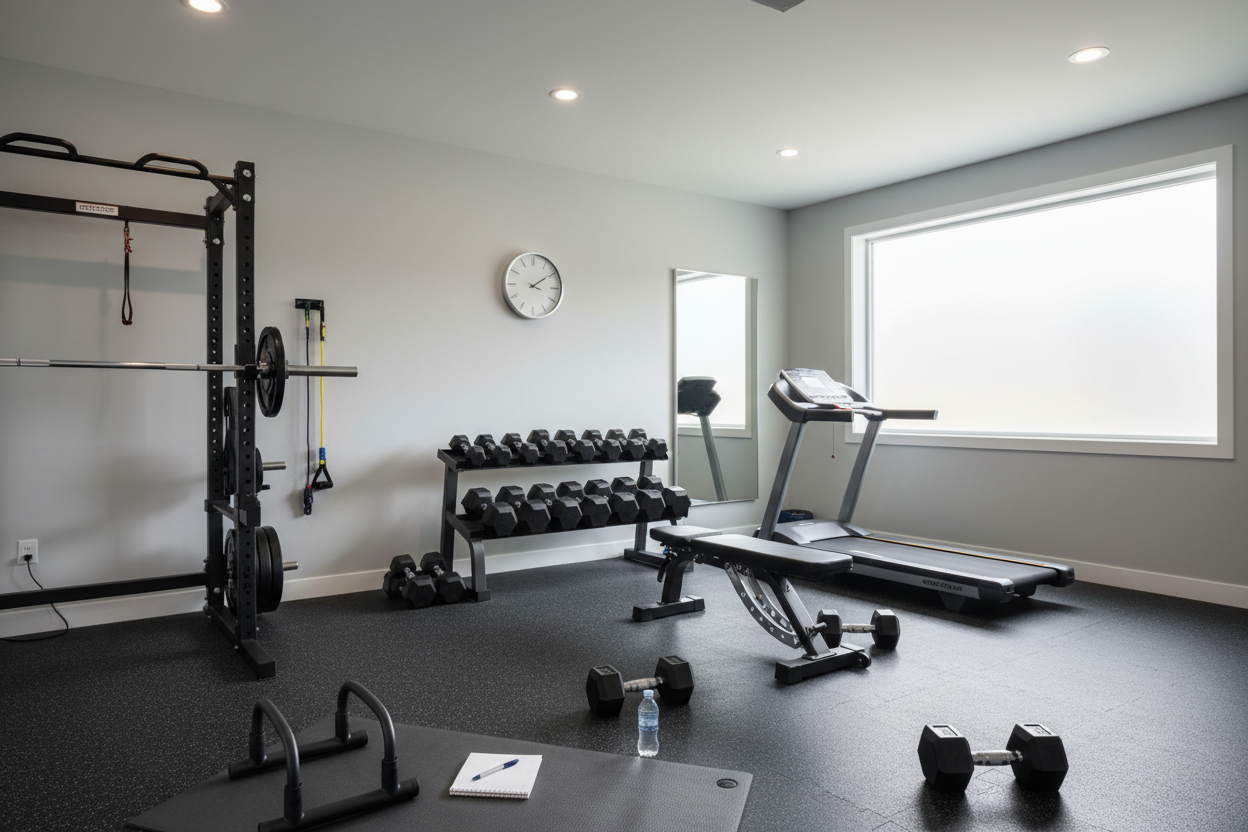
The same rule applies to the lower body, but with an added challenge: balance. For slow, isometric lower-body holds like paused goblet squats or deep lunges, you need a wide, stable base. I always tell my clients to invest in a large exercise mat for home gym setups. Slipping during a 3-second pause at the bottom of a squat is a fast track to a groin injury. You need enough floor space and traction to plant your feet firmly and drive through your heels.
Integrating the Upper-Lower Split
Tempo training causes significant muscle damage, meaning you need more recovery time. You cannot do full-body tempo workouts five days a week and expect your central nervous system to keep up. Instead, group your movements into dedicated days.
This allows you to hit the chest, back, and shoulders with deep eccentric control, then give them 48 hours to rebuild while you torture your legs. If you want to see exactly how to structure this weekly schedule, I highly recommend reading up on the upper-lower shift to balance your intensity and recovery properly.
Upgrading Working Out Routines at Home Safely
Slowing down your reps exposes every weak link in your form. When you upgrade working out routines at home with tempo, joint safety and breathing mechanics take center stage.
Do not hold your breath for a full 7-second rep. Inhale smoothly during the 4-second eccentric lowering phase, brace your core during the bottom pause, and exhale sharply as you push the weight up. Holding your breath under prolonged tension spikes your blood pressure unnecessarily.
Because you are spending so much time under tension, traction is non-negotiable. When I test intense isometric pauses with clients, I insist on a high-traction surface. A premium gym flooring for home workout spaces prevents your feet from sliding outward during wide-stance squats or deep reverse lunges. Without grip, your stabilizing muscles panic, your form breaks down, and you lose the mind-muscle connection entirely.
Sample Tempo-Based Home Routine
Ready to test this? Grab your light dumbbells or just use your body weight. Perform 3 sets of 8 to 10 reps for each exercise. Rest 90 seconds between sets.
- Bulgarian Split Squats (Tempo: 4-2-1-1): 4 seconds down, 2 seconds hold at the bottom stretch, 1 second up, 1 second squeeze at the top.
- Deficit Push-Ups (Tempo: 3-1-1-1): 3 seconds down, 1 second hold at the bottom stretch, 1 second up, 1 second squeeze.
- Dumbbell Rows (Tempo: 3-0-1-2): 3 seconds lowering the weight, no pause at the bottom, 1 second pull, 2-second hard squeeze at the top against your lats.
- Glute Bridges (Tempo: 2-1-1-3): 2 seconds down, 1 second pause, 1 second up, 3-second hard squeeze at the top.
Personal Experience: The Mental Toll of Tempo
Over the last three years, I have tested dozens of setups in my own 10x12 foot garage space. When I switched to tempo training using a basic 5-52.5 lb adjustable dumbbell set, my chest and quad growth matched what I used to get from heavy barbell lifting. The physical results were undeniable.
However, I will share one honest downside: tempo training is mentally exhausting. Counting 'one-one-thousand, two-one-thousand' while your muscles are screaming requires intense focus. It is incredibly easy to cheat and speed up your counting as fatigue sets in. You have to be strictly disciplined to keep the eccentric phase slow on your final reps.
Frequently Asked Questions
How light is too light for tempo training?
If you can easily perform 20 reps at a strict 4-1-1-1 tempo without breaking a sweat, the weight is too light. You should reach muscular failure or technical breakdown between 8 and 12 reps.
Does tempo training build strength or just size?
It primarily builds muscle size (hypertrophy) and connective tissue strength. For absolute maximal strength, like increasing your 1-rep max, you will eventually need heavier physical loads to train your central nervous system.
Can I use tempo training for core exercises?
Absolutely. A 3-second eccentric lowering phase on hanging leg raises or ab wheel rollouts will severely challenge your core stability and force your abdominals to work much harder than fast, swinging reps.