Exercises to Strengthen Quads After Knee Surgery: The Safe Protocol
Waking up from surgery is often the easy part. The real challenge begins when you look down at your leg and realize the muscle definition seems to have vanished overnight. This isn't just in your head; it's a physiological response called arthrogenic muscle inhibition (AMI). Your brain effectively "shuts off" the quad to protect the traumatized joint.
Many patients rush into heavy lifting too soon, leading to setbacks. However, if you want to recover full range of motion, you must follow a strategic progression. Below, we break down the specific exercises to strengthen quads after knee surgery that prioritize safety and long-term joint health.
Key Takeaways: The Recovery Roadmap
- Wake up the muscle first: You cannot strengthen a muscle your brain cannot activate. Start with isometrics.
- Respect the swelling: Inflammation shuts down muscle firing. Manage swelling to improve quad contraction.
- Closed-chain is safer: Exercises where your foot is planted (like mini-squats) are generally safer for the new graft or repair than open-chain extensions.
- Frequency over intensity: In the early stages, perform low-intensity reps multiple times a day rather than one heavy session.
The Science: Why Your Quads Shut Down
Before grabbing a resistance band, you need to understand the mechanism at play. After knee surgery, swelling and pain send signals to the spinal cord that inhibit the motor neurons controlling the quadriceps.
This means you aren't just weak; you are neurologically inhibited. Attempting standard leg extensions in this state often leads to "cheating" by using hip flexors or hamstrings, which creates muscle imbalances. The goal of the early phases is to re-establish the neural connection.
Phase 1: Isometric Activation
Isometrics involve muscle contraction without joint movement. These are the gold standard for early rehab because they place minimal stress on the surgical site.
The Quad Set
This is the most critical movement in your arsenal. It looks simple, but doing it correctly requires intense focus.
Sit with your leg straight out. Place a small rolled-up towel under the knee. The goal is to crush the towel into the floor by tightening the top of your thigh. Do not just push with your heel; focus entirely on the muscle above the kneecap. Hold for a strict 5-10 seconds. Repeat this 10 times, every hour you are awake.
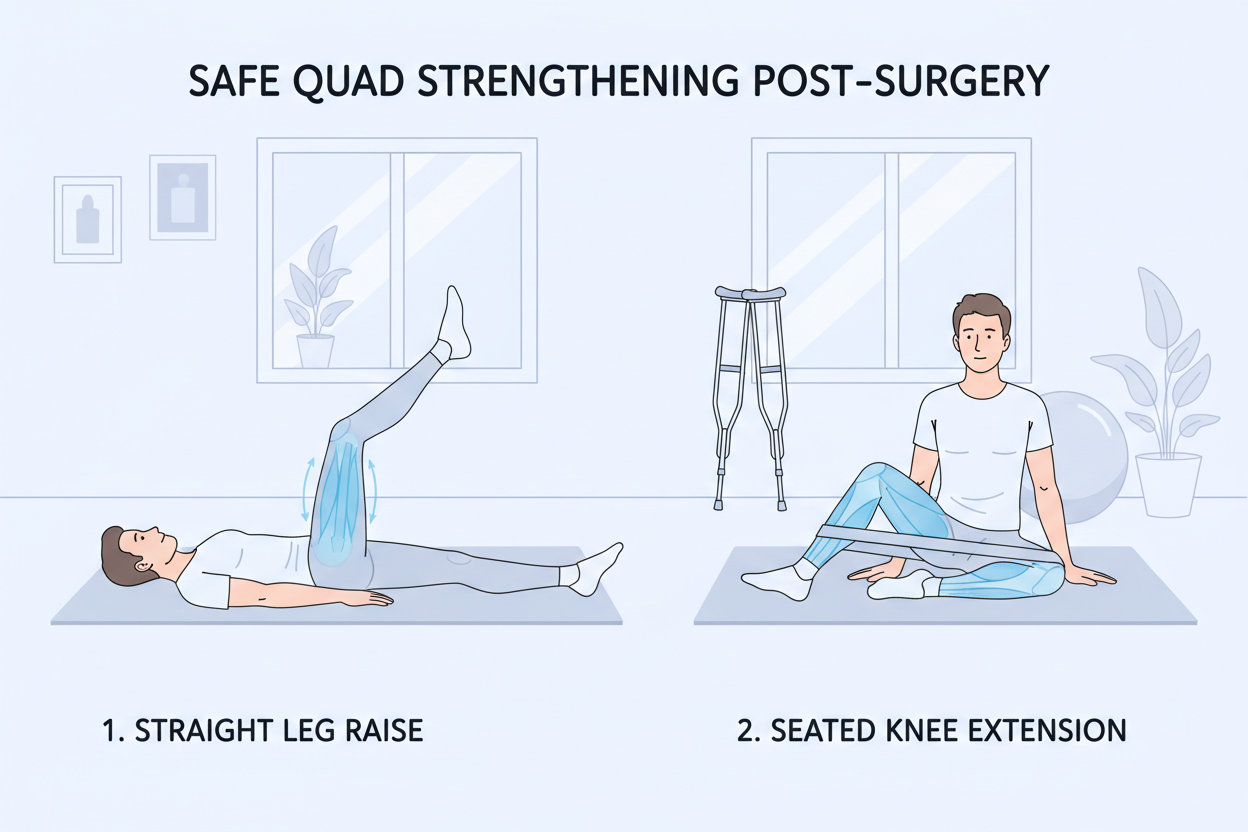
Straight Leg Raises (SLR)
Once you can perform a quad set with no lag (the muscle fires immediately), you graduate to the SLR. Lie flat. Bend the non-surgical knee. Lock your surgical knee straight (perform a quad set) and lift the leg about 12 inches off the bed.
Crucial Tip: If your knee bends even slightly during the lift, you aren't ready. The leg must remain a rigid plank to effectively strengthen quads after knee surgery without straining the joint capsule.
Phase 2: Closed Kinetic Chain Movements
Once you can bare weight, we move to closed-chain exercises. These simulate real-life movements and increase joint stability by compressing the joint surfaces together safely.
The Wall Slide
Stand with your back against a wall, feet shoulder-width apart and about 12 inches from the baseboard. Slowly slide your back down the wall, bending your knees to about 30 or 45 degrees. Do not go to 90 degrees yet.
Hold the bottom position for 3-5 seconds. This time under tension builds endurance. Push back up through your heels, not your toes. Pushing through the toes increases shear force on the knee, which we want to avoid.
Terminal Knee Extensions (TKE)
You will need a resistance band for this. Anchor the band to a sturdy object and loop it behind your surgical knee. Step back until there is tension with the knee slightly bent.
Straighten your knee against the resistance of the band by contracting the quad. This specifically targets the VMO (the teardrop muscle on the inside of the knee), which is vital for patellar tracking.
My Training Log: Real Talk
I want to be honest about what this process actually feels like. I remember lying on my living room floor three days post-op. My physical therapist told me to do a "quad set." I stared at my knee, commanded it to tighten, and... absolutely nothing happened.
It felt like the wiring had been cut. I remember the specific cold sweat that broke out on my forehead—not from physical exertion, but from the sheer mental strain of trying to make a muscle twitch that refused to listen. It wasn't painful; it was silent and frustrating.
It took four days of staring at my VMO before I saw a flicker of movement. That mental fatigue is real. The "shake" you feel when doing a simple leg lift isn't weakness in the traditional sense; it's your nervous system trying to reboot. If you feel that wobble or that mental exhaustion, you're doing it right.
Conclusion
Rebuilding your legs takes patience. It is not about how much weight you can move, but how much control you possess. Start with the neural connection, master the isometrics, and only then progress to weight-bearing movements. Consistency in these small habits is the only way to return to the field or the gym stronger than before.
Frequently Asked Questions
How soon can I start quad exercises after surgery?
Most surgeons allow basic quad sets immediately after surgery, sometimes even in the recovery room. However, always consult your specific post-op protocol, as meniscus repairs or complex ligament reconstruction may have different timelines.
Why does my knee click when I do these exercises?
Painless clicking or popping is usually scar tissue breaking up or fluid moving within the joint capsule. If the clicking is accompanied by sharp pain or swelling, stop immediately and consult your physical therapist.
Can I use a leg extension machine?
Generally, open-chain leg extension machines are avoided in the early stages of ACL rehab because they place significant shear stress on the new graft. Stick to closed-chain movements (like squats or leg presses) until cleared by your medical team.