Exercise Rope Machine: Stop Doing Boring Cardio at Home
If you are piecing together a home gym, you have likely run into the cardio dilemma: treadmills are massive, stationary bikes can get boring, and rowers take up a huge footprint. Enter the exercise rope machine. Often called an endless rope trainer, this compact piece of equipment is rapidly becoming a favorite for garage gym owners looking to build upper-body endurance and torch calories without sacrificing precious floor space.
But before you drill holes into your drywall or drop a thousand dollars on a freestanding unit, you need to know if it actually fits your training style. In this guide, we will break down exactly what makes these machines tick, how to integrate them into your routine, and what to look for when buying one.
Key Takeaways
- Unmatched Upper Body Cardio: Delivers a high-intensity, low-impact cardiovascular workout that heavily targets the lats, shoulders, and core.
- Space-Saving Design: Wall-mounted units require zero floor space, making them ideal for cramped garage or basement gyms.
- Variable Resistance: Most quality units use magnetic resistance, allowing you to seamlessly switch from light cardio to heavy strength pulls.
- Accessibility: Excellent for athletes working around lower-body injuries who still need intense conditioning.
Choosing the Right Rope Trainer: A Buying Guide
Resistance Mechanisms Explained
The heart of any endless rope trainer is its resistance system. Entry-level models often use friction resistance, which can feel jerky and wear down the rope over time. If your budget allows, prioritize a machine with magnetic resistance. Magnetic systems provide a buttery-smooth pull, operate quietly (a huge plus for apartment dwellers), and offer distinct, measurable levels of difficulty.
Build Quality and Rope Material
You are going to be pulling this rope thousands of times. Look for models utilizing custom-braided polyurethane or poly-dacron ropes. These materials are gentle on the hands, resist fraying, and wipe down easily. Avoid cheap nylon ropes that can cause friction burns during high-speed intervals.
Space Planning for North American Home Gyms
One of the biggest selling points of an exercise rope machine is its minimal footprint, but you still need to plan your space carefully. If you opt for a wall-mounted unit, you need a solid structural anchor. You cannot mount these to drywall—they must be secured to wooden studs or concrete.
Clearance requirements: While the unit itself might only be 20 inches tall, you need adequate operational space. Plan for at least 4 to 5 feet of clear space in front of the machine so you can step back, drop into a squat, or perform kneeling pulls. Mount the pulley roughly 6 to 7 feet off the ground for optimal range of motion.
Training Applications and Programming
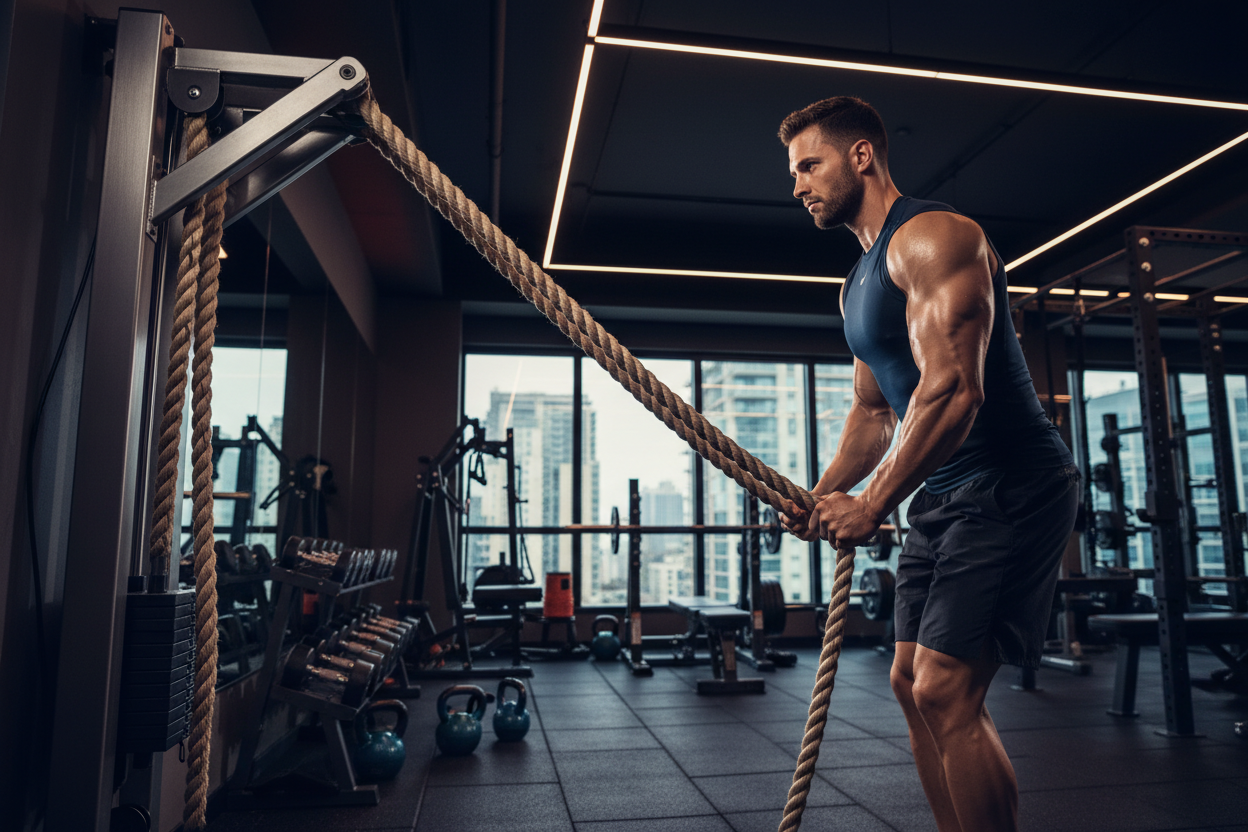
Integrating a workout rope machine into your routine opens up a new world of conditioning. Unlike traditional battle ropes that require 30 feet of floor space and rely on wave mechanics, an endless rope provides continuous time-under-tension.
The 5-Minute Finisher
For a brutal workout finisher, set the resistance to medium. Perform 45 seconds of rapid, hand-over-hand downward pulls, followed by 15 seconds of rest. Repeat for 5 rounds. Your forearms, lats, and lungs will be burning by round three. You can also perform upward pulls (if your machine reverses), kneeling pulls, and lateral twists to engage the obliques.
From Our Gym: Honest Take
We have been running a wall-mounted magnetic rope trainer in our main garage gym setup for the past eight months. As someone who despises traditional cardio, this machine has been a game-changer for my conditioning days. The pump you get in your forearms and upper back is incredible, and the magnetic resistance is whisper-quiet—I can easily hear my music over the machine.
However, I have to be completely honest about the installation: the mounting hardware that came in the box was severely lacking. The provided lag screws stripped almost immediately. I highly recommend taking a trip to the local hardware store to buy heavy-duty, 3-inch structural screws. Once I swapped the hardware and hit the center of the wooden studs, the machine felt rock solid, even during aggressive, heavy-resistance pulls.
Frequently Asked Questions
Is an exercise rope machine good for weight loss?
Yes. Because it engages large muscle groups in the upper body and core simultaneously, it elevates your heart rate incredibly fast. When combined with a proper diet, the high calorie expenditure makes it an excellent tool for fat loss.
How much space do I need for a wall-mounted rope trainer?
The machine itself takes up virtually zero floor space, protruding only about 10 to 15 inches from the wall. However, you should leave a 4-by-4 foot active working area in front of the unit to allow for different pulling stances and lateral movements.
Can beginners use endless rope machines?
Absolutely. Because the resistance is adjustable and the movement is very low-impact on the joints, beginners can start with light resistance to build foundational upper body endurance before moving on to heavy strength pulls or high-intensity intervals.