Exercise Plan at Home: Why Racing the Clock Beats Heavy Weights
I remember training a client in a 400-square-foot apartment equipped with nothing but a pair of dusty 15-pound dumbbells. He was frustrated, convinced he'd lose all his muscle because he couldn't bench press 225 pounds anymore. That is the trap most people fall into when building an exercise plan at home. They try to replicate the heavy lifting of a commercial facility in their living room.
When you lack access to a full rack of incremental weight plates, chasing heavy loads is a losing battle. Instead of focusing on the weight on the bar, I shifted his focus to the clock on the wall. Racing the clock through time-capped density blocks completely revolutionized his results, proving you don't need a massive power rack to force adaptation.
Quick Takeaways
- Traditional 3x10 set/rep schemes fail at home when you max out your available dumbbells.
- Time-capped density training focuses on doing more total work in a strict 15-minute window.
- Pairing antagonistic exercises (push/pull) allows for active recovery without resting.
- Progression means adding total repetitions to your time block week over week.
- A slip-resistant surface and a reliable timer are your most critical pieces of home gear.
The Problem with the Traditional Gym Workout Plan at Home
If you pull up a standard routine online, it usually prescribes three sets of ten repetitions for every exercise. That works flawlessly in a commercial facility where you can micro-load a barbell from 45 pounds up to 500 pounds. But what happens when you try to apply that same gym workout plan at home?
You hit a wall fast. If your heaviest adjustable dumbbells cap out at 52.5 pounds, doing three sets of ten goblet squats will eventually feel like a warmup. You can slow the tempo down, but eventually, your legs will adapt to that specific load.
I've watched countless clients buy expensive, bulky equipment trying to solve this problem, only to realize a power rack dominates a 6x6 foot space and ruins the aesthetics of a spare bedroom. The core issue isn't a lack of equipment; it is a lack of adaptation. When you can't increase the weight, you have to manipulate the volume and the rest periods.
Enter Time-Capped Density Training
This is where Escalating Density Training (EDT) comes in. Instead of counting sets and resting for two minutes while scrolling on your phone, you set a timer for a strict 15-minute block. Your only objective is to perform as many high-quality repetitions as possible before the buzzer sounds.
This shifts the entire paradigm of your home training plan. You aren't chasing heavier dumbbells; you are chasing work capacity. By compressing more work into a fixed timeframe, you force your muscles to adapt to metabolic stress.
When I tested this method on myself during a month-long travel stint with zero access to heavy weights, the pump was unbelievable. My heart rate stayed pinned between 140 and 160 beats per minute, turning a standard resistance routine into a brutal cardiovascular conditioning session. The one honest downside I experienced? The lactic acid buildup is intense. If you don't pace yourself in the first five minutes, you will completely gas out by minute ten and your form will fall apart.
Structuring Your Exercise Plan at Home
The secret to a successful density block is exercise selection. You cannot pair two exercises that fatigue the same muscle group, or your rep count will plummet. The magic lies in antagonistic supersets.
By pairing opposite movement patterns—like push-ups and dumbbell rows—you allow your chest to recover while your back is working. You bounce back and forth between the two movements with zero planned rest. You only stop to catch your breath when your form starts to break down.
If you are entirely new to fitness, I highly recommend mastering a free beginner workout plan first. You need to groove the basic movement patterns of squatting, hinging, pushing, and pulling before you throw yourself into the fire of a timed density block. Once your baseline strength is solid, you can start building your 15-minute circuits.
Progression: Beating Your Own Score
The beauty of this system is how easily you can track progressive overload. Let's say you pair dumbbell lunges with overhead presses. In week one, you complete 40 total lunges and 40 total presses within the 15 minutes.
That number—80 total reps—is your score. Next week, your only goal is to hit 82 or 85 reps using the exact same weight. You are doing more work in the same amount of time, which scientifically proves your muscles are getting stronger and your conditioning is improving. No heavy barbell required.
Essential Gear for Your Density Gym Workout Home Plan
Because you are racing against the clock, your environment needs to support rapid transitions. You don't have time to adjust complicated pin-loaded machines or clear away clutter. You need open space, a reliable digital timer (your phone works fine), and a solid foundation.
When you are dripping sweat and moving quickly from a floor-based core exercise to a standing dynamic movement, slipping is a real hazard. I learned this the hard way when a client slid on a cheap, thin yoga mat during a set of mountain climbers, tweaking his wrist.
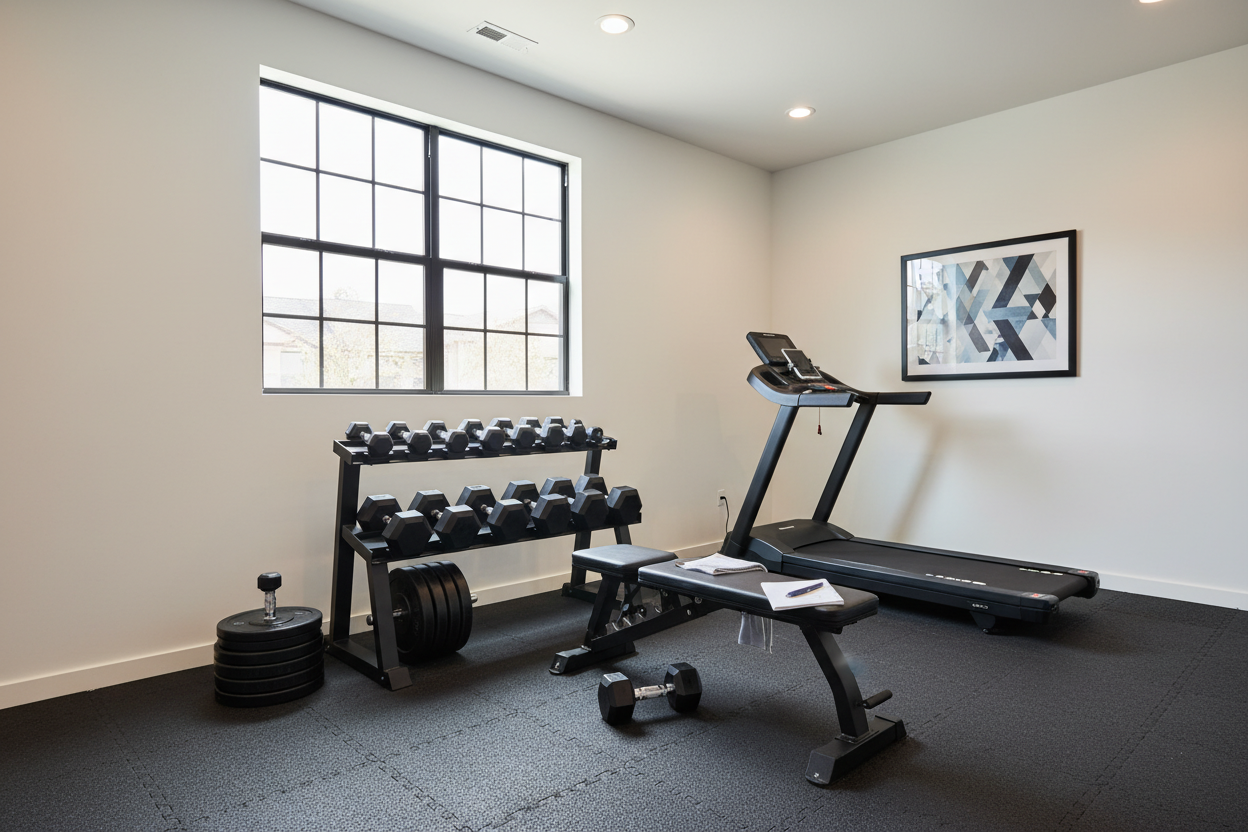
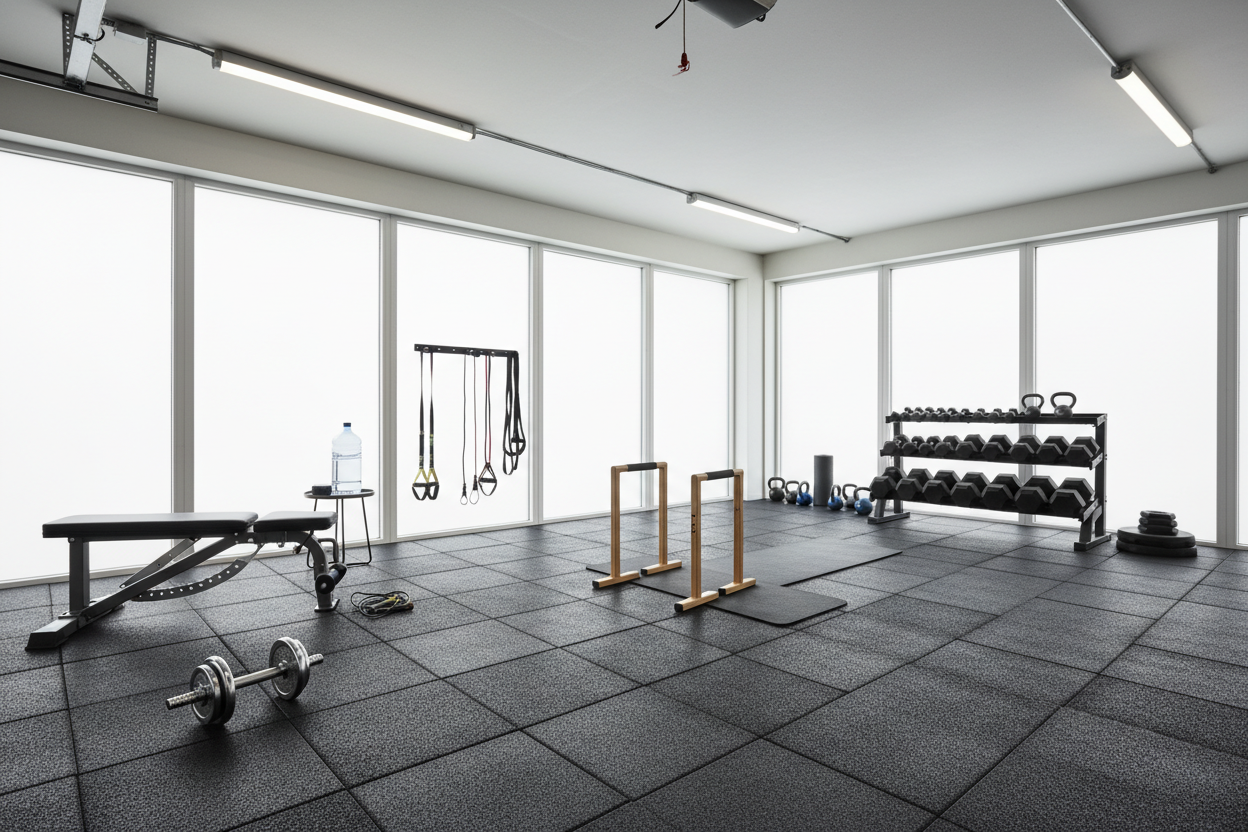
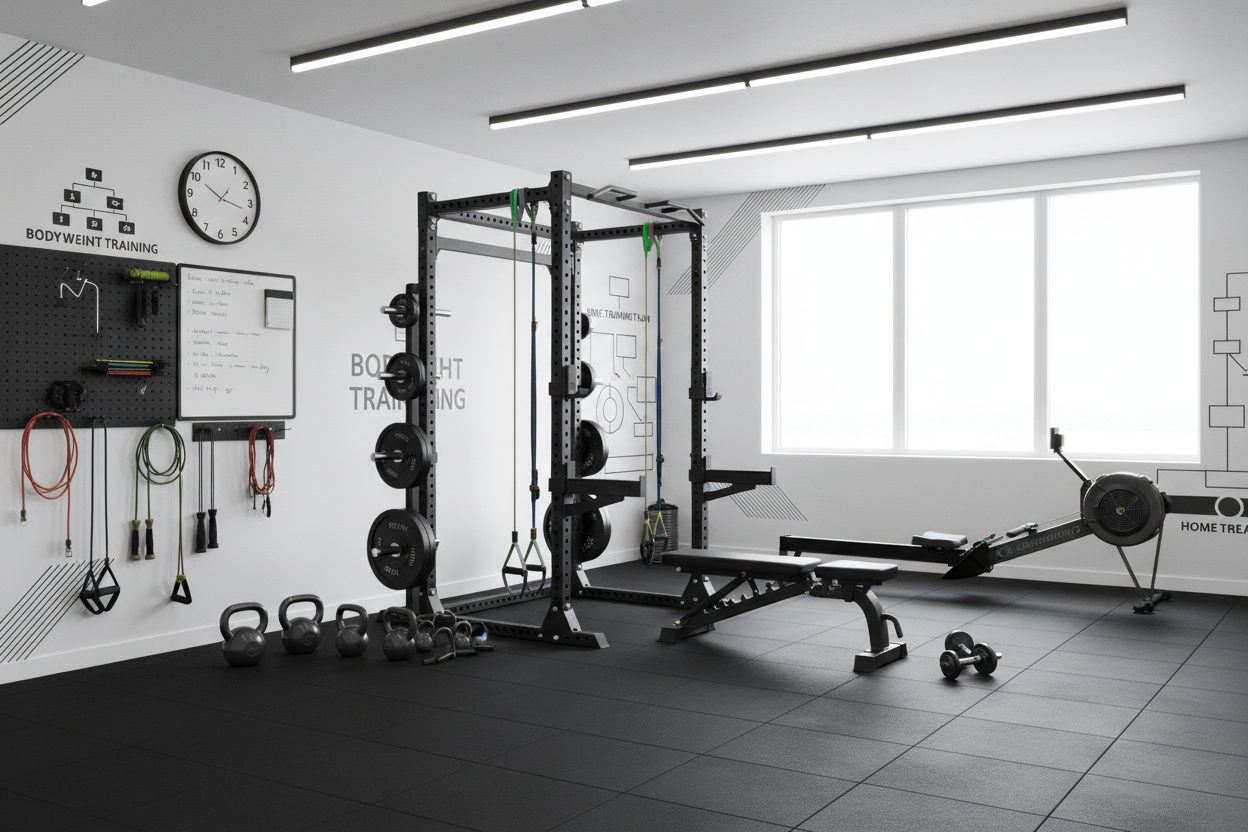
For a serious density setup, you need high-quality, slip-resistant large gym flooring for home. It provides the traction necessary for fast transitions, absorbs the impact of plyometric movements, and protects your joints when you inevitably drop to your knees in exhaustion at minute fourteen.
Sample 15-Minute Density Blocks to Try Today
Ready to implement this gym workout home plan? Here are two highly effective blocks. Set your timer for 15 minutes and alternate between the two exercises, doing 5 to 8 reps per mini-set to manage fatigue.
Block One: The Upper Body Burn. Pair flat dumbbell floor presses with bent-over dumbbell rows. Keep the reps low so you don't hit failure early. Do 5 presses, immediately stand up, do 5 rows. Repeat until the timer stops.
Block Two: The Leg Destroyer. Pair goblet squats with Romanian deadlifts. If you only have a single 30-pound dumbbell, this will still leave your legs shaking by the end of the block.
As you get stronger, bodyweight squats and standard push-ups might not provide enough resistance, even in a density format. When that happens, you can swap them out for unilateral moves for at-home routines like Bulgarian split squats or single-arm push-ups to instantly ramp up the difficulty.
Frequently Asked Questions
How many times a week should I do density training?
For most clients, 3 to 4 days a week is the sweet spot. Because these sessions are highly metabolic, your central nervous system needs adequate recovery days in between.
Can I build muscle without lifting heavy?
Absolutely. Muscle hypertrophy is driven by mechanical tension and metabolic stress. Density training maximizes metabolic stress, forcing muscle growth even with moderate dumbbells or bodyweight.
How long should my total workout be?
A complete session typically consists of two 15-minute density blocks, separated by a 5-minute rest. Add a quick 5-minute warmup and a brief cooldown, and you are done in under 45 minutes.