
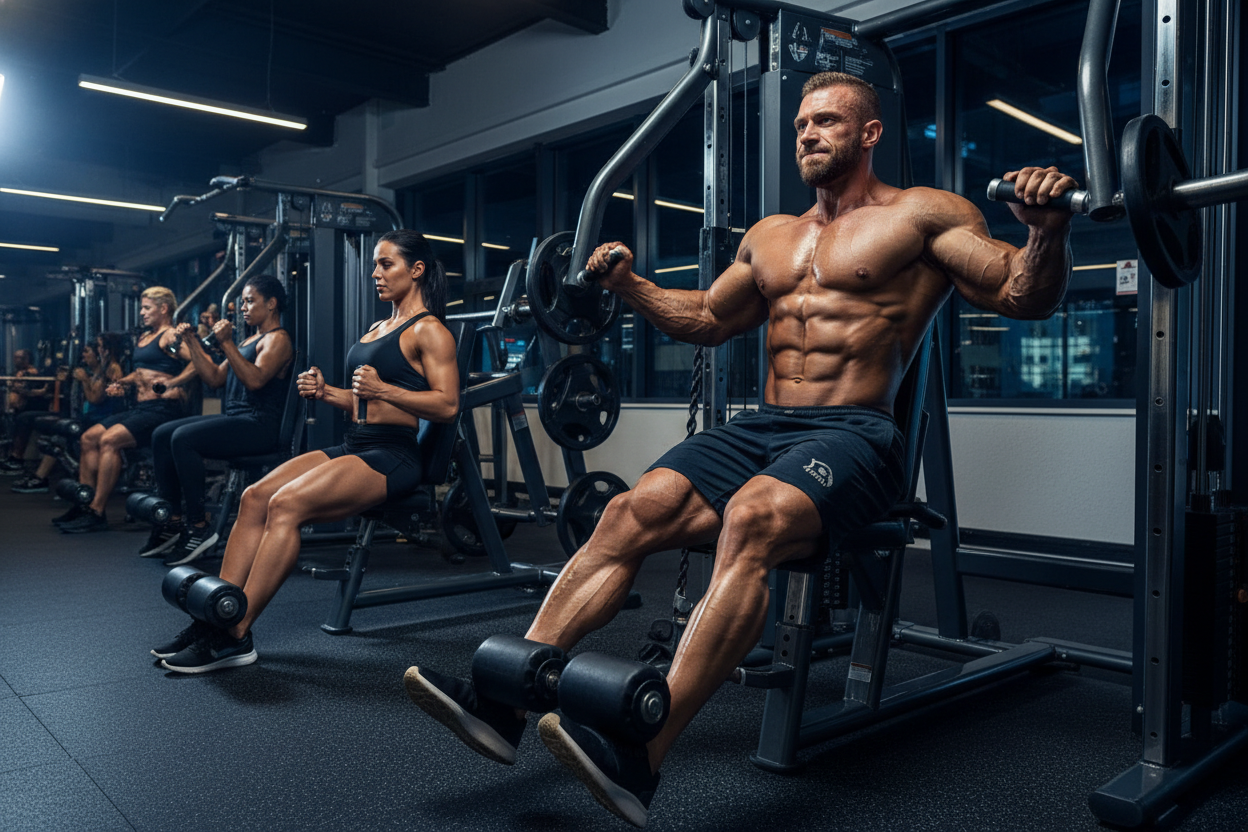
Exercise on Machines: The Smart Way to Build Muscle Safely
There is a lingering stigma in the fitness community that barbells are for serious lifters and machines are for beginners or rehabilitation. This binary way of thinking is holding back your gains. The truth is, exercise on machines offers a unique advantage that free weights simply cannot match: external stability.
When you remove the need to balance a heavy load, you free up your nervous system to focus entirely on output. This guide cuts through the dogma and explains how to use machines to generate maximum mechanical tension.
Key Takeaways: Why Use Machines?
- Targeted Isolation: Machines stabilize your body, allowing you to direct 100% of your effort into the target muscle without stabilizer fatigue.
- Safety at Failure: You can push to absolute muscular failure safely without the risk of getting crushed by a barbell.
- Constant Tension: Many modern machines provide a consistent resistance profile (via cams) that matches your muscle's strength curve better than gravity alone.
- Quick Adjustments: Drop sets and intensity techniques are significantly easier when working out with weight machines.
The Science of Stability and Output
The primary argument for working out on machines is stability. In biomechanics, there is a concept regarding the trade-off between stability and force production. If your body has to work hard to stabilize a load (like in a barbell squat), the prime movers (quads/glutes) cannot exert their maximum potential force because the brain is limiting output to keep you upright.
Machines provide artificial stability. Because the machine dictates the path of motion, your internal stabilizers get a break. This allows the target muscle to contract with higher motor unit recruitment. If your goal is specifically hypertrophy (muscle growth) rather than functional balance, machines are often superior tools.
Structuring Your Machine-Based Workout
You don't need to choose between free weights and machines, but if you are focusing on a machine-heavy block, structure is key.
Start With Compound Movements
Just because you are on a machine doesn't mean you skip heavy compounds. Start with multi-joint movements like the Hack Squat, Chest Press, or Seated Row. These allow for the heaviest loads and greatest systemic fatigue.
Move to Isolation
Once the heavy work is done, transition to single-joint movements like Leg Extensions or Pec Deck Flyes. This is where working out with weight machines shines, as you can safely take these muscles to deep fatigue without form breakdown.
Common Mistakes When Working Out on Machines
Even though the path of motion is fixed, you can still mess this up. Here are the pitfalls to avoid.
Misaligning the Axis of Rotation
Every machine with a pivot point (like a leg extension or preacher curl) has an axis of rotation—usually marked by a red dot or a bolt. If your joint (knee or elbow) isn't perfectly aligned with this mechanical axis, you create shearing forces on your joints. Take the extra ten seconds to adjust the seat height.
Relying on Momentum
We've all heard the "clank" of a weight stack slamming down. If the weights are crashing, you aren't controlling the eccentric (lowering) portion of the lift. You are robbing yourself of half the growth potential. Control the weight; don't let the weight control you.
My Training Log: Real Talk
I want to be honest about the reality of machine training because it's not all smooth sailing. I recall a specific training block where I swapped barbell squats for the Hack Squat to spare my lower back.
On paper, it’s the "perfect" quad builder. In reality? I remember the specific, stinging friction burn on my shoulders because the pads on that specific Cybex model were worn down and slick with sweat. I also remember the "sticking point" in the guide rails—a gritty, stuttering feeling halfway up the rep because the gym hadn't greased the rods in months.
That friction actually threw off my tempo. I had to learn to push explosively through that gritty patch rather than trying to grind it out slowly. Machines are engineered for perfection, but gym maintenance rarely is. You have to learn the quirks of the specific unit you are using, or that little wobble in the cable will distract you from the contraction every single rep.
Conclusion
Exercise on machines is not a shortcut; it is a strategic choice for hypertrophy. By utilizing the stability machines provide, you can take your muscles to a place of failure that is difficult to reach safely with free weights alone. Mix them into your routine intelligently, align your joints properly, and respect the eccentric phase.
Frequently Asked Questions
Can I build significant muscle mass using only machines?
Yes. Your muscles do not know if you are holding a barbell or a machine handle; they only detect tension. As long as you apply progressive overload (increasing weight or reps over time) while working out on machines, you will build muscle mass effectively.
Are machines safer than free weights?
Generally, yes. Machines reduce the risk of acute injury caused by dropping weights or losing balance. However, chronic overuse injuries can still occur if the machine forces your body into an unnatural path of motion that doesn't fit your specific biomechanics.
How often should I change the machines I use?
Consistency is better than variety. Stick to the same machines for at least 8-12 weeks so you can track strength gains accurately. If you constantly switch between different brands of chest presses, it becomes impossible to track if you are actually getting stronger.


