Exercise At Home Book Strategy: Ditch The Apps
I recently had a client who could not finish a 45-minute living room session without getting derailed by work emails. Every time she picked up her phone to check her fitness app for the next set, a notification popped up. Ten minutes of scrolling later, her heart rate was down, and her workout was effectively over. That is the harsh reality of digital training. If you want to build deep, distraction-free habits, you need an exercise at home book.
Over the last decade of building and testing garage gyms, I have watched the fitness industry push everyone toward monthly app subscriptions. But some of the most consistent, strongest trainees I know run their entire programs from dog-eared paperbacks. Analog programming forces you to focus on the movement, not the screen.
Quick Takeaways
- Physical fitness manuals eliminate digital distractions and notification fatigue.
- Look for books that provide 12-to-16 week structured programs, not just random daily sweat sessions.
- A quality manual teaches you how to adapt movements for tight spaces and limited gear.
- Pairing analog programming with a simple interval timer creates a highly focused training environment.
Why You Need an Exercise At Home Book Today
App fatigue is a massive hurdle for modern trainees. We spend eight hours a day staring at monitors, only to fire up another screen to tell us how to do a push-up. The constant pings, texts, and battery-drain anxiety actively pull you out of the training zone. A physical home exercise book provides a timeless, uninterrupted programming logic that does not require Wi-Fi or a monthly fee.
When you use a physical manual, you engage with your workout differently. You read the day's programming before you start. You internalize the rep schemes. You write your numbers down in a notebook. This cognitive engagement builds a much stronger mind-muscle connection than blindly following an avatar on a screen.
Furthermore, apps are often designed to keep you guessing. They throw random, high-intensity workouts at you daily to keep you entertained. But entertainment rarely builds strength. Real physical adaptation requires doing the same boring, effective movements repeatedly over months. A solid book lays out that unglamorous, highly effective path clearly. You can see week one and week twelve on the same page, giving you a tangible sense of progression that an algorithmic daily workout simply cannot match.
What Makes the Best Home Workout Book?
Not all fitness literature is created equal. If you walk into a bookstore, you will find shelves packed with what I call "exercise encyclopedias." These books feature 500 variations of a plank and a bicep curl, but they give you zero context on how to put them together. The best home workout book is not a dictionary; it is a programming manual.
A true programming manual teaches you the underlying principles of strength and conditioning. It explains why you are doing squats before sit-ups. It tells you how long to rest between sets of heavy lunges versus high-rep push-ups. When evaluating a book, flip to the table of contents. If it lacks a dedicated section on programming, scheduling, or periodization, put it back. You need a roadmap, not a list of random exercises.
Look for Progressive Overload Roadmaps
The single most important concept in fitness is progressive overload. If your book does not explicitly tell you how to make an exercise harder next week, it is useless. The best manuals include clear instructions on advancing movements week over week.
For example, if you are doing bodyweight squats, the book should map out a progression. Week one might be 3 sets of 10 reps. Week two is 3 sets of 12 reps. Week three introduces a pause at the bottom of the squat. Week four requires you to hold a heavy household object. This structured advancement forces your muscles to adapt.
Look for books that outline specific rep ranges, rest periods, and RPE (Rate of Perceived Exertion) scales. They should tell you exactly what to do when you hit a plateau. If you fail to complete your target reps, a good manual provides a troubleshooting guide to help you deload and rebuild your strength safely.
Space and Equipment Adaptability
Most home trainees do not have a 400-square-foot garage dedicated to lifting. You are likely working out in a 6x6 foot clearing between your coffee table and your sofa. Therefore, your chosen book must teach you how to modify exercises based on your specific room dimensions and available gear.
If a program calls for pull-ups but you cannot install a bar in your apartment doorway, the book should offer immediate alternatives. Can you do towel rows on a sturdy door? Can you do sliding floor pullovers? Adaptability is crucial. The literature should focus on movement patterns—like horizontal pulling, vertical pressing, and hip hinging—rather than demanding you buy a specific, bulky piece of equipment to execute a single exercise.
Transitioning from Page to Floor
Taking a workout from a piece of paper and executing it physically requires a bit of environmental setup. When I test new programs in my own garage, I realize quickly that you cannot hold a book while doing a kettlebell swing. You have to set up your space so you can easily reference your manual without interrupting your exercise flow.
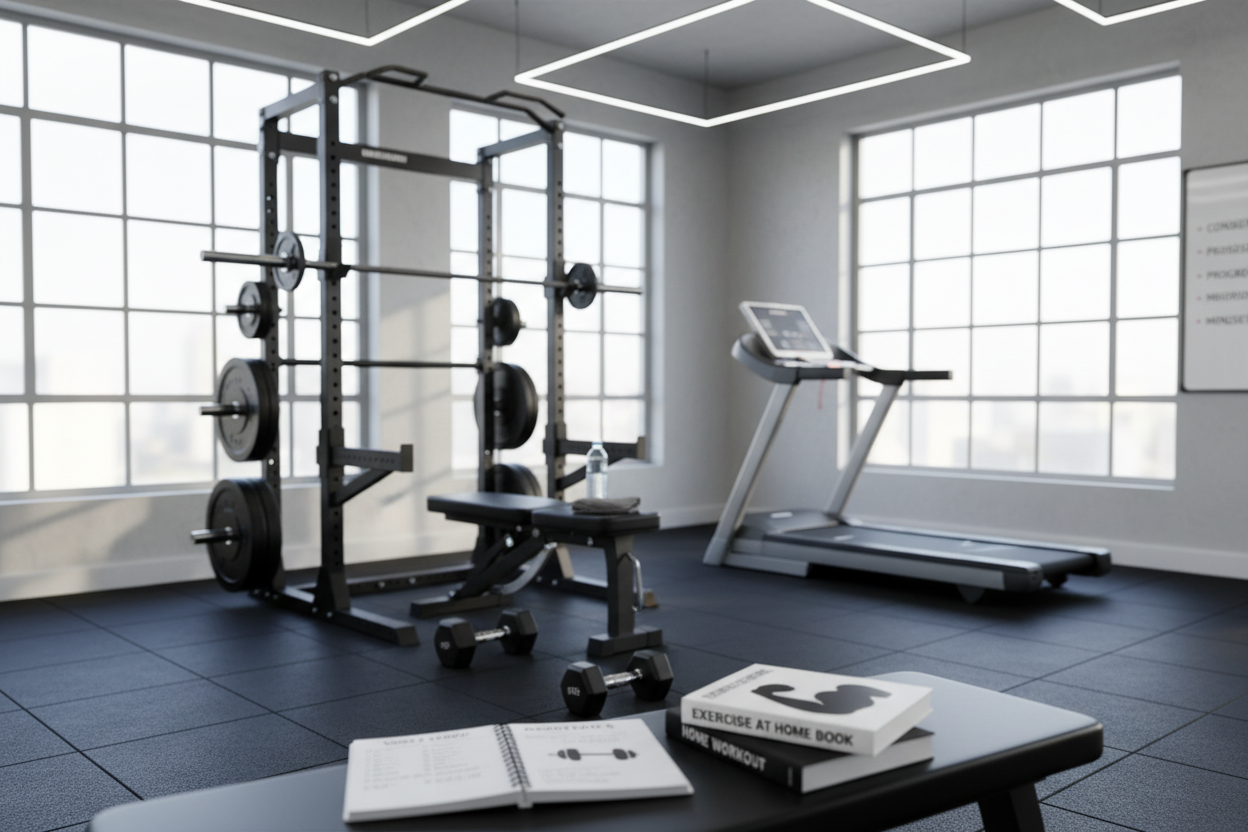
First, establish your training footprint. You'll want a solid foundation, like a large exercise mat for home gym setups, where you can comfortably lay out your text and perform ground-based movements without slipping. I highly recommend buying a cheap, folding sheet music stand. Placing your open book on a stand at waist height allows you to glance at your next set or check a form cue without having to bend down and lose your momentum.
One honest downside to analog training is that a book cannot dynamically check your form or beep when your 60-second rest period is over. You have to be self-reliant. I advise clients to read the entire workout the night before. Visualize the transitions. When it is time to train, use a basic digital watch or a dedicated wall timer for your rest periods. Leave the smartphone in another room entirely. By physically separating your programming (the book) from your timing (a basic clock), you create an incredibly focused, distraction-free environment that yields much faster results.
The Essential Genres of Home Fitness Literature
Building a fitness library is like building a tool bench. You need a few specific manuals to cover all your bases. Every serious home trainee should own at least three types of fitness books to ensure well-rounded development.
First, you need a bodyweight and calisthenics guide. Even if you eventually buy weights, mastering your own body weight is non-negotiable. These books teach you how to manipulate leverage to build tremendous strength using zero equipment. Second, pick up a minimal-equipment resistance manual. Usually, this means a dedicated kettlebell or dumbbell book. These texts teach you how to extract maximum mechanical tension from a single 35-pound or 50-pound weight.
Finally, you need a mobility handbook. Lifting weights in your living room will make you strong, but it can also make you stiff. If your manual focuses strictly on strength, you'll need to supplement it with a dedicated stretching workout at home to maintain hip and shoulder mobility. A good restoration book teaches you how to maintain joint health, ensuring you can keep executing the heavy programs without nagging lower back or knee pain.
Pairing Your Book with the Right Gear
A great home fitness manual will grow with you, but eventually, your physical strength will outpace your starting equipment. The beauty of a structured book is that it tells you exactly when it is time to scale up your home gym hardware.
If you are following a progressive overload roadmap, you will eventually max out the rep ranges for bodyweight squats or light dumbbell presses. The book will indicate that to trigger further adaptation, you must increase the load. This is when you slowly transition from minimal gear to heavier investments. You don't need to buy everything at once. Let the chapters of your book dictate your purchases.
For instance, once you master the foundational bodyweight movements in your calisthenics book, you might buy a weighted vest. Once you master a single kettlebell, you buy a second one for double-rack squats. And when you hit the absolute ceiling of free weights in your living room, you can start looking into the best at home exercise machines to add mechanical tension safely. Let your education drive your equipment purchases, not the other way around.
Conclusion: Building Your Off-Screen Fitness Journey
Replacing scattered digital apps with a structured, physical manual is one of the highest-ROI decisions you can make for your physical health. It forces you to slow down, absorb the mechanics of a program, and execute it with deep focus. By mastering the principles found in high-quality fitness literature, you stop renting your workout routines from software companies and start owning your long-term physical development. Grab a book, leave your phone in the kitchen, and get to work.
Frequently Asked Questions
Can a beginner use a fitness book instead of a video app?
Yes. Many high-quality books feature extensive photo sequences and detailed text descriptions of proper form. While video apps show you the movement, books often do a better job explaining the internal cues, like which specific muscle you should feel contracting.
How do I track my progress with a physical book?
The best method is to keep a cheap spiral notebook right next to your manual. Write down the date, the exercises, the weight used, and the reps completed. Reviewing this logbook weekly is highly motivating and keeps you accountable to the progressive overload principles.
What if I don't understand an exercise description in the text?
If a photo and text description leave you confused, use your phone strictly as an educational tool outside of your workout window. Look up a form tutorial on YouTube the night before your workout, visualize the movement, and then execute it analog the next day.