Exactly What Do I Need to Build Muscle on a $500 Budget?
I spent three hours last night scrolling through a $5,000 power rack configurator, adding 11-gauge steel laser-cut attachments I’ll never use. It’s a sickness. We’ve been brainwashed into thinking that if we don't have a commercial-grade functional trainer and a custom-logoed platform, our muscles simply won't grow. It’s total nonsense.
If you’re asking what do i need to build muscle without draining your savings, you’re already ahead of the game. You don't need a gym membership or a massive footprint in your garage. You need tension, a place to stand, and a dose of reality. I’ve built more mass in a 10x10 corner with a pair of dumbbells than I ever did using the fancy circuit machines at the local big-box gym.
Quick Takeaways for the $500 Build
- Adjustable Dumbbells: The 5-52.5 lb range is the sweet spot for beginners.
- Flat Bench: Skip the incline/decline fluff; get a high-capacity flat bench.
- Flooring: 1/2-inch rubber is the minimum to save your joints and your slab.
- Resistance Bands: These are for the 'extra' volume that iron can't always provide cheaply.
The 'Equipment Creep' Trap of Home Gyms
Fitness influencers are the kings of 'equipment creep.' They make you feel like you need a specialized cambered bar for your squats and a $600 adjustable bench just to see a bicep vein. They’re selling a lifestyle, not a physiological result. Your quads don't know if you’re doing a $3,000 belt squat or a $20 Bulgarian split squat with a grocery bag full of rocks.
The secret is prioritizing resistance over gear. Most of the 'innovations' in the last decade are just ergonomic tweaks. They’re nice to have, but they aren't requirements. If you're just starting, every dollar spent on a 'smart' screen is a dollar stolen from the actual iron that creates the stimulus for growth.
So, What Do I Need to Gain Muscle Biologically?
Hypertrophy is a survival response. When you subject a muscle to mechanical tension it isn't used to, it adapts by getting bigger. It’s that simple. To make this happen, you need to be able to add weight or reps over time—what we call progressive overload.
When you're trying to figure out what helps to gain muscle, it usually isn't more gear. It's control. If you can't feel the muscle working with a 30-lb dumbbell because you're swinging it like a pendulum, a $1,000 cable machine won't fix your physique. Focus on the mind-muscle connection and keeping the target tissue under tension for 30-60 seconds per set.
Heavy Objects That Can Be Incrementally Loaded
You need a way to go from 'this is heavy' to 'this is slightly heavier' every few weeks. This is why fixed-weight dumbbells are a trap for budget builders—you'll spend your whole $500 on three pairs. Instead, look for adjustable dumbbells that go up to at least 50 lbs. They take up the space of a shoebox but replace an entire rack of weights.
If you prefer the barbell route, a basic 300-lb weight set from a local sporting goods store is the gold standard. The knurling might be passive and the bar might have a bit of sleeve slop, but 315 lbs is 315 lbs. It will build your back and legs just as well as a competition-grade Eleiko bar.
A Rock-Solid Surface to Push Against
Lifting on a squishy carpet or a bare concrete floor is a recipe for disaster. Carpet kills your stability—it's like trying to squat on a mattress. Concrete, on the other hand, will eventually crack your weights and chew up your joints. You need a foundation that absorbs shock and provides grip.
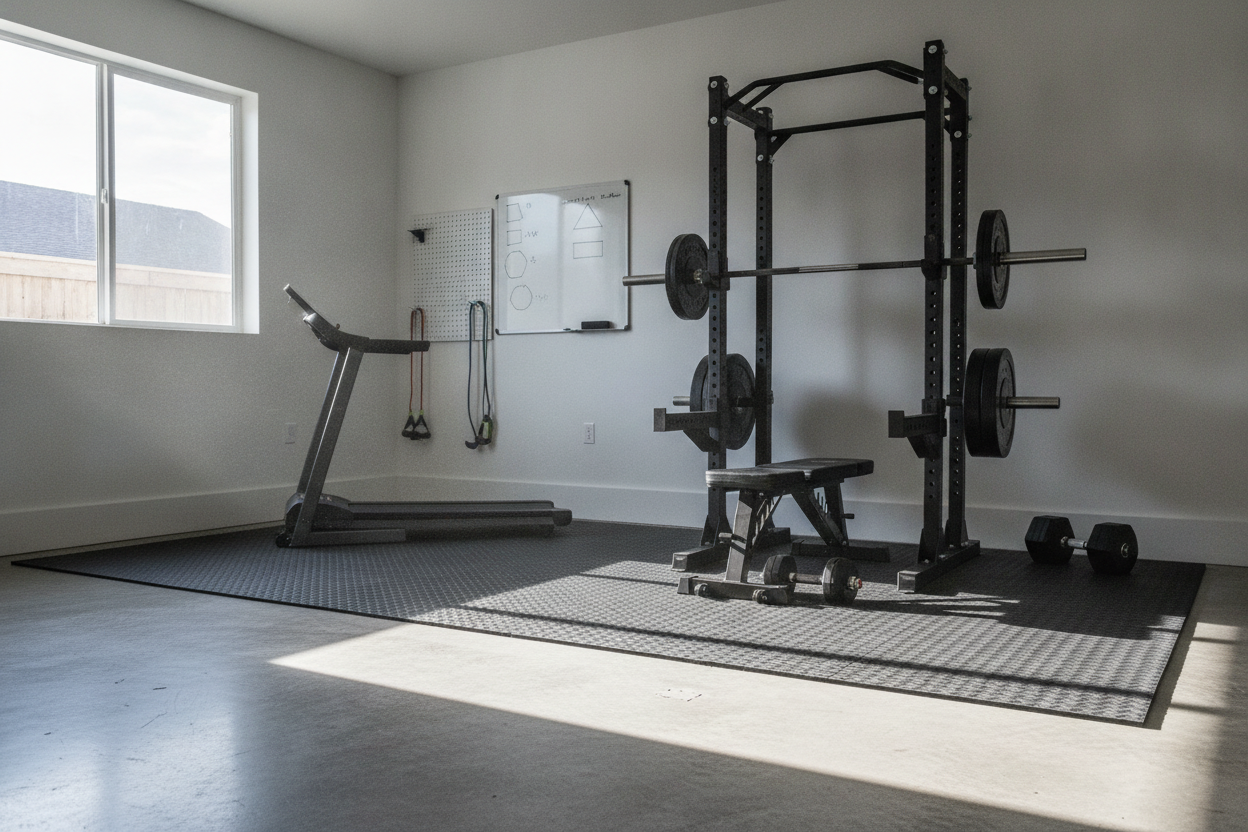
I always tell people to lay down extra wide exercise mats before they even unbox their weights. Having a dedicated 7x8 or 7x10 space that doesn't slip when you're sweating through a set of lunges is more important than any fancy accessory. It defines your 'gym zone' and protects your home.
What You Absolutely Do NOT Need to Buy
Stop looking at isolation machines. Leg extension machines and pec decks are great for bodybuilders in the final weeks of a show, but for a home trainee on a budget, they’re a waste of space. You can get the same stimulus with a pair of $20 resistance bands or a slight tweak in your dumbbell positioning.
Also, ignore the high-end cardio screens. If you want to get your heart rate up, go for a run or do some high-rep kettlebell swings. Don't pay a $40 monthly subscription to have a screen tell you to pedal faster. That’s money that should be going toward more plates or better recovery food.
Putting It Together: The Minimalist Action Plan
If I had $500 and a blank garage today, here is my shopping list: A pair of 52.5-lb adjustable dumbbells ($250), a 1,000-lb capacity flat bench ($120), and a high-quality rubber mat ($100). That leaves $30 for a set of pull-up handles you can bolt to a ceiling joist.
That setup allows you to hit every single muscle group with enough intensity to trigger growth for at least the first year. You don't need endless variety; you need intensity. Most effective build muscle workouts don't even require an hour of your time if you're actually pushing your limits. Buy the basics, use them until they're beat up, and only then consider the upgrades.
My Personal Experience: The 'Bargain' Bench Mistake
I once bought a 'pro' adjustable bench for $60 from a liquidation site. The specs said it held 300 lbs. I weighed 200 lbs and was benching 185 lbs. During a set, the adjustment pin sheared off, and the backrest dropped into a decline while I had the bar over my throat. I survived, but I learned that 'budget' shouldn't mean 'dangerous.' Buy a heavy-duty flat bench with a welded frame. It’s safer and more stable than a cheap adjustable one.
FAQ
Can I build muscle with just dumbbells?
Absolutely. Dumbbells allow for a greater range of motion and force your stabilizer muscles to work harder than a barbell does. You can build a world-class physique with nothing but heavy dumbbells and a bench.
Do I need a squat rack to build big legs?
No. While back squats are great, you can destroy your quads and glutes with Bulgarian split squats, goblet squats, and weighted lunges using dumbbells. A rack is a luxury, not a necessity for growth.
How much space do I really need?
A 6x8 foot area is plenty for a minimalist setup. If you can lay down a standard gym mat and have room to extend your arms, you have enough space to build serious muscle.