Dumbbell Workout for Women: Full-Body Home Training Blueprints, Form Mechanics, and Floor Protection
Principles of At-Home Dumbbell Training for Women
Strength training with free weights offers unmatched versatility for home fitness setups. A well-constructed dumbbell workout for women builds balanced functional strength, enhances movement coordination, and adapts easily to compact living spaces. To maximize training effectiveness at home, routines should prioritize fundamental movement balance, deliberate tempo control, and progressive loading strategies.
Movement Vector Balance and Compound Sequencing
An effective home strength routine organizes exercises around foundational human movement patterns rather than isolated muscle groups. Prioritizing compound lifts—such as squats, hinges, overhead presses, and horizontal rows—engages multiple joints simultaneously. Balancing opposing movement vectors ensures postural symmetry and muscular balance across the anterior and posterior chains. Starting sessions with complex, multi-joint exercises when energy levels are highest helps maintain technical precision and reduces fatigue-induced form breakdowns.
Tempo Control and Mechanical Tension vs. Momentum
Lifting weights at home requires intentional cadence. Rather than using momentum to swing hand weights, applying controlled tempo increases time under tension across working muscles. Emphasizing a slow, controlled eccentric (lowering) phase creates high levels of mechanical stimulus while keeping the joints properly aligned. A brief pause at the bottom range of motion minimizes bounce and ensures that muscle contraction drives the entire repetition.
Selecting Versatile Hand Weight Resistance for Progression
Selecting appropriate weight ranges is essential for steady progression. A starter collection of light, moderate, and heavier dumbbell pairs accommodates different exercise demands. Smaller upper body muscle groups, such as the rear deltoids and rotators, respond well to lighter loads with high technical focus. Conversely, compound lower body movements like goblet squats and Romanian deadlifts require moderate to heavier loads to effectively challenge larger muscle groups. When structuring full-body movement sequences across multiple weekly training days, consult our weight training workout guide for structured loading schemes.
Foundational Dumbbell Movement Frameworks
Constructing a complete strength session involves selecting reliable exercises that reinforce primary movement patterns while offering straightforward scalability.
Lower Body Push and Hinge Mechanics (Goblet Squats and Romanian Deadlifts)
Lower body strength is anchored by knee-dominant push patterns and hip-dominant hinge patterns:
- Goblet Squat: Holding a single dumbbell vertically against the sternum encourages an upright torso and deep hip flexion, distributing load evenly across the quadriceps and core.
- Dumbbell Romanian Deadlift (RDL): Maintaining a soft knee bend and pushing the hips backward loads the hamstrings and gluteal complex while teaching neutral spine stabilization under load.
- Reverse Lunges: Stepping backward into a split stance challenges unilateral balance and isolates single-leg strength while reducing shearing stress on the front knee.
Upper Body Push and Pull Dynamics (Overhead Presses, Floor Presses, and Rows)
Upper body development requires balanced horizontal and vertical pressing and pulling mechanics:
- Dumbbell Floor Press: Performing presses directly from the floor naturally restricts elbow hyperextension, offering a stable shoulder-friendly pressing plane without requiring a dedicated bench. For targeting anterior chain pressing strength with joint-friendly hand positions, explore our detailed workout dumbbells women guide on chest and shoulder mechanics.
- Single-Arm or Bent-Over Dumbbell Rows: Pulling the weights toward the hip crease engages the latissimus dorsi, rhomboids, and mid-trapezius, supporting upper back posture.
- Neutral-Grip Overhead Press: Pressing dumbbells overhead with palms facing inward promotes comfortable shoulder mechanics and engages the upper stabilizers.
Rotational Stability and Core Anti-Extension Integration
Core training within a dumbbell regimen focuses primarily on resisting unwanted spinal movement. Movements such as single-arm farmer carries, kneeling overhead holds, and dumbbell planks challenge the trunk to resist rotation, lateral flexion, and extension. This anti-movement stability transfers directly to everyday lifting and protects spinal alignment during heavy compound lifts.
Structured Full-Body Dumbbell Workout Blueprints
Depending on weekly schedules and recovery capabilities, training can be organized into full-body circuits or targeted split routines.
Time-Efficient Full-Body Circuit Sequence
A full-body circuit trains the entire body in a single session by alternating non-competing movement patterns. This approach maintains an elevated heart rate while allowing individual muscle groups to rest between exercises:
- Goblet Squat (Lower Body Push)
- Dumbbell Floor Press (Upper Body Push)
- Dumbbell Romanian Deadlift (Lower Body Hinge)
- Dumbbell Bent-Over Row (Upper Body Pull)
- Split-Stance Farmer Carry (Core Stability)
Perform each exercise with deliberate tempo, completing two to three rounds per session with moderate recovery between rounds.
Upper-Lower Split Variations for Consistent Weekly Pacing
For individuals training four days per week, dividing routines into upper-body and lower-body training days allows for increased exercise variety and focused volume per muscle group. Lower-body days pair squats, lunges, and hinges with core carries, while upper-body days combine horizontal and vertical pressing with diverse pulling angles.
Regulating Rest Intervals and Form Integrity Under Fatigue
Pacing is critical during resistance training. Rushing between sets with inadequate rest can degrade lifting mechanics. Taking structured rest periods allows phosphagen energy systems to recharge, ensuring that every repetition is completed with controlled posture, steady breathing, and full range of motion.
Home Gym Environment, Equipment Staging, and Floor Protection
The physical training environment plays a major role in the comfort, safety, and longevity of a home workout space.
Mitigating Subfloor Impact and Dumbbell Drops
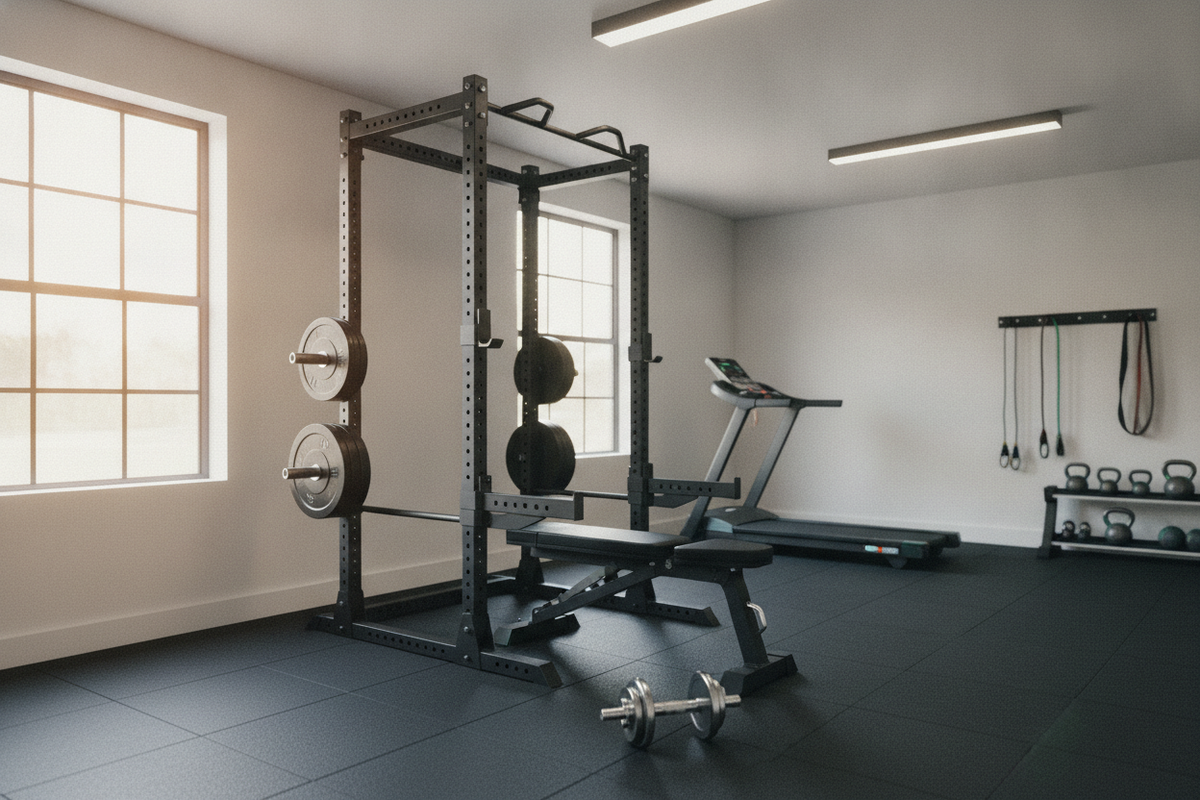
Hardwood, laminate, and tile flooring are susceptible to cracking and scratching when exposed to repeated free weight use. Even controlled set-downs can transmit vibration into residential subfloors. Dedicated high-density rubber or foam flooring acts as a protective barrier, absorbing surface contact and reducing acoustic resonance throughout the living space.
High-Traction Mat Setup for Multi-Planar Stability and Knee Cushioning
Executing multi-directional lunges and floor-based dumbbell presses requires a stable, high-density surface such as a dedicated exercise workout product that prevents shifting underfoot. Textured surfaces offer firm traction that prevents slipping during wide-stance squats and dynamic split steps. In addition, balanced mat density provides joint cushioning during kneeling movements like half-kneeling presses and quadrupeds without causing unstable sinking under heavy loads.
Equipment Staging and Mat Care for Long-Term Home Training
Maintaining a clean, organized workout perimeter enhances safety and efficiency. Store dumbbells neatly on designated racks or perimeter mats to avoid tripping hazards between working sets. Routinely cleaning your protective mat surface with mild soap and water removes sweat and dust buildup, preserving its grip and material integrity over time. If you plan to expand your home strength station beyond free weights to include cable or rack stations, review the weight lifting collection for integrated layout options.