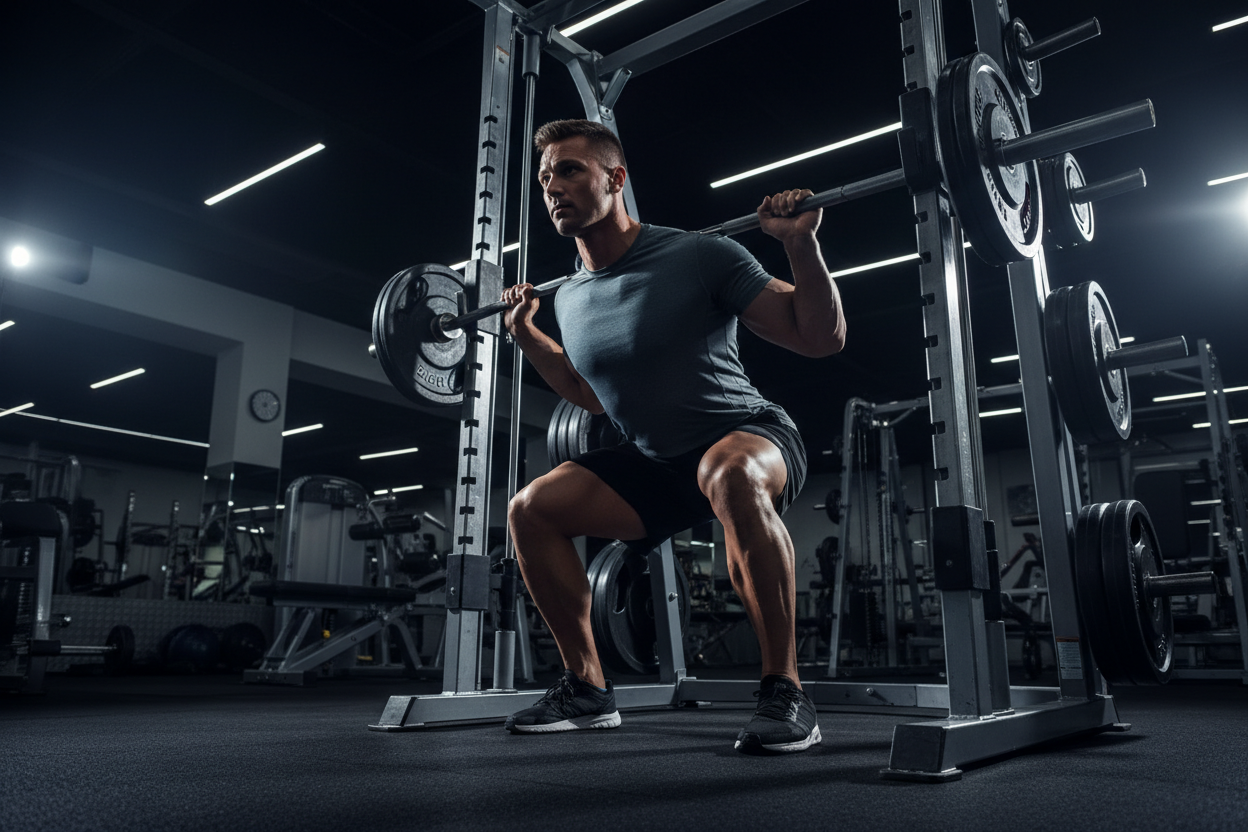
Do Smith Machines Make Lifting Easier? The Biomechanical Truth
Walk into any commercial gym, and you will eventually hear the whispers. Someone sets a personal record on the bench press or squat, and a purist from the corner mutters, "It doesn't count; it was on the Smith." This creates a massive confusion for beginners and intermediates alike. Do smith machines make lifting easier, or are they just a different tool for a different job?
The answer isn't a simple yes or no. It depends entirely on your definition of "easier." Are we talking about balance? Yes. Are we talking about muscle activation? That is where things get complicated. Let's break down the mechanics, the physics, and the reality of fixed-plane training.
Key Takeaways: The Short Answer
- Stability is Outsourced: The machine handles the balance, meaning your stabilizer muscles work less, making the movement feel more controlled.
- Force Output Increases: Because you don't waste energy stabilizing the load, you can often push more raw weight on a Smith machine.
- Bar Weight Varies: Unlike a standard 45lb Olympic bar, Smith machine bars often have counterweights, making the starting weight significantly lighter (sometimes as low as 15lbs).
- Fixed Path Friction: The guide rails introduce friction, which can actually make the concentric (lifting) portion feel slightly harder or "gritty" compared to free weights.
The Stability Factor: Why You Can Lift More
The primary reason people ask can you lift more on a smith machine is because they usually find they can add an extra 10 to 20 pounds to their squat or bench press immediately. This isn't magic; it is biomechanics.
When you use free weights, a significant portion of your neural energy and muscular effort goes into keeping the bar in the correct path. You are fighting gravity vertically, but also fighting lateral movement horizontally. The Smith machine eliminates that lateral fight.
The "Energy Leak" Concept
Think of free weights like driving a car on an icy road. You have to drive slower and more carefully to stay in the lane. The Smith machine is like a train on tracks. You can go full throttle (maximum force output) without worrying about steering. This allows the prime movers—like the pecs in a bench press or quads in a squat—to handle a heavier load because the stabilizers are taking a break.
The Biomechanical Trade-Off
While the machine stabilizes the weight for you, it also forces your body into a fixed, vertical path. This is unnatural for most human movements.
Take the bench press, for example. A natural barbell bench press travels in a slight "J" curve—starting over the shoulders, touching the lower chest, and pressing back toward the shoulders. The Smith machine forces a straight line. This can put unnatural stress on the shoulder joints if you don't set up perfectly, potentially making the lift feel mechanically awkward, even if the weight feels lighter.
How Much Does Smith Machine Help With Weight?
If you are trying to calculate your max, you are likely wondering how much does smith machine help regarding the numbers on the plates. There are two variables here:
1. The Counterbalance
This is the biggest trap for ego lifters. A standard Olympic barbell weighs 45lbs (20kg). A Smith machine bar often has a cable and pulley system acting as a counterweight. This can reduce the bar's actual weight to anywhere between 15lbs and 25lbs. If you load two 45lb plates on a Smith machine, you might be lifting 105lbs total, whereas on a free bar, that same setup is 135lbs.
2. The Friction Drag
It is not all easier, though. The linear bearings on the guide rods create friction. On the eccentric (lowering) phase, the machine might help you slightly by slowing the weight down. However, on the concentric (pushing) phase, you have to overcome that friction. On poorly maintained machines, this drag can make the weight feel heavier than it actually is.
My Training Log: Real Talk
I want to step away from the science for a second and talk about actual gym reality. A few years ago, I tweaked my lower back doing barbell squats. My stabilizers were shot, but my quads still needed work. I switched to Smith machine squats for six weeks.
Here is what the textbooks don't tell you: The lock-in anxiety. When I unracked the Smith bar, the first thing I noticed wasn't that it was "easier," but that I felt trapped. With a free bar, I can dump it backward if I fail. With the Smith, I had to rely entirely on the safety stoppers.
I also vividly remember the lack of "whip." A heavy free weight bar has a slight bend and bounce (whip) that you can use to your advantage out of the hole. The Smith bar felt dead. It was rigid. While I could load more weight because I wasn't wobbling, the movement felt lifeless and grinding. I actually got more sore in my quads because I could place my feet further forward (impossible with free weights) and target the muscle directly, but my core strength plummeted when I eventually went back to the rack.
Conclusion
So, do Smith machines make lifting easier? They make balancing the weight easier, which allows you to lift heavier loads and isolate specific muscles more effectively. However, they do not make the work easier. You are still moving mass against gravity. Use the Smith machine as a tool for hypertrophy (muscle growth) or rehabilitation, but don't expect your Smith machine max to translate perfectly to a free weight max.
Frequently Asked Questions
Is a 225lb bench on a Smith machine the same as free weights?
Generally, no. Due to the stability assistance and the potentially lighter starting weight of the bar, a 225lb lift on a Smith machine is usually easier than 225lbs with a free barbell. Most lifters find they can lift 10-15% more on the machine.
Does the Smith machine kill gains?
Not at all. In fact, for hypertrophy (muscle growth), the Smith machine can be superior. Because you don't have to balance the weight, you can take the target muscle closer to true failure safely, which is a primary driver of growth.
Why do bodybuilders use the Smith machine so much?
Bodybuilders prioritize muscle isolation over functional movement patterns. The Smith machine allows them to place their feet in positions that would be impossible with free weights (like narrow stance squats) to specifically target the teardrop of the quad or the upper chest without worrying about falling over.