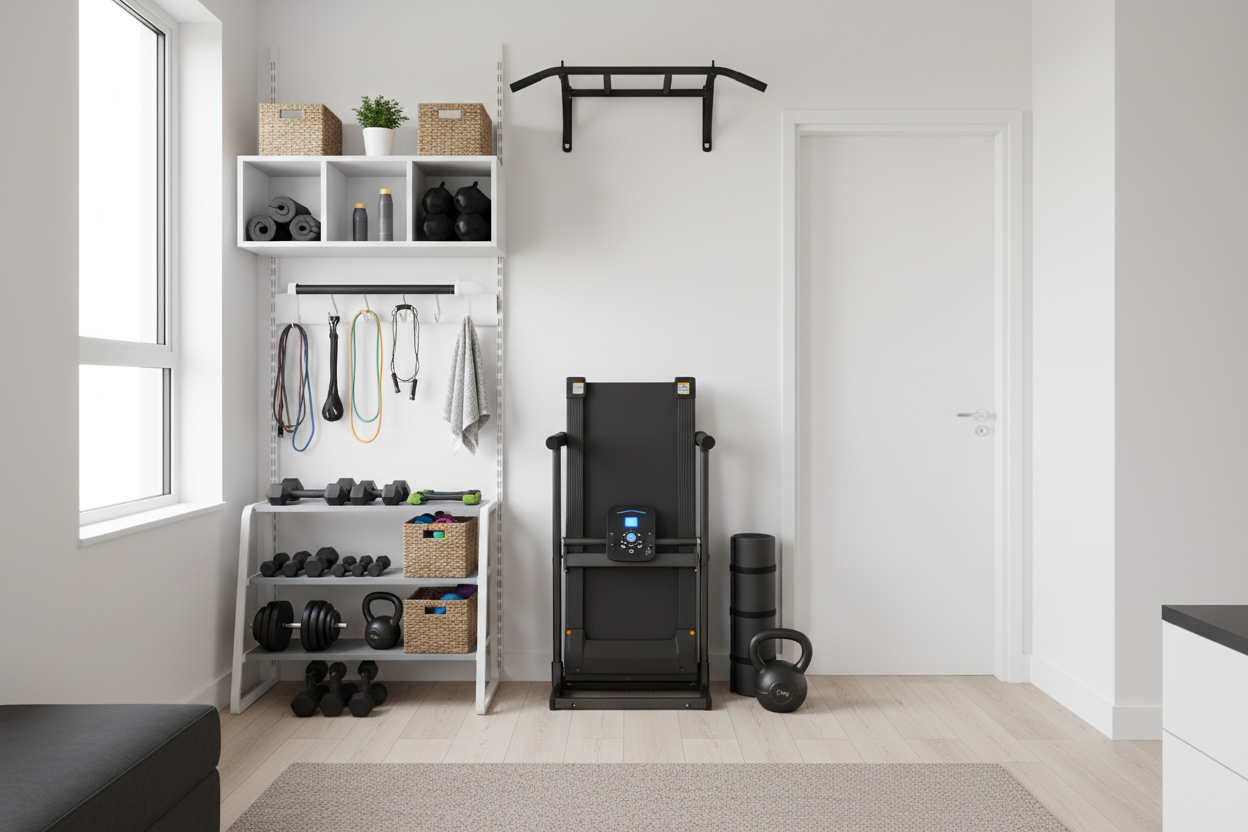
Ditch the Gym: How to Build Powerful Legs in Your Living Room
You do not need a squat rack, a leg press machine, or a monthly membership fee to build a lower body that is both strong and athletic. Many people fall into the trap of thinking that without heavy iron, their progress will stall. That is simply not true. Your muscles understand tension, not location. If you can generate enough fatigue and mechanical tension in your living room, your legs will grow.
The secret to effective legs strength training at home lies in manipulation. Since you might not have hundreds of pounds of external load, you have to manipulate leverage, tempo, and rest times to force adaptation. By shifting the focus to single-leg movements and increasing the time your muscles spend under tension, you can simulate the intensity of a heavy gym session with little to no equipment.
My Realization: The Backpack Epiphany
I spent years convinced that unless I had a barbell across my back, I wasn't really training. Then came a period where I couldn't get to the gym for three months due to travel and work constraints. I was terrified of losing my strength. I started experimenting with high-volume calisthenics and loaded a sturdy backpack with water bottles and textbooks.
The first time I tried a slow-tempo Bulgarian split squat with that backpack, my legs were shaking uncontrollably by the eighth rep. I woke up the next day with a level of soreness I hadn't felt in years. That experience humbled me. It taught me that gravity is a harsh mistress if you know how to use it against yourself. It wasn't about how much weight I could move, but how effectively I could make a light weight feel heavy.
The Mechanics of Good Home Leg Exercises
To construct a routine that works, we need to categorize movements. Aimlessly doing air squats will eventually become cardio rather than strength training. You need exercises that challenge the quads, hamstrings, and glutes through a full range of motion.
The Unilateral Advantage
If you take away one thing from this guide, let it be this: single-leg (unilateral) training is the king of home workouts. When you stand on two legs, your bodyweight is distributed. When you stand on one, the load instantly doubles relative to the working limb, and your stabilizers have to work overtime.
The Bulgarian Split Squat stands at the top of the list for good home leg exercises. Place your rear foot on a couch or chair, step forward, and lower your hips until your back knee hovers an inch off the floor. Keep your torso upright to target the quads or lean forward slightly to bias the glutes. This movement exposes imbalances and builds raw strength without compressing your spine.
Posterior Chain Power
Most home routines neglect the hamstrings, leading to knee issues and poor posture. The Single-Leg Romanian Deadlift (RDL) is your solution. Stand on one leg, keep a slight bend in the knee, and hinge at the hips, reaching toward the ground while kicking your other leg back. You should feel a deep stretch in the hamstring of the standing leg. If balance is an issue, hold onto a wall lightly. This movement is crucial for legs strength training at home because it solidifies the connection between your back, glutes, and hamstrings.
The Squat Variation You Need
Standard air squats are fine for warming up, but for growth, you need the 1.5 Rep Squat. Lower yourself into a full squat, come up halfway, drop back down to the bottom, and then stand up fully. That counts as one rep. This technique increases the time under tension and forces your quads to work harder in the most difficult part of the movement. It turns a basic exercise into a grueling test of endurance and strength.
Structuring Good Home Leg Workouts
Random effort gives random results. To see changes, you need a structure that allows for progressive overload. You can't just add 5 pounds to the bar every week, so you must add reps, reduce rest, or slow down the movement.
Here is a blueprint for leg workouts you can do at home that covers all the bases. Perform this routine twice a week with at least two days of rest in between.
- Warm-up: 3 minutes of jumping jacks or high knees to get blood flowing.
- Bulgarian Split Squats: 3 sets of 8-12 reps per leg. (Progression: Add a backpack with weight or slow the descent to 3 seconds).
- Single-Leg Glute Bridges: 3 sets of 15 reps per leg. Squeeze hard at the top for a full second.
- 1.5 Rep Squats: 3 sets of 15-20 reps. Keep the rhythm steady; do not rush the "half" rep.
- Sliding Hamstring Curls: 3 sets of 10-12 reps. Lie on your back on a smooth floor with your heels on a towel (or wearing socks). Bridge your hips up and slide your heels out and back in. This creates massive tension in the hamstrings.
- Calf Raises: 4 sets of 20 reps. Do these on a step or a thick book to get a full stretch at the bottom.
Advanced Techniques for Home Gains
Once the routine above becomes manageable, do not just do more reps. That is the path to boredom. Instead, intensify the contractions.
Pause reps are a phenomenal tool. During your squats or lunges, pause at the very bottom of the movement for a count of two. This kills the stretch reflex—the elastic energy your muscles use to bounce back up. By eliminating momentum, your muscles have to generate force from a dead stop. This builds starting strength and muscle density.
Another method is the "rest-pause" set. On your final set of an exercise, go until you can't do another rep with good form. Rest for 15 seconds, then try to squeeze out 3 to 5 more reps. Rest 15 seconds again, and try for another 2 to 3. This fully exhausts the muscle fibers and signals the body that it needs to grow stronger to handle this stress.
Consistency Wins
The beauty of good home leg workouts is their accessibility. You can train while dinner is in the oven or while watching your favorite show. The barrier to entry is low, but the ceiling for effort is high. If you attack these movements with the same focus you would bring to a heavy barbell session, the results will follow.
Building legs requires grit. It burns. Your heart rate will spike, and you will want to quit halfway through a set of split squats. Push through that feeling. That discomfort is where the change happens. With consistent effort and smart programming, you can build a set of legs that look like they were forged in a squat rack, right from the comfort of your own home.
Frequently Asked Questions
Can I really build muscle size without heavy weights?
Yes, muscle growth (hypertrophy) occurs when you fatigue the muscle fibers and apply tension. By using high reps, slow tempos, and unilateral exercises, you can create enough metabolic stress and mechanical tension to stimulate growth, even with just bodyweight.
How often should I do leg workouts at home?
For most people, training legs 2 to 3 times per week is ideal. Since home workouts often cause less systemic fatigue and joint stress than heavy barbell lifting, you can typically recover faster and train them more frequently.
What if my knees hurt during lunges?
Knee pain often stems from poor hip stability or the knee caving inward. Try stepping backward into a reverse lunge instead of forward, as this is generally easier on the knees. Focus on keeping your weight in the heel of your front foot and engaging your glutes.