Daily Routine Exercise at Home: The Submaximal Strategy
Most of my clients come to me exhausted. They try to squeeze a 60-minute, high-intensity sweat session into a cramped apartment living room at 6 AM. They end up waking the kids, feeling sore for days, and completely abandoning the plan by Wednesday. I tell them to stop treating their living room like a hardcore bootcamp. A sustainable daily routine exercise at home does not require leaving a pool of sweat on the floor every single morning. Instead, I teach them a concept that completely changes how they view fitness: submaximal neural training. By breaking your movement into a home exercise daily routine that feels almost too easy, you build incredible strength and consistency without the dreaded burnout.
Quick Takeaways
- Submaximal training means stopping at 50 percent of your maximum effort to avoid central nervous system fatigue.
- Spreading your volume throughout the day creates an everyday home workout you can stick to long-term.
- Leaving your equipment out in plain sight acts as a visual trigger for quick exercise workouts.
- You do not need traditional rest days when your daily workout in home stays below your failure threshold.
The Flaw in Traditional Daily Workouts
When people decide to get in shape, they usually adopt an all-or-nothing mindset. They search for an everyday workout routine at home and stumble upon programs designed to push them to absolute muscle failure. Here is the physiological problem with that approach: training to failure causes significant micro-tears in the muscle tissue and heavily taxes your central nervous system. Your body physically requires 48 to 72 hours to rebuild those tissues. If you try to do that seven days a week, you are not building fitness; you are digging a massive recovery hole. You will feel sluggish, your joints will ache, and your motivation will tank.
Instead of forcing a grueling hour-long session, I program little workouts to do at home for my clients. The goal of daily exercise home programming is consistency, not destruction. Think of your body like a battery. If you drain it to zero every day, it takes a long time to recharge. If you only drain it by 10 or 20 percent, it recharges almost instantly. This is why a quick exercise routine works so well for busy professionals and parents. You get the blood flowing, you stimulate the muscle, and you move on with your day. By stepping away from the heavy-fatigue mentality, you open the door to a daily simple exercise routine that actually leaves you with more energy than you started with.
What is Submaximal Neural Training?
Submaximal neural training is often referred to in strength and conditioning circles as greasing the groove. The concept is straightforward: strength is a skill, and like any skill, it requires frequent practice. When you perform an easy daily exercise at half of your maximum capacity, you are teaching your nervous system how to fire those specific muscle fibers efficiently. You are building the neural pathways without accumulating the physical fatigue that demands days of rest.
Let's say your absolute maximum number of perfect push-ups is ten. In a traditional workout, you might do three sets of eight, struggling through the last few reps and feeling sore the next day. In a submaximal quick easy workout, you would only do sets of four or five push-ups. Because you are only operating at 50 percent effort, you can do a set of five at 9 AM, another at noon, and another at 4 PM. By the end of the day, you have accumulated 15 perfect reps with zero fatigue. Over a week, that volume dwarfs what you would accomplish in a single, exhausting session.
This method turns fitness into a quick and easy exercise habit rather than a daunting chore. It is the ultimate everyday home workout because it eliminates the mental friction of gearing up for a massive sweat session. You do not need to change into gym clothes, mix a pre-workout drink, or block out an hour on your calendar. You just drop down, perform your quick exercise workouts with perfect form, and get back to your life. This approach is highly effective for bodyweight movements like pull-ups, squats, and push-ups, making it the perfect foundation for a daily simple workout routine.
Designing Your Daily Routine Exercise at Home
To make this work, you have to structure your daily simple workout routine around environmental triggers. Rather than doing all your sets at once, you scatter them throughout your waking hours. This requires removing as much friction as possible from your environment. If your weights are buried in a closet or your mat is rolled up under the bed, you simply will not do the work.
I always instruct my online clients to carve out a permanent, dedicated space, even if it is just a small corner of the office. Leaving a large exercise mat for home gym out on the floor is one of the most effective psychological hacks I have found. When you walk past it, it serves as a visual cue to drop down and do a quick set of core work or mobility drills. It transforms your environment from a place of passive resting to a space that encourages spontaneous movement.
Your daily routine exercise at home should be divided into distinct phases based on your schedule. I like to use an anchor habit in the morning to set the tone, followed by strength triggers during the workday. This ensures you are accumulating volume steadily. The beauty of simple everyday workouts is their flexibility. If you miss a mid-day trigger because of a long meeting, you just pick it up later. There is no ruined workout, only delayed reps.
The Morning Mobility Anchor
Your morning routine should take no longer than five minutes. The goal here is not to build muscle, but to lubricate the joints and wake up the central nervous system after eight hours of lying still. I usually prescribe a sequence of cat-cows, hip 90/90s, and thoracic rotations.
If you are stiff from sleeping, doing a dedicated stretching workout at home right when you wake up is the best quick workout to start your day. Keep the breathing slow and nasal. This morning anchor signals to your brain that it is time to move, setting a positive physical tone for the rest of your quick daily exercise triggers.
The Mid-Day Strength Trigger
This is where the actual strength work happens. Pick two exercises, for example, doorway pull-ups and bodyweight squats. Every time you get up to refill your water bottle or use the restroom, perform a submaximal set.
If your max is 20 squats, do 10. If your max is 4 pull-ups, do 2. These act as a quick everyday workout that breaks up the monotony of sitting at a desk. Because the effort is low, you will not sweat through your work clothes, making this an ideal easy daily workout for people working from home.
Essential Gear for an Everyday Home Workout
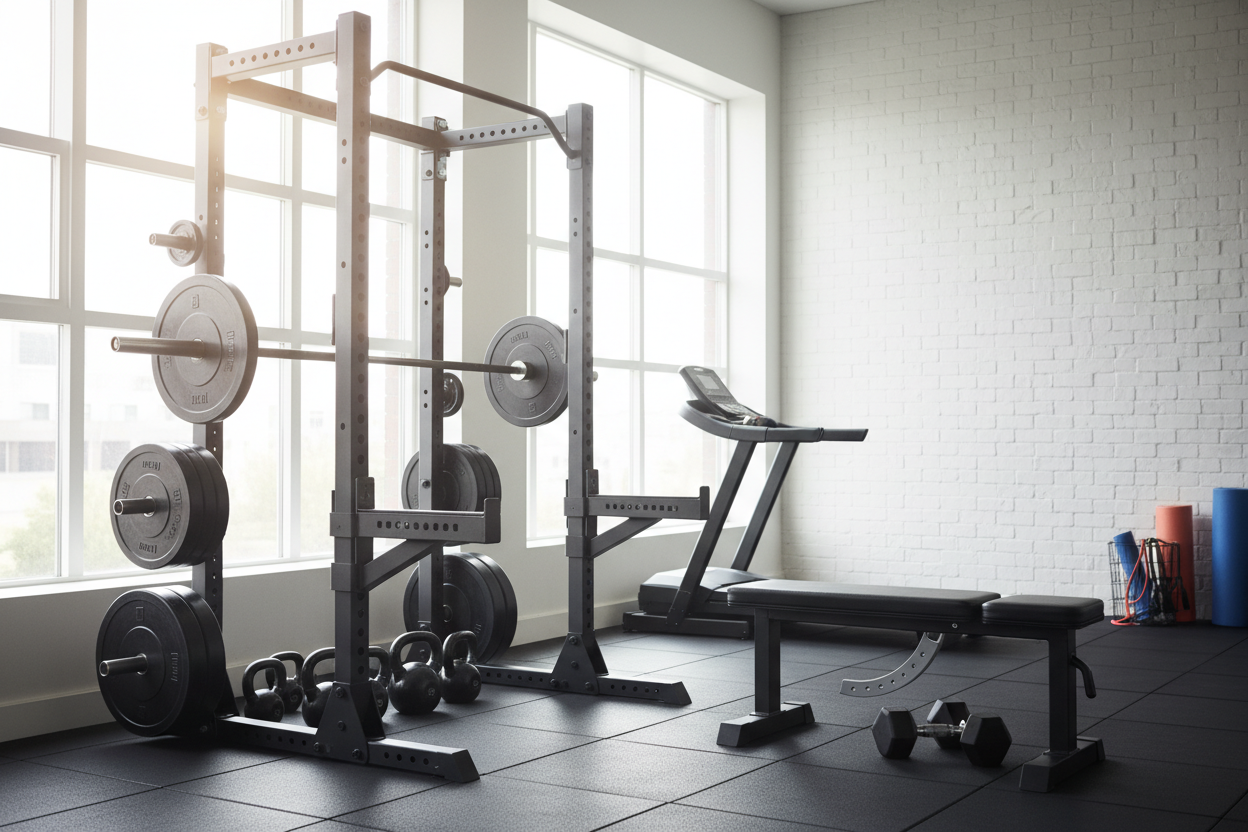
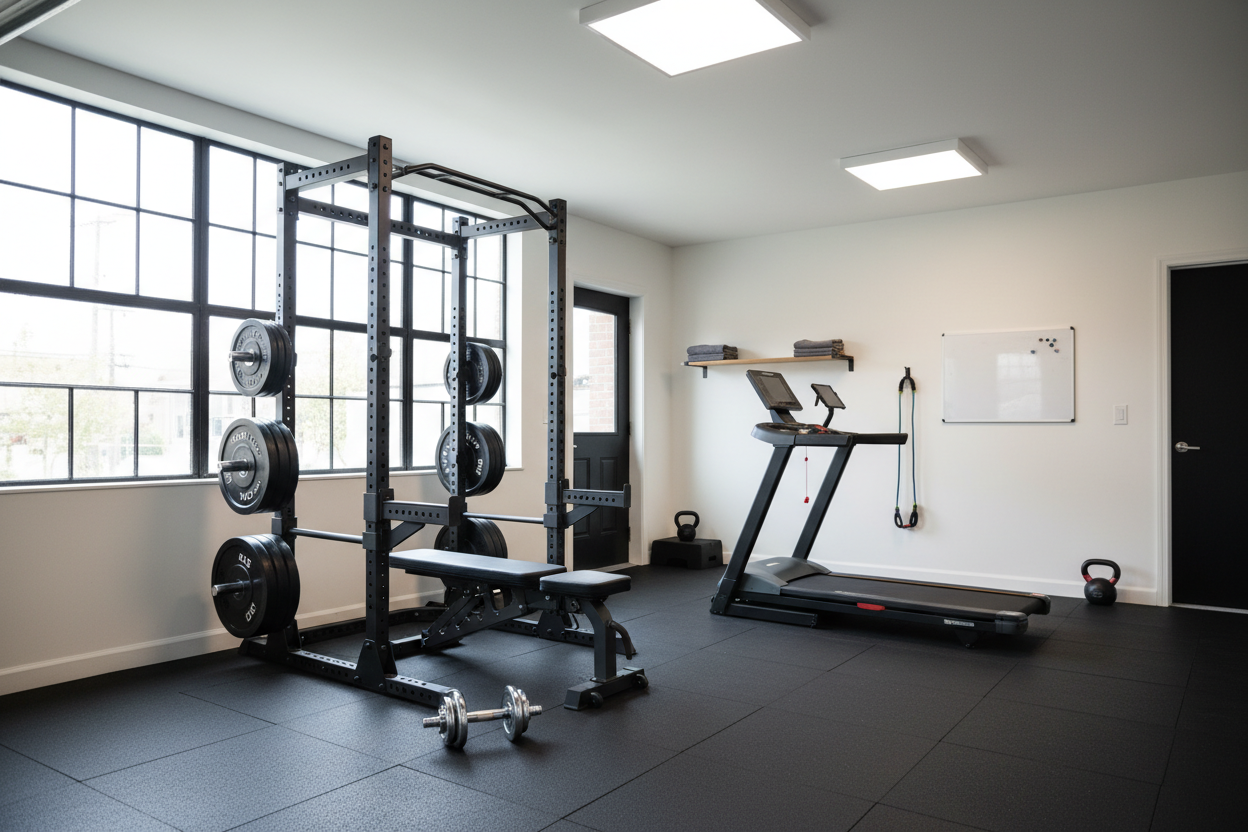
One of the biggest misconceptions about building a fast daily workout habit is that you need a garage full of expensive commercial equipment. You actually need very little to execute a highly effective short workout at home. Comfort and accessibility are far more important than heavy iron when you are doing submaximal training.
I have tested dozens of home gym setups for clients over the years. In my own living room, I keep things incredibly minimal: a doorway pull-up bar, a single 35-pound kettlebell, and a dedicated 6x4 foot floor space. I personally use proper gym flooring for home workout because it provides the exact right amount of density to absorb the impact of setting a kettlebell down, while giving me excellent grip for barefoot squats. Having a permanent, comfortable surface removes the friction of having to drag out a flimsy yoga mat every time I want to knock out some push-ups.
I will be honest about one downside I experienced: if you have cats, they might view a premium high-density foam mat as a giant scratching post. I learned that the hard way and now throw a light blanket over it at night. But that minor inconvenience is worth it. Having your gear permanently deployed is the absolute key to maintaining a daily quick workout schedule.
Scaling Your Quick Daily Exercise Schedule
The magic of submaximal training lies in the cumulative volume, but you still need to apply progressive overload to keep seeing results. The trick is to increase the volume without increasing the perceived effort of your fast daily workout. You scale up slowly.
If you spent week one doing sets of five push-ups, week two should be sets of six. The effort should still feel like a 5 out of 10. You are simply expanding your capacity. Over a few months, your maximum number of reps will naturally increase, which means your 50 percent submaximal threshold increases as well. Your easy daily exercise naturally evolves into a more robust routine without ever feeling overly taxing.
Once your bodyweight adaptations begin to plateau, you can start adding external resistance. Eventually, many of my clients look into the best at home exercise machines to incorporate light, high-rep accessory work like hamstring curls or cable rows into their home exercise daily routine. The principle remains exactly the same: keep the effort at 50 percent, do it frequently, and let the cumulative volume do the heavy lifting.
Frequently Asked Questions
Will I actually build muscle doing submaximal workouts?
Yes. Muscle growth is primarily driven by total weekly volume and mechanical tension. By doing multiple submaximal sets every day, your weekly volume often exceeds what you would achieve in a single heavy workout, leading to excellent strength and hypertrophy gains.
How many times a day should I do these mini-workouts?
Aim for 3 to 5 mini-sessions scattered throughout the day. This provides enough frequency to grease the neural groove without interrupting your daily schedule or causing fatigue.
Do I need rest days with this routine?
Generally, no. Because you are strictly keeping your effort at 50 to 60 percent of your maximum capacity, your central nervous system does not require traditional 48-hour recovery windows. However, if you feel unusually sluggish, take a day off to focus purely on mobility.