Can You Build Muscle Using Machines? The Science-Based Truth
Walk into any hardcore gym, and you will inevitably hear the rumors echoing from the squat rack. The old-school mentality dictates that barbells are for building mass, while machines are merely for polishing or rehabilitation. This dogma has held many lifters back from reaching their full potential.
The reality of hypertrophy is far more nuanced than "free weights good, machines bad." If you are asking, can you build muscle using machines, the short answer is a resounding yes. In fact, for certain goals and body types, they might actually be superior to their iron counterparts. Let’s break down the physiology, the mechanics, and the practical application of machine-based training.
Key Takeaways
- Mechanical Tension is King: Your muscles do not have eyes; they cannot see if you are holding a barbell or pushing a lever. They only sense tension.
- Stability Equals Output: Machines provide external stability, allowing you to focus 100% of your effort on the target muscle rather than balancing the weight.
- Safety at Failure: You can push closer to true muscular failure on machines without the risk of injury associated with failing a squat or bench press.
- Volume Capability: It is easier to perform drop sets and high-volume work on machines, facilitating metabolic stress.
The Science of Stability and Hypertrophy
To understand why machines work, you have to understand what makes a muscle grow. Hypertrophy is primarily driven by mechanical tension. The more force a muscle can generate and sustain, the more growth signal it receives.
Here is the critical factor many ignore: Stability.
When you perform a barbell squat, a significant amount of your neurological energy goes toward balance and coordination. You are stabilizing your core, your hips, and your ankles. When you use a Hack Squat or Leg Press, that stability is provided by the machine.
This allows for greater motor unit recruitment in the target muscle. Because your brain isn't worried about falling over, it allows you to drive closer to true failure with the prime movers (the quads or glutes). Essentially, machines allow you to isolate the muscle from the skill of the movement.
Can You Build Muscle With Just Machines?
A common LSI question we get is: can you build muscle with just machines? If you have no access to dumbbells or barbells, are you doomed to stay small?
Not at all. A machine-only program can build an impressive physique. However, you must understand the trade-offs.
The Pros of Machine-Only Training
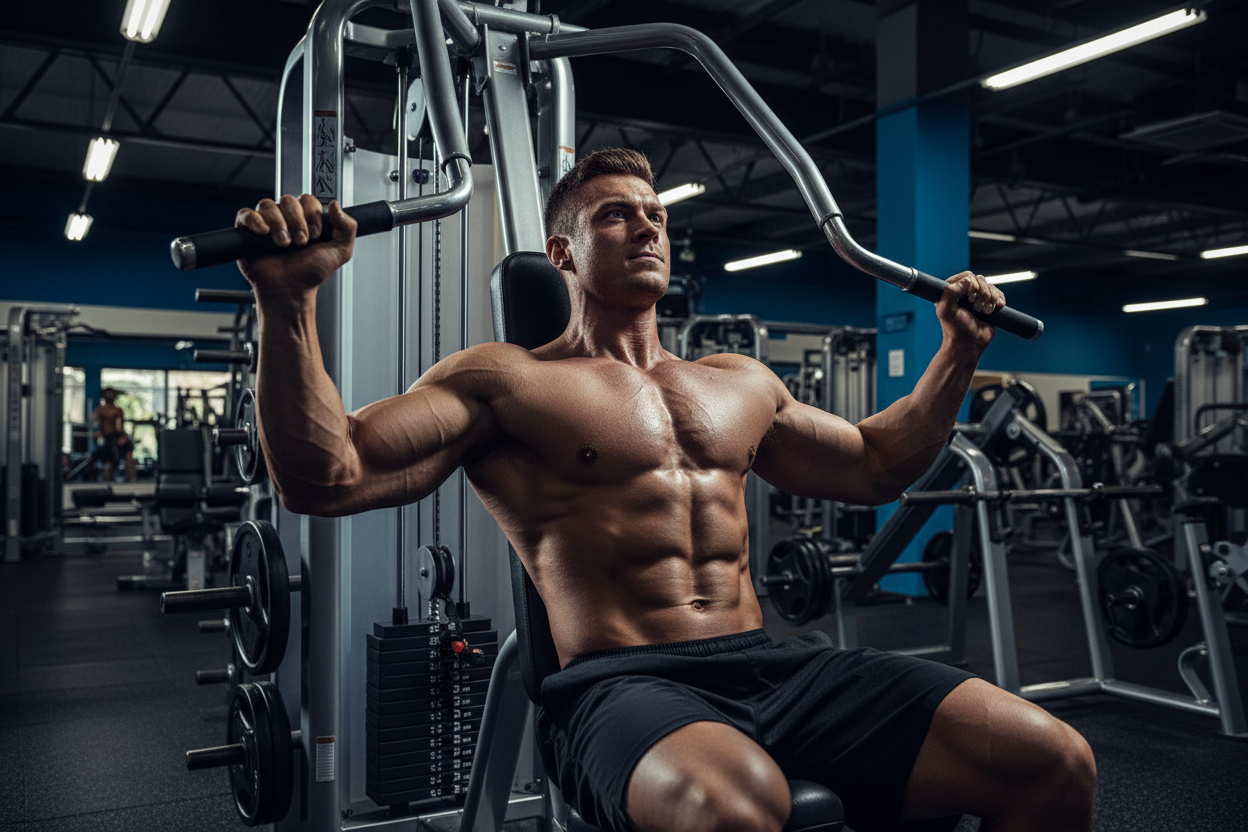
Machine-only training is highly time-efficient. You spend less time loading plates and setting up racks. It is also exceptionally good for bringing up lagging body parts. If your chest is weak but your triceps are strong, a chest press machine allows you to pre-exhaust the pecs safely, something that is risky to do with a heavy barbell bench press.
The Cons to Watch Out For
The main drawback is the neglect of stabilizer muscles. Machines dictate the path of motion for you. Over time, if you never engage your core or stabilizers, you may find yourself with plenty of "show" muscle but lacking functional stability when lifting heavy objects in the real world. If you are training strictly for aesthetics (bodybuilding), this matters less. If you are training for athletics, you need to supplement with free motion.
Optimizing Machine Training for Growth
Simply sitting in a machine and moving the pin up and down won't cut it. Because machines remove the stability requirement, it is easy to go through the motions without intensity. To combat this, you need to apply specific intensity techniques.
Control the Eccentric
Machines often have less friction on the way down. Do not let the weight stack slam. Control the negative portion of the rep for a 2-3 second count. This is where the most muscle damage occurs.
Utilize the Safety
Since you won't get crushed, use that to your advantage. On a machine press, when you hit failure, try to squeeze out partial reps or hold the weight in the stretched position for ten seconds. This intensity is terrifying with free weights but perfectly safe with machines.
My Training Log: Real Talk
Let's step away from the studies for a second. I want to share a specific experience from my last hypertrophy block where I swapped free-weight squats for the pendulum squat machine.
I’ve always been a "squat or die" lifter. But my lower back was consistently frying before my quads actually fatigued. I switched to the pendulum squat for eight weeks.
The first thing I noticed wasn't the pump—it was the fearlessness. When you are under a heavy barbell, there is a psychological brake in your head that says, "Save a little energy to get back up." On the pendulum machine, that brake vanished. I could grind through reps that took 4 or 5 seconds to complete.
The specific feeling was different, too. With a barbell, the pressure is distributed across your traps and spine. On the machine, the shoulder pads locked me in so tight that the only sensation was a searing, almost acidic burn directly in the vastus lateralis (outer quad). I remember stumbling out of the machine, my legs feeling like jelly, realizing I had never actually taken my quads to absolute failure before because my lower back had always quit first. That cycle added more size to my legs than two years of traditional squatting.
Conclusion
So, can you build muscle using machines? The answer is not just yes; it is that you might be handicapping your growth by avoiding them. Machines offer stability, safety, and the ability to target specific fibers that free weights sometimes miss.
Don't fall for the dogmatic view that you have to suffer under a barbell to grow. Use the tools that allow you to apply the most tension to the muscle. Often, that tool is a machine.