Can Cardio Tone Your Body? How It Affects Muscle
A frequent question among home fitness enthusiasts revolves around body composition: can cardio tone your body on its own, or does true muscle definition require external iron? The casual concept of being toned usually describes possessing firm, noticeable musculature accompanied by a relatively low amount of overlying body fat. When people ask is cardio good for toning, they generally want to know whether cycling, running, jumping rope, or rowing can reshape their physique without requiring a room full of heavy barbells.
The biomechanical reality is nuanced. Cardiovascular training challenges the aerobic and anaerobic energy systems, but muscle tissue responds primarily to mechanical tension, metabolic stress, and volume. Understanding how different cardiovascular modalities stimulate or fail to stimulate structural muscle tissue helps clarify how to program these sessions alongside resistance work, while properly arranging the physical training environment to support dynamic movement.
Deconstructing "Tone": Muscle Structure, Energy Balance, and Movement
In standard exercise physiology, resting muscle tone refers to continuous, involuntary muscular contractions that sustain posture and readiness. In everyday consumer fitness conversations, however, muscle tone is shorthand for visible muscular contours. Achieving that physical appearance relies on two concurrent elements: developing or preserving underlying contractile tissue, and managing total body composition so that muscle outlines become visible beneath the skin.
Standard continuous cardio helps manage energy expenditure, which can assist in revealing existing muscle contours over time. However, passive or unresisted aerobic movement does not inherently force muscle tissue to adapt, grow, or firm up. If a conditioning modality lacks sufficient resistance, the body adapts by becoming more metabolically efficient rather than building denser muscular fibers. To elicit meaningful muscular development, a movement must apply substantial mechanical tension across the working limbs.
Can Cardio Tone Your Body? Comparing Low-Tension vs. High-Tension Conditioning
Whether cardiovascular exercise contributes to muscular development depends largely on mechanical resistance and movement dynamics. Evaluating your routine through the lens of movement tension clarifies why some cardio options build visible leg or back structure while others simply burn energy.
- Low-Tension Steady-State Work: Activities like flat-surface walking, casual jogging, or unresisted stationary spinning feature minimal external load. They improve stamina and systemic conditioning, but they apply little localized strain to fast-twitch muscle fibers responsible for shape and firmness.
- High-Tension Resisted Conditioning: Movements involving incline sprinting, heavy-flywheel rowing, stair climbing, or weighted sled dragging require deliberate force output against continuous resistance. This higher force requirement challenges muscular motor units, encouraging functional firmness and regional development.
Therefore, cardio can contribute to a firmer physique when structured as high-tension work, but gentle continuous aerobic movement primarily serves cardiovascular endurance rather than muscle sculpting.
Lower-Body Engagement Across Common Cardio Modalities
The lower body carries the majority of workload in traditional cardio. Stationary bikes with magnetic resistance, stair climbers, and steep incline treadmills impose focused demands on the quadriceps, glutes, hamstrings, and calves. Stepping against gravity or pushing through heavy pedal resistance requires muscular drive that mimics moderate-load gym movements.
For those aiming to build firm lower extremities, consulting a targeted cardio toning guide can help map out interval structures that prioritize cadence resistance over passive duration. Adjusting the incline on a treadmill or dialing up resistance magnets converts a session from pure stamina work into an active muscular stimulus.
Upper-Body and Full-Body Hybrid Cardio Patterns
A primary shortcoming of conventional cardio is the absence of upper-body involvement. Jogging and upright cycling leave the back, shoulders, chest, and arms largely unengaged. When upper-body musculature remains unloaded, overall muscular balance suffers.
Full-body conditioning implements—such as air-resistance rowers, upper-body ergometers, and ski trainers—distribute mechanical effort across the posterior chain, lats, and arms. Integrating specialized tools detailed in a dedicated body cardio guide allows lifters and trainees to maintain elevated heart rates while actively recruiting the shoulder girdle and trunk muscles that standard treadmill sessions overlook.
Why Cardio Alone Often Falls Short for Comprehensive Muscle Toning
While high-tension conditioning activates muscle tissue, cardio alone rarely provides complete physique transformation. Progressive overload—the systematic increase of resistance over time—is fundamentally difficult to sustain through purely aerobic equipment. Eventually, cadence caps out, and increasing duration only yields excess systemic fatigue rather than new muscular firmness.
Furthermore, excessive volume of repetitive, non-resisted cardio can compromise muscle retention during an energy deficit. When the body faces prolonged aerobic demands without sufficient mechanical loading, it may shed metabolically demanding muscle tissue to conserve energy. Combining strategic conditioning with structured strength circuits, such as those found in a structured body toning guide, ensures that muscle tissues receive the robust mechanical signals necessary to remain dense, resilient, and distinct.
Home Gym Staging: Floor Stability, Impact Damping, and Equipment Anchoring
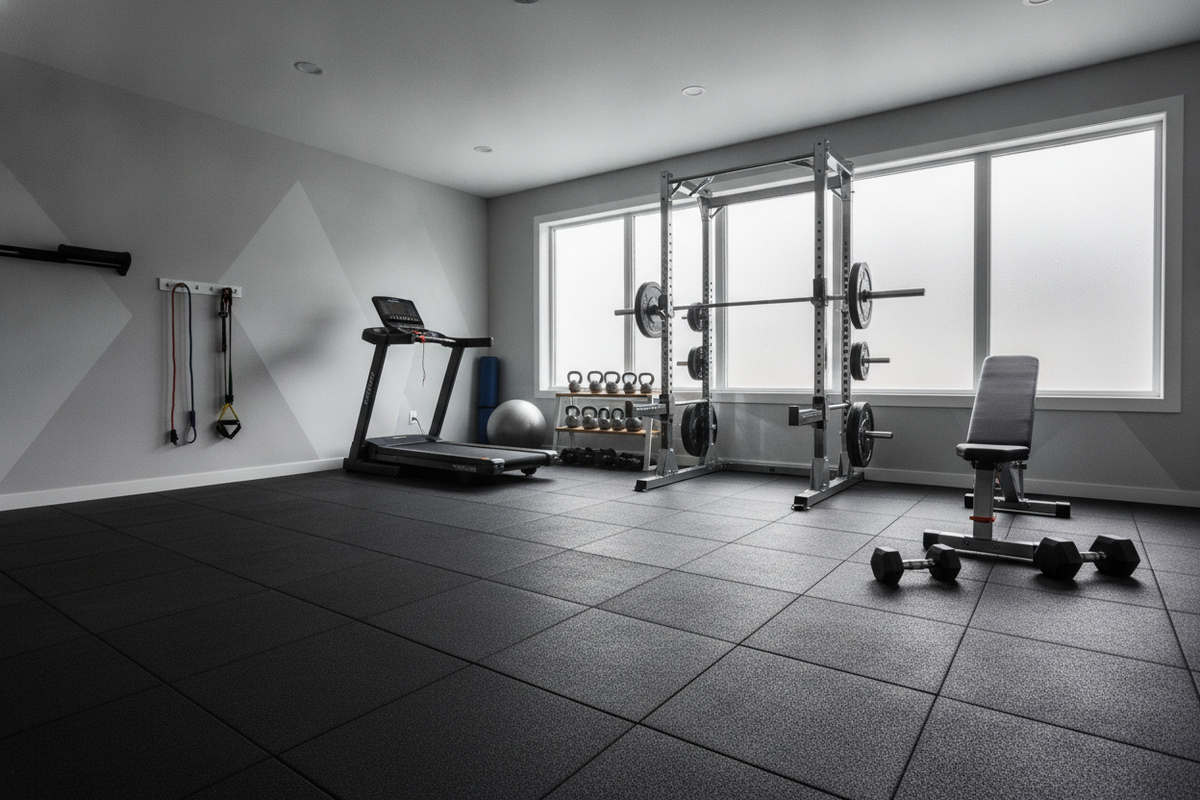
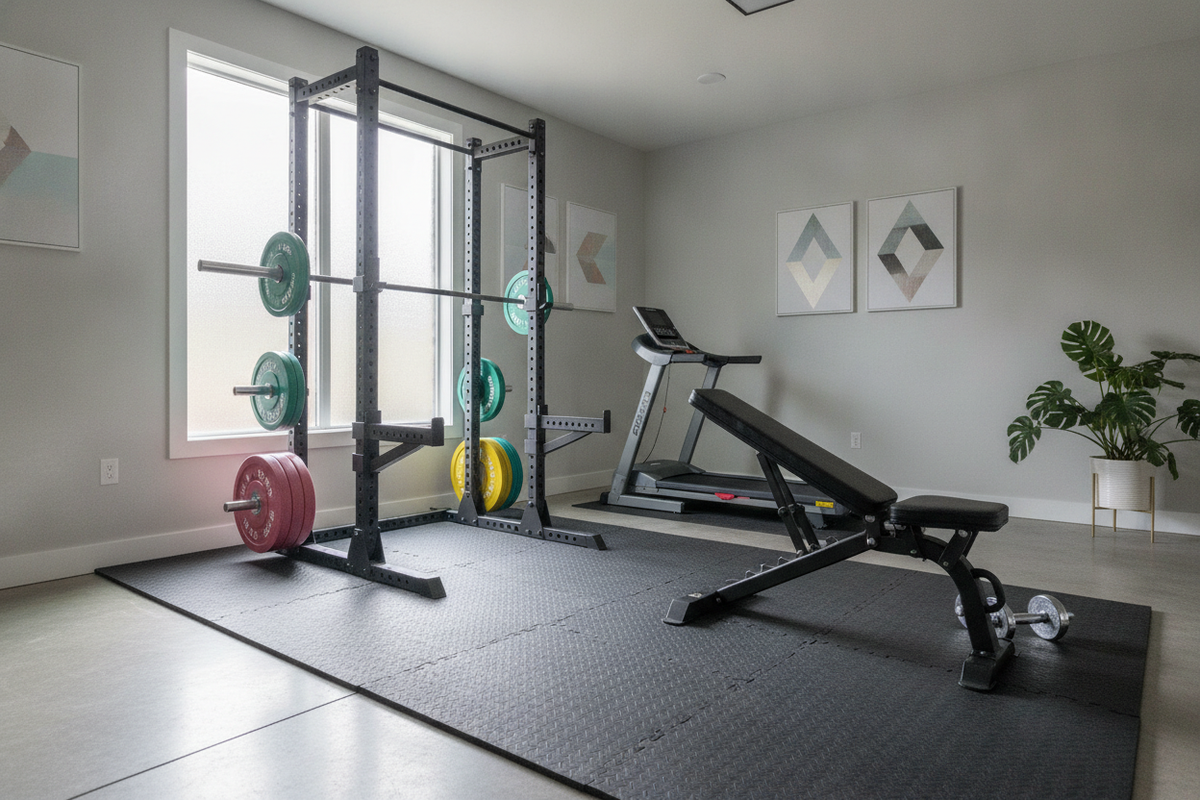
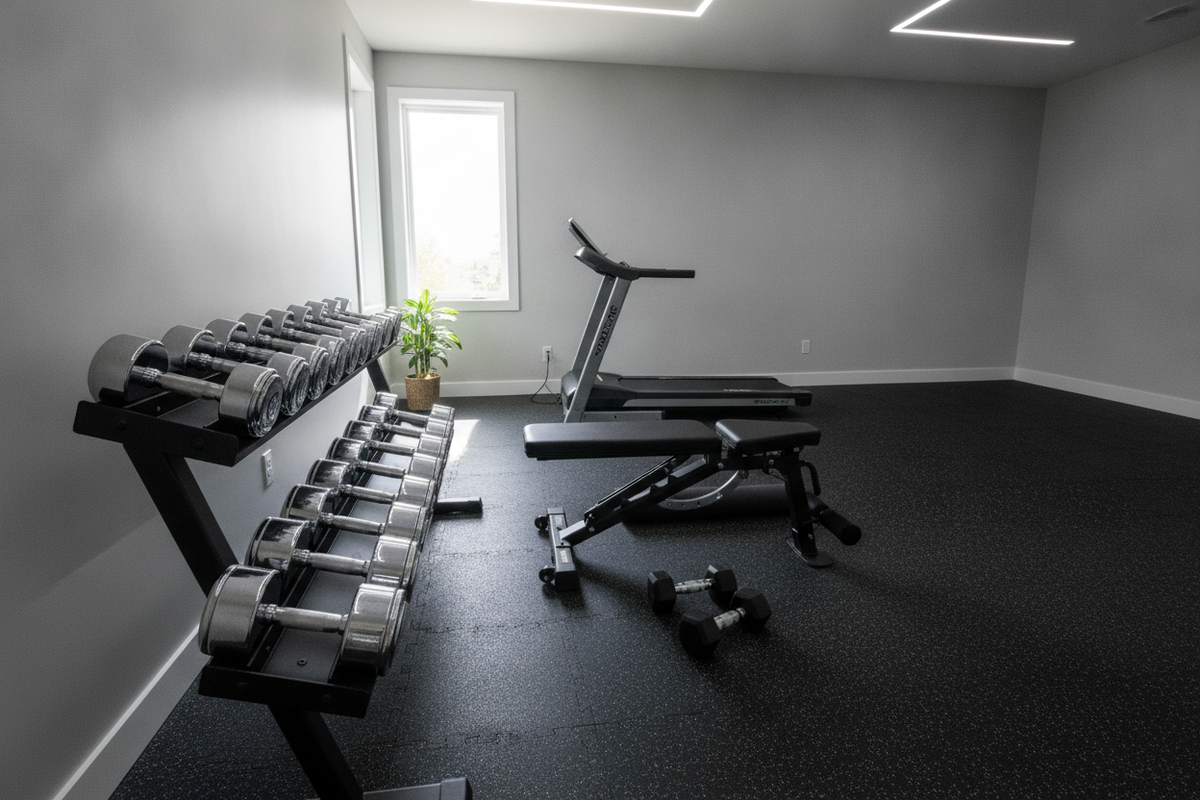
When incorporating dynamic conditioning, jump rope intervals, and cardio machines into a home workout space, the flooring surface becomes a critical piece of functional equipment. Dynamic conditioning exerts substantial vertical and lateral kinetic forces that standard residential floors are ill-equipped to handle.
In my editorial reviews of home training layouts, inadequate matting is the most frequent cause of premature equipment wear, annoying room vibrations, and joint discomfort during bodyweight cardio. A stable, dense workout floor serves three non-negotiable functions:
- Machine Anchoring and Floor Protection: High-output rowing, sprinting, or cycling introduces lateral torque. Without heavy rubber matting underneath, machines can creep across smooth surfaces, scratching underlying floorboards and altering mechanical alignment.
- Impact Damping and Subfloor Attenuation: Plyometric cardio, such as burpees, split jumps, and rope skipping, sends sharp shock waves into concrete or wood subfloors. High-density rubber mats dissipate point-load impact, buffering joints from harsh ground reactions and deadening airborne acoustics.
- Traction Under Perspiration: Dynamic interval conditioning produces moisture. Smooth vinyl or hardwood floors become hazardous slipping hazards under sweat. Dense, non-porous matting maintains surface grip under high-friction foot transitions, ensuring foot strike integrity.
Organizing a training area into distinct zones—anchoring stationary machines on rigid equipment mats while dedicating open floor space to dense, shock-absorbing rubber sheets—creates a versatile environment suited for both high-cadence intervals and floor-based conditioning.
Structuring a Balanced Home Conditioning Routine for Defined Results
To achieve a well-proportioned, firm aesthetic at home, cardiovascular work should complement—not replace—multi-joint resistance exercises. A successful routine integrates functional conditioning intervals alongside resistance movements that challenge the full range of human movement patterns: squatting, hinging, pressing, pulling, and rotating.
A well-balanced home template often alternates between compound resistance blocks and high-resistance conditioning finishers. For example, lower-body focused training days can blend targeted multi-planar exercises, detailed in a comprehensive tone body guide, with short bursts of high-incline intervals or jump-rope rounds.
Maintaining this training space requires regular surface care. High-intensity home conditioning leaves behind sweat, chalk dust, and shoe debris. Wiping dense rubber mats down with mild soap solutions keeps the traction layer clean, resists odor buildup, and preserves the floor's slip-resistant texture across months of demanding training sessions.