Cable Machine vs Smith Machine: The Ultimate Home Gym Choice
Building a home gym often means making tough compromises. Unless you have a massive two-car garage dedicated entirely to fitness, you probably don't have the floor space or budget for every piece of commercial equipment. When it comes down to maximizing your floor plan, the debate of cable machine vs smith machine is one of the most common crossroads our customers face.
Both machines are titans of strength training, but they serve drastically different purposes. One offers unparalleled versatility and constant tension, while the other provides a safe haven for heavy, barbell-style lifting without a spotter. In this guide, we'll break down exactly which machine deserves that coveted spot in your home gym based on your training style, space, and budget.
Key Takeaways
- Primary Focus: Smith machines excel at heavy compound movements (squats, presses), while cable machines are unmatched for isolation and functional training.
- Space Requirements: Cable machines (especially functional trainers) often require wider footprints, whereas Smith machines need deeper clearance for benches and plates.
- Safety: A Smith machine allows you to push to failure safely without a spotter thanks to its fixed bar path and safety catches.
- Versatility: If you want to train every single muscle group from multiple angles, the cable machine is the superior all-in-one tool.
Training Application: Versatility vs. Heavy Loads
The core difference between these two pieces of equipment lies in how they apply resistance to your muscles.
The Case for the Cable Machine
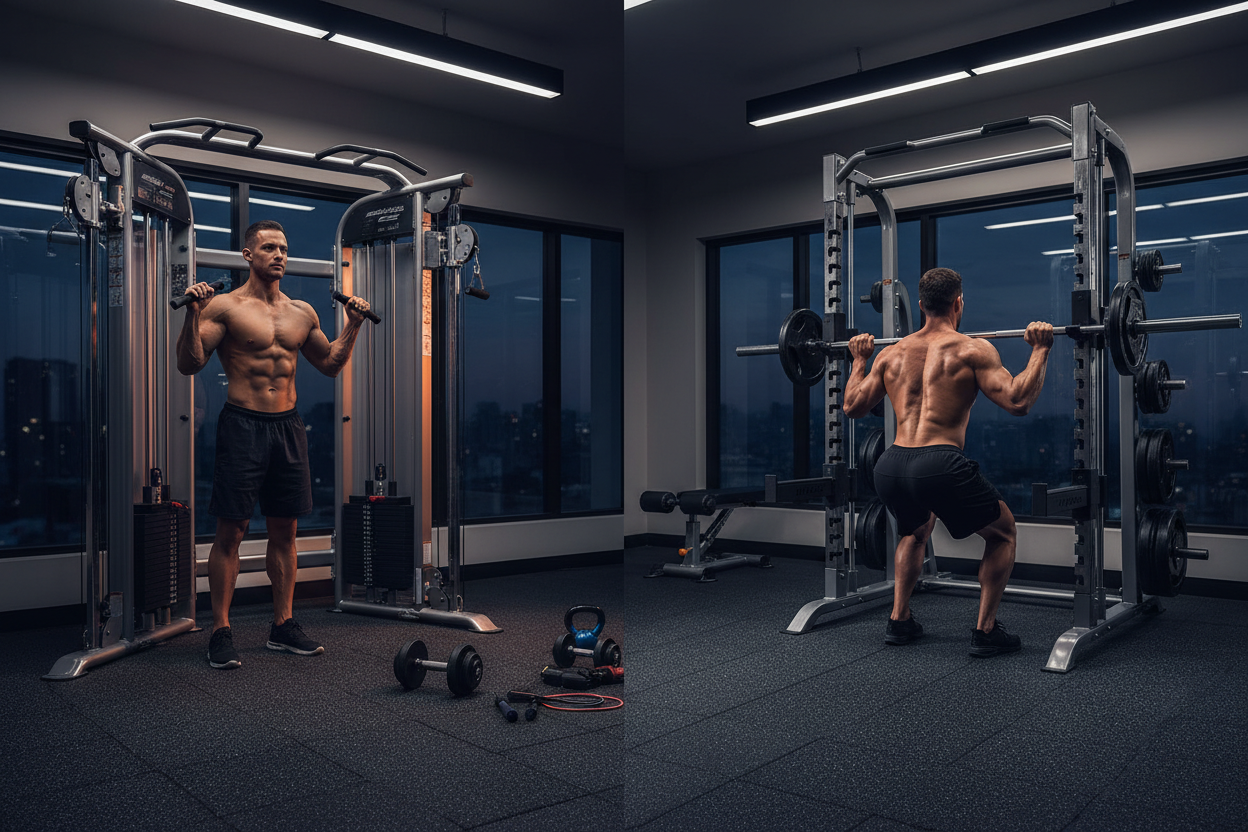
Cable machines provide constant tension throughout the entire range of motion. Because the resistance is driven by a pulley system, you aren't fighting gravity in a straight vertical line. This allows you to perform horizontal and diagonal movements—think woodchoppers, face pulls, and cable crossovers. If your goal is bodybuilding, hypertrophy, or athletic conditioning, a functional trainer is incredibly hard to beat.
The Case for the Smith Machine
If your training revolves around the 'Big Three' (squats, bench press, deadlifts) but you train alone, a Smith machine is your best friend. The fixed bar path stabilizes the weight for you, allowing you to focus purely on pushing maximum poundage. You can safely unrack and rerack the bar with a simple twist of the wrist, making it ideal for safely pushing your limits on heavy pressing movements.
Space Planning for North American Home Gyms
Most garage and basement setups in North America hover around 150 to 400 square feet. Choosing between a smith machine vs cable machine often comes down to your ceiling height and available width.
Footprint and Ceiling Clearance
Standard functional trainers (cable machines) tend to be wide. You'll need at least 60 to 72 inches of horizontal wall space, plus room to stand in the center. However, they can sit relatively flush against a wall. Smith machines, on the other hand, require depth. You need space to slide a utility bench in and out, plus clearance on the sides to load Olympic plates. If you have a narrow basement with low ceilings, a compact dual-pulley cable system might be easier to accommodate than a towering 84-inch Smith rack.
Value & Budget: Making the Right Investment
Both machines represent a significant investment, typically ranging from $1,000 to $3,500 for quality home-grade models.
Price-to-Performance Breakdown
Entry-level cable machines often use nylon pulleys and lighter weight stacks (or plate-loaded sleeves) to keep costs down. Upgrading to a commercial-grade unit with aluminum pulleys and dual 200lb stacks will cost more but offers a buttery-smooth feel. Smith machines are generally simpler mechanically, but you must factor in the additional cost of Olympic weight plates if you don't already own them. For pure exercise variety per dollar spent, the cable machine usually wins.
From Our Gym: Honest Take
Over the last three years, we've tested dozens of setups in our own facility. When I built out my personal garage gym, I initially leaned toward a Smith machine because I loved heavy shoulder presses. However, I noticed a common issue with mid-tier Smith machines: linear bearing friction. If the guide rods aren't perfectly lubricated, the bar can feel 'sticky' during the eccentric phase of a lift.
I eventually swapped it for a dual-stack functional cable machine. The versatility was a game-changer. Being able to do heavy tricep pushdowns, seated rows, and lateral raises in one compact footprint completely transformed my workout efficiency. That said, I do miss the security of the Smith machine for heavy solo squats. If your budget and space allow, a Smith/Functional Trainer combo unit is the holy grail, but if you must pick one, I recommend the cable machine for 80% of home lifters.
Frequently Asked Questions
Which is better for building muscle: a cable machine or a Smith machine?
Both build muscle effectively, but in different ways. A Smith machine is better for overall mass building through heavy compound lifts. A cable machine is superior for targeted hypertrophy and isolation work due to constant muscle tension.
Can I do squats on a cable machine?
Yes, you can perform goblet squats or cable front squats using a straight bar attachment. However, it won't replicate the heavy spinal loading of a traditional barbell or Smith machine back squat.
Is a Smith machine safer than free weights?
Generally, yes. The fixed bar path and integrated safety catches make it much safer to lift heavy without a spotter, significantly reducing the risk of getting pinned under a failed rep.