Burning Fat Lifting Weights: Home Resistance Protocols, Movement Density, and Subfloor Staging
Approaching body composition through resistance training requires looking beyond conventional steady-state cardio. When evaluating the mechanics of burning fat lifting weights, the primary driver is movement density: sustaining high muscular engagement across multiple joint systems with disciplined pacing. Performing high-density resistance work in a residential setting introduces distinct mechanical demands not only on the body, but also on the domestic floor structure supporting the training space.
The Biomechanics of Burning Fat Lifting Weights
Using resistance training to alter body composition centers on challenging major kinetic chains rather than isolating individual muscles. Multi-joint exercises recruit extensive muscle groups simultaneously, requiring greater systemic output to stabilize and move external loads. This holistic muscular involvement challenges the cardiorespiratory system alongside the musculoskeletal structure.
A primary strategy for lifting weight burn fat programs is movement density, which refers to the volume of productive work accomplished relative to total session time. By structuring paired sets or complexes with compact rest intervals, total tension remains high throughout the training block. Unlike steady-state treadmill or stationary bike sessions, compound lifting introduces eccentric loading and constant stabilization demands across the core, hips, and shoulder girdle, producing a thorough whole-body training stimulus.
Constructing Density-Based Resistance Circuits at Home
Designing an effective circuit in a home environment relies on complementary pairings rather than complex equipment setups. Agonist-antagonist groupings—such as alternating between an upper-body pressing motion and an upper-body pulling motion—allow one muscle group to recover while the opposing group works, keeping session tempo active without sacrificing mechanical form.
Foundational lower-body compound movements anchor these circuits effectively. Alternating goblet squats with Romanian deadlifts or walking lunges provides significant physical challenge with modest footprints. When planning a routine around systemic output, reviewing a dedicated burn fat guide highlights why large, compound movements provide a far broader training stimulus than isolated core movements alone. Emphasize deliberate cadences and controlled eccentrics; rushing repetitions under fatigue often compromises posture, degrades lifting technique, and elevates impact risks when returning weights to the ground.
Equipment Selection and Movement Footprints
Selecting appropriate equipment for dynamic, circuit-style resistance training requires balancing versatility with spatial availability. While free weights like dumbbells, kettlebells, and adjustable barbells offer multi-planar freedom and fast transitions between stations, fixed apparatus also serve specific functions within home gyms. Exploring a dedicated weight lifting collection can clarify how selectorized equipment or compact cable columns might fit alongside open-floor training zones.
For fast-paced resistance circuits, free weights minimize transition downtime. However, they require careful environmental planning:
- Clearance perimeter: Maintain unobstructed clearance around the primary working zone to avoid clipping walls, furniture, or secondary racks during wide lunges or overhead presses.
- Staging zones: Designate a flat, slip-resistant surface for parking secondary weights between supersets so that implements do not roll across working pathways.
- Overhead clearance: Verify ceiling height before programming dynamic standing movements to prevent contact with light fixtures or joists.
Subfloor Protection and Impact Control for Dynamic Lifting
High-density resistance sessions inevitably produce physical fatigue. As grip strength wanes toward the end of a superset, weights are often set down more abruptly than during low-intensity lifting. This creates point-load stress on home floors. Before assembling an array of heavy implements, reviewing a comprehensive weight lifting weights guide reinforces the importance of preparing the room foundation before loading it with heavy iron.
Residential subfloors—whether plywood over timber joists or concrete slabs—react differently to repeated dynamic loading:
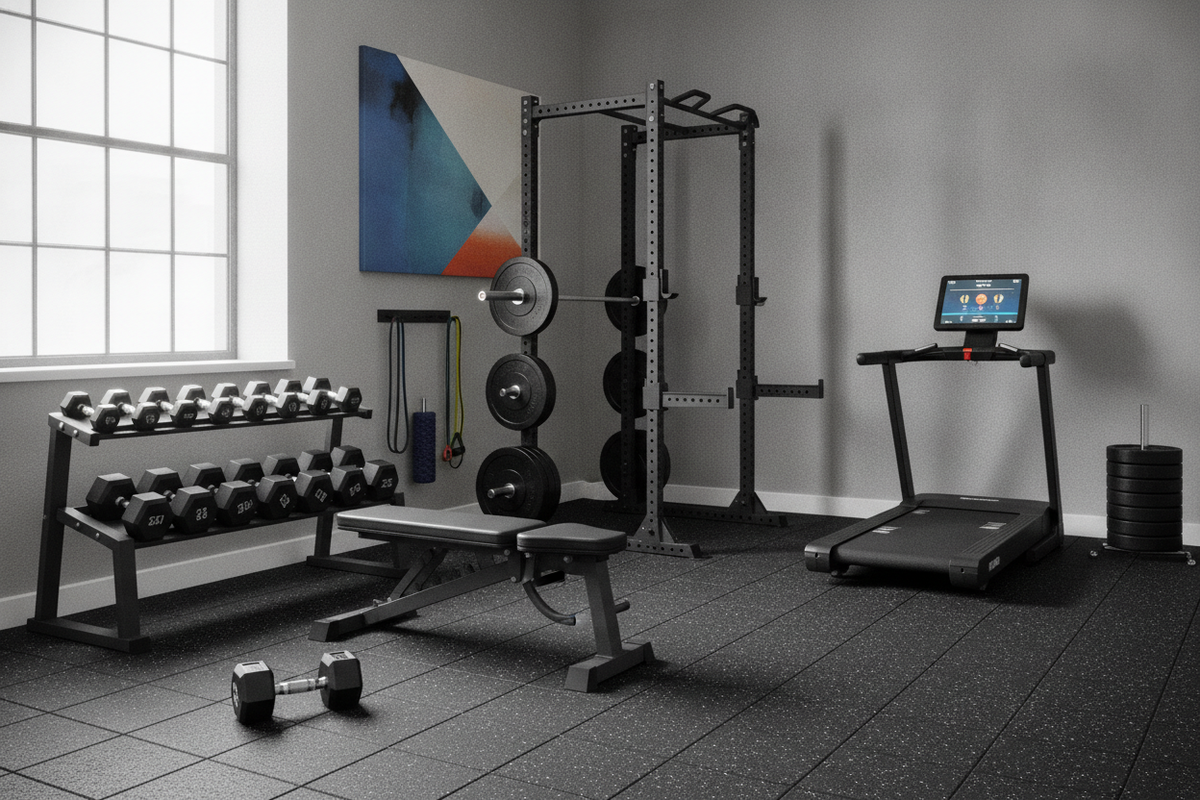
- Point-load distribution: High-density rubber matting spreads the concentrated downward force of small dumbbell rims or kettlebell bases across a wider surface area, helping shield underlying tiles, hardwood, or laminate from cracking.
- Vibration and sound attenuation: Rapid circuit pacing generates repeated contact. Thick elastomeric flooring absorbs acoustic resonance and minimizes structure-borne vibration transmitted through shared walls or lower living spaces.
- Traction and moisture management: Dense circuit training increases perspiration. Textured, non-porous mat surfaces prevent footing slippage during wide-stance squats and explosive hip hinges, maintaining firm footing throughout long training bouts.
Mat Maintenance and Training Space Longevity
Maintaining a clean, well-aligned gym floor ensures consistent grip and prolongs the lifespan of both protective mats and training gear. Fast transitions subject flooring joints to lateral shearing forces, making ongoing layout management essential. Consulting an established weight lifting guide offers structural context for integrating mat layouts into a permanent home gym strategy.
Implement a straightforward routine to keep the training zone performing smoothly:
- Routine hygiene: Wipe down matting surfaces with mild, neutral detergents following sweaty training blocks to preserve traction textures and prevent residue buildup.
- Seam inspection: Check puzzle-edge interlocks or tape seams periodically. Dynamic footwork can pull mat sections apart, creating subtle trip hazards during brisk circuit transitions.
- Strategic tile rotation: Mats positioned directly beneath deadlift drop areas or dumbbell staging racks experience the highest localized stress. Periodically rotating tiles distributes wear evenly across the entire surface footprint.
By pairing compound resistance protocols with a thoughtfully staged, shock-absorbent subfloor setup, lifters can safely pursue high-density training routines at home while maintaining space longevity and environmental control.