Building Natural Muscle: Grounded Movement Mechanics, Loading Vectors, and Protective Flooring Layouts
Foundational Principles of Building Natural Muscle at Home
Pursuing physical development without pharmaceutical enhancement requires a systematic approach to movement execution, recovery, and training environment design. At its core, building natural muscle represents an adaptive response to progressive mechanical tension across targeted muscle groups. Because natural lifters rely entirely on intrinsic recovery capacity, every training variable must be balanced to encourage tissue remodeling rather than systemic exhaustion.
Understanding how to increase muscle mass naturally starts with routine design centered on compound motor patterns rather than erratic exercise rotation. Muscle fibers respond to tension placed through active ranges of motion where the target musculature controls both the eccentric lowering phase and the concentric contraction. Rapidly adding load to a bar or machine at the expense of control shifts tension away from primary movers and onto passive connective tissues. By treating movement quality as the non-negotiable baseline, home lifters can apply steady, repeatable stimulus across months and years.
Consistency also demands an environment that supports focused, uninterrupted sessions. Training at home removes common commercial gym distractions, yet it introduces the necessity of managing equipment staging, footing, and room acoustics directly. When the training footprint provides reliable traction and clear movement pathways, natural lifters can dedicate full mental focus to generating muscular tension during every working repetition.
Movement Categories That Drive Natural Hypertrophy
A balanced natural physique develops primarily through multi-joint compound movement categories: the squat, the hinge, the horizontal push, the horizontal pull, the vertical push, and the vertical pull. These major patterns recruit substantial amounts of active tissue simultaneously, stimulating robust muscular adaptations across complementary muscle groups.
Lower-body movements form the structural anchor of this approach. Heavy knee-flexion and hip-extension exercises demand substantial ground stability and trunk bracing. For athletes looking to organize lower-body training days, consulting a dedicated muscle building mass guide helps match specific compound selections to individual limb lengths and mobility constraints. Variations such as Romanian deadlifts, split squats, and front-loaded squats challenge hip and thigh musculature through significant joint excursions without requiring complex commercial machinery.
Upper-body mechanics should balance pressing movements with an equal or greater volume of pulling variations. Overhead presses and horizontal bench presses develop the anterior deltoids, pectorals, and triceps, while rows and pull-up variations stabilize the scapulae and build the latissimus dorsi and upper back. Incorporating targeted accessory work, such as lateral raises and calf work, rounds out the routine by reinforcing joint perimeters and addressing minor muscular weak points.
Equipment Selection: Free Weights, Cables, and Machines in Home Spaces
Selecting equipment for a residential strength setup involves balancing versatility, footprint, and resistance curves. Barbells and adjustable dumbbells remain the foundational tools for building natural muscle because they permit natural joint paths and continuous micro-loading. However, free weights present open-plane movement challenges where stability requirements dictate the load that can be handled.
Stationary resistance systems and guided tools offer alternative loading profiles. While barbell paths require continuous active stabilization from deep trunk musculature, selectorized equipment or cable towers maintain steady tension throughout the complete arc of motion. When evaluating equipment tradeoffs, reviewing a balanced building muscle guide clarifies how guided tracks can isolate specific muscle groups when joint fatigue limits free-weight volume.
In home spaces where square footage is limited, adjustable dumbbell sets paired with a sturdy flat-to-incline utility bench deliver broad exercise variety across a compact floor footprint. Adding resistance bands or a ceiling-mounted suspension system expands tension angles for rear deltoid and pulling patterns without cluttering perimeter walkways.
Flooring Stability: Grounding Force Production and Foot Grip
The interaction between the lifter's footwear and the room surface is an often-overlooked factor in hypertrophy training. Muscular force production during compound exercises begins at the contact patch with the floor. When executing a heavy squat, overhead press, or deadlift, the body must generate ground reaction forces that transfer through the ankles, knees, hips, and spine.
Standard residential surfaces create distinct biomechanical drawbacks:
- Bare Concrete: Offers a rigid foundation but lacks surface texture, becoming slick when exposed to sweat or humidity, which compromises foot purchase.
- Carpet and Underlayment: Introduces uneven compression beneath the heels and balls of the feet, shifting balance during heavy bilateral lifts.
- Low-Density Foam Tiles: Tends to deform excessively under point loads, causing unstable ankle pronation or supination that bleeds mechanical tension.
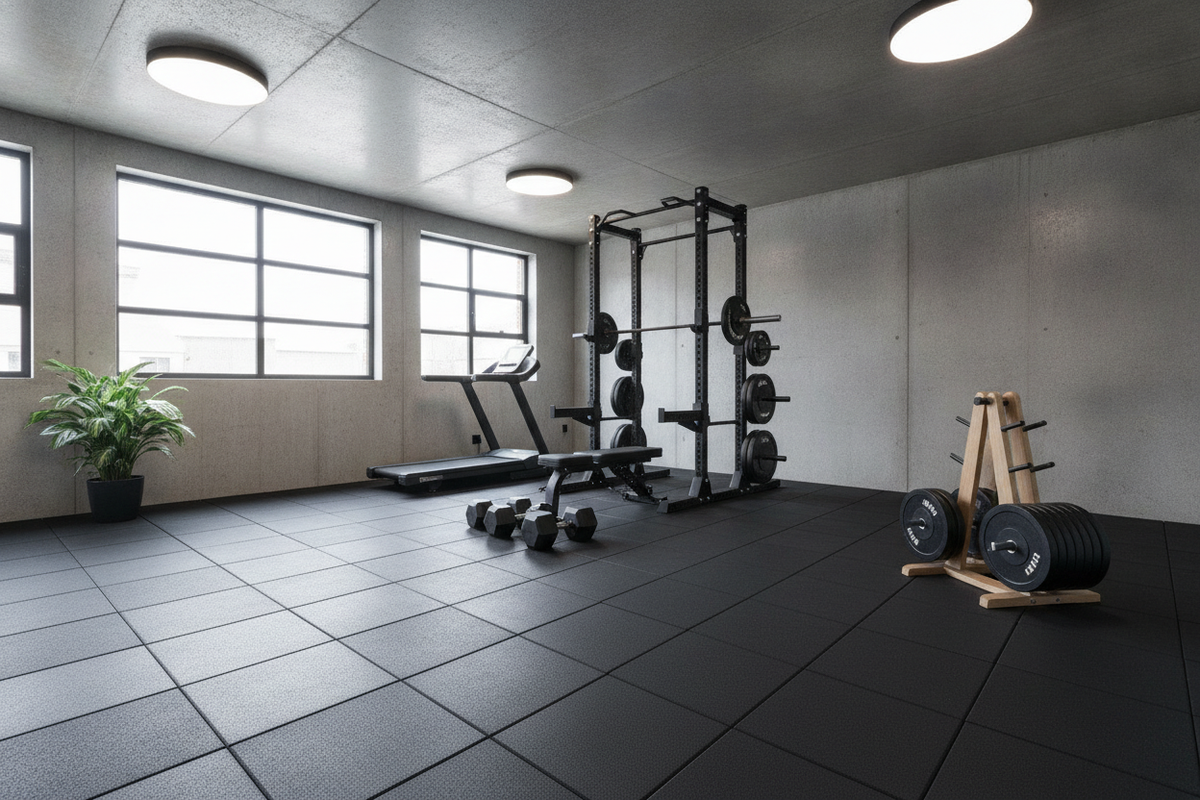
In contrast, high-density rolled rubber or vulcanized matting creates a non-compressible, textured base. A dense surface ensures that force driven downward translates directly into upward bar momentum rather than being absorbed by squishy floor padding. Large-format mats also eliminate shifting seams, giving lifters an expansive, dependable surface for wide-stance deadlifts, lunges, and dynamic warm-up movements.
Room Protection and Heavy Equipment Placement Strategies
Beyond foot stability, home strength training introduces localized static and dynamic loads that can degrade residential structures over time. Storing heavy iron plates, weight trees, and power racks creates concentrated point loading on underlying floor joists, subfloors, and finished surfaces. Safeguarding the room requires intentional floor protection and strategic equipment placement.
Positioning heavy racks and dumbbell storage units along load-bearing walls or directly over primary structural floor joists minimizes subfloor deflection. Placing thick, high-density rubber mats beneath every piece of stationary equipment distributes concentrated contact points across a wider surface area, preventing indentation in hardwood, laminate, or vinyl plank flooring. For those planning a practical setup with basic gear, consulting a residential building mass guide provides perspective on arranging functional training zones within small footprints.
Creating dedicated drop zones around the lifting area safeguards against accidental cosmetic scuffs and chipped subfloors. Even controlled descents during dumbbell bench presses or deadlifts subject flooring to repetitive focal pressure. Maintaining open clearance zones of at least several paces around the working perimeter ensures that lifters can move safely between racks, plate storage, and benches without tripping hazards or cramped transitions.
Flooring Care and Maintenance for Long-Term Home Gym Performance
Maintaining gym matting ensures reliable traction and preserves surface integrity over years of regular training sessions. In our editorial view, a clean, well-kept training surface creates a professional atmosphere that subtly encourages consistent workout habits.
Routine care involves simple, regular steps:
- Dry Debris Removal: Sweep or vacuum the mat surface frequently to eliminate dirt, dust, and dry chalk particles that diminish shoe traction.
- Gentle Damp Mopping: Clean the surface using a microfiber mop dampened with water and a neutral, mild detergent designed for rubber or vinyl materials.
- Avoid Harsh Solvents: Steer clear of petroleum-based solvents, bleach, or acidic cleaning chemicals, as these agents can break down rubber binders, cause surface slickness, or lead to premature material degradation.
- Periodic Inspection: Check mat seams, anchor points, and high-traffic zones beneath bench feet for signs of wear or moisture accumulation underneath the tiles.
By combining structured compound movements, deliberate equipment staging, and a dense, well-maintained floor foundation, lifters create an environment designed for steady, drug-free muscular development.