Building an Exercise Programme Around a Busy Home Schedule
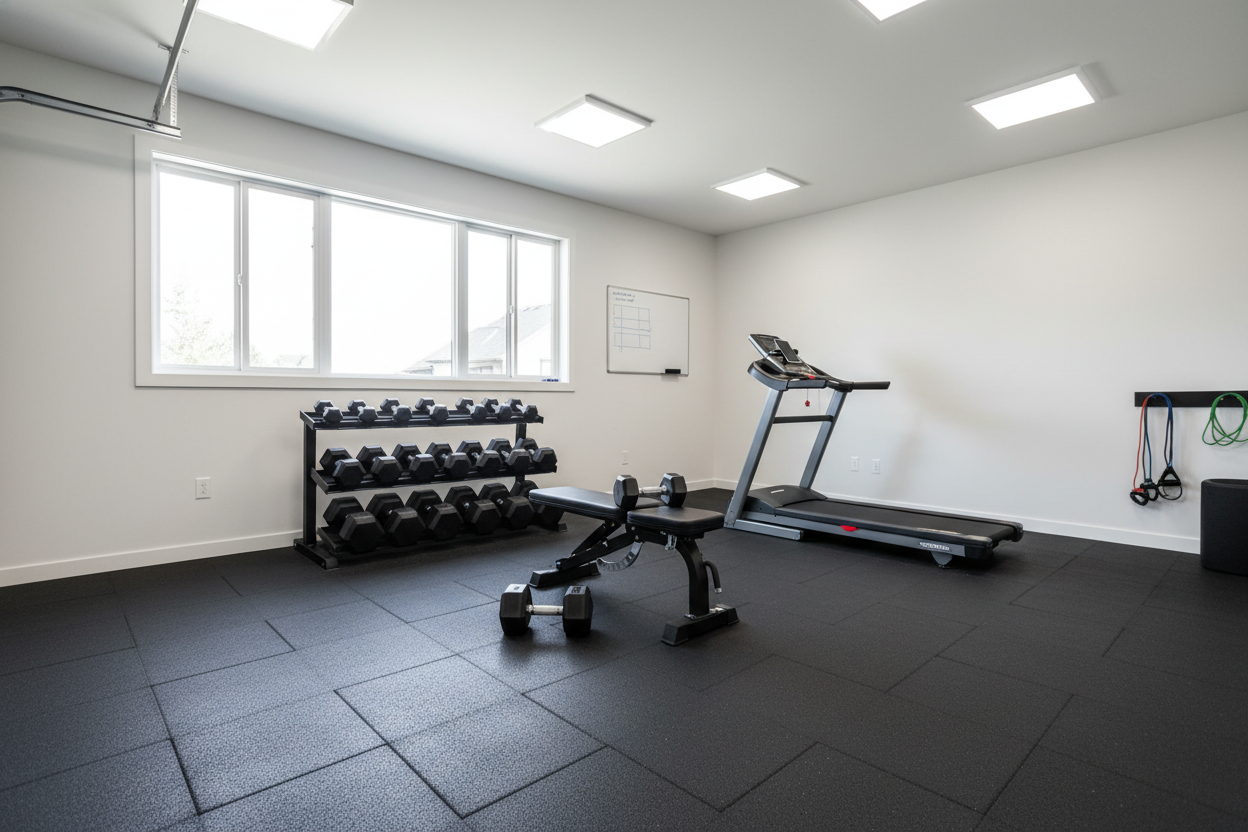
As a trainer, I see the exact same pattern every January. A busy parent or work-from-home professional clears out a 10x10 foot space in their garage, buys a bunch of gear, and vows to train for 60 uninterrupted minutes every single day. By week three, life gets in the way. A sick kid, a late Zoom call, or just sheer exhaustion derails the whole thing. If you are struggling to maintain your exercise programme at home, the issue probably is not your willpower. It is your schedule.
We need to stop trying to force commercial gym routines into a home environment. Instead, we can use micro-dosing to build fitness around your life, rather than forcing your life around your fitness.
Quick Takeaways
- Ditch the 60-minute mindset and break workouts into 10-15 minute micro-sessions.
- Focus morning blocks on mobility and core activation to wake up your nervous system.
- Use lunchtime for high-yield compound strength training like squats and rows.
- Transition to sleep with evening steady-state cardio or flow yoga.
- Keep your workout space permanently set up to eliminate friction and excuses.
The Problem With Traditional Physical Fitness Plans
Standard physical fitness plans are designed for a sterile environment: the commercial gym. They assume you have an hour to kill, plus 30 minutes to commute, change, and shower. When you try to force that structure into a home environment filled with distractions, it usually falls apart.
I have had clients try blocking out 6 AM to 7 AM, only to be interrupted by a toddler waking up early. Others try the 6 PM post-work slot, but mental fatigue from staring at a screen all day leaves them drained. You end up skipping the workout entirely because you think 20 minutes is not enough time to matter. That all-or-nothing mentality is the enemy of progress.
What is Micro-Dosing Your Exercise Programme?
Instead of cramming everything into one massive block, micro-dosing involves splitting your routine into three or four short, intense 10 to 15-minute sessions spread across the day. Think of it as habit-stacking. You attach a short burst of activity to an existing daily habit, like making your morning coffee or taking your lunch break.
When I design a plan for physical fitness using this method, the total volume at the end of the day is exactly the same. Three 15-minute blocks equal 45 minutes of work. You still hit your target heart rate, you still accumulate time under tension for muscle growth, and you still burn calories.
The difference is compliance. It is incredibly easy to convince your brain to do 10 minutes of work. You do not need a massive warm-up. You just step into your designated space, execute, and get back to your life. Over a month, those micro-doses compound into massive physiological changes.
Morning Activation: Mobility and Core
Your first 10-minute block happens right after you wake up. The goal here is not to crush yourself with heavy weights. We want to wake up the central nervous system, lubricate the joints, and fire up your core stabilizers.
I usually program a circuit of cat-cows, bird-dogs, dead bugs, and thoracic rotations. You want to move continuously for the full 10 minutes. Because you are doing floor work, comfort is critical. I always tell my clients to invest in a large exercise mat for home gym spaces. If you have to dig a rolled-up yoga mat out of the closet every morning, you will not do it. Having a dedicated, always-ready surface removes that barrier to entry.
Lunchtime Strength: High Yield, Low Time
Midday is when your core body temperature is optimal for force production. This is your 15-minute resistance training block. Because time is incredibly tight, we ignore isolation exercises like bicep curls. Everything must be a compound movement: goblet squats, push-ups, dumbbell rows, and lunges.
A standard setup is an AMRAP (As Many Rounds As Possible) format. Grab a pair of 25-pound dumbbells. Do 10 squats, 10 rows, and 10 push-ups. Rest briefly, then repeat for 15 minutes. If you want to maximize this short window, some of the top rated exercise machines allow for rapid resistance changes without fiddling with weight plates. Cable trainers or selectorized dumbbells are perfect for keeping your heart rate up during quick-transition strength workouts.
Evening Decompression: Steady State Cardio or Yoga
The final 15-minute block of your physical fitness exercise plan happens right before a shower and bed. We are shifting from sympathetic (fight or flight) to parasympathetic (rest and digest) nervous system dominance.
This is the time for down-regulation. Try light, steady-state cardio on a stationary bike, or a slow yoga flow focused on deep breathing. You want to stretch out the muscles you contracted during lunch. For evening flows, space matters. I prefer using a 6x8ft exercise mat because it gives you enough room to fully extend into poses like downward dog or a supine twist without sliding off onto a hard floor.
Structuring Your Weekly Physical Fitness Plans
To make this sustainable, you need a template. Here is how I structure 5-day physical fitness plans for my busiest clients to ensure a balanced, full-body stimulus without overtraining.
Monday, Wednesday, and Friday are your primary strength days. Your lunchtime block will focus on heavy compound lifts. Think squats and push-ups on Monday, deadlifts and rows on Wednesday, and lunges and overhead presses on Friday.
Tuesday and Thursday are active recovery and conditioning days. Your lunchtime block shifts from heavy weights to high-intensity interval training (HIIT) or kettlebell swings. Just 15 minutes of 30 seconds of work followed by 30 seconds of rest.
Your morning mobility and evening yoga blocks remain relatively constant all five days. Consistency in the morning and evening anchors your daily routine, while the lunchtime block provides the progressive overload needed to build muscle.
Essential Gear for Quick-Transition Workouts
When your workout only lasts 15 minutes, you cannot spend 5 minutes setting up equipment. Zero-friction environments are the secret to micro-dosing. Leave your weights out where you can see them. Keep your resistance bands attached to the door anchor.
Most importantly, fix your flooring. If you are not sure where to start, reading up on how to choose the best exercise mat will help you select a permanent foundation. You want something with enough density to support dropped weights, but comfortable enough for barefoot stretching.
Personal Experience: Testing the Micro-Dose Method
I actually tested this exact 3-block method myself when my first child was born. I went from training 90 minutes a day in a commercial facility to squeezing in reps while the baby napped. I used a pair of 5-52.5 lb adjustable dumbbells and a heavy-duty floor mat in my home office.
The results were surprising. I maintained almost all my strength and actually improved my mobility. However, I have to share one honest downside: sweating during the lunchtime block. If you push hard in those 15 minutes, you will sweat. Finding time to quickly rinse off before jumping back into afternoon video calls was a logistical hurdle I had to plan around. Keep some body wipes handy if a quick shower is not an option.
Frequently Asked Questions
Can you actually build muscle in 15 minutes?
Yes, if the intensity is high enough. Muscle growth requires mechanical tension and metabolic stress. Taking a heavy set of squats to near failure in 15 minutes provides enough stimulus for hypertrophy.
Do I need to warm up before a micro-workout?
For the morning mobility block, the workout is the warm-up. For the lunchtime strength block, spend the first 2 minutes doing bodyweight variations of the exercises you are about to load with weight.
Is it better to lift weights fast or slow during short workouts?
Keep your lifting tempo controlled. Do not rush the lowering portion of the lift just to beat the clock. Quality reps always trump quantity, even when time is limited.