Building a Booty Workout: Weighted Movement Frameworks, Progressive Hypertrophy Blueprints, and Home Floor Staging
Designing an effective training session dedicated to lower-body development requires more than random exercise selection. A structured building a booty workout combines biomechanical principles, multi-planar loading patterns, and consistent progressive overload. Whether exercising in a commercial facility or outfitting a dedicated garage gym, understanding how to load the gluteal complex across various movement vectors ensures productive training while managing joint stress.
Foundational Biomechanics of Glute Hypertrophy
The gluteal musculature consists primarily of the gluteus maximus, gluteus medius, and gluteus minimus. Each sub-group contributes to specific functional actions around the pelvis and hip joint:
- Gluteus Maximus: The largest muscle in the complex, primarily responsible for hip extension, external rotation, and transverse abduction. It experiences maximal mechanical tension during horizontal thrusting and deep hip flexion movements.
- Gluteus Medius and Minimus: Positioned along the lateral hip, these muscles drive hip abduction, internal rotation, and pelvic stabilization during unilateral stances.
To construct an ultimate booty workout, programming must account for different angles of resistance. Horizontal loading vectors (such as hip thrusts) place peak tension on the glutes in a fully shortened position, whereas vertical and diagonal loading vectors (such as Romanian deadlifts and squats) emphasize tension in the lengthened or stretched position. Combining these complementary vectors maximizes mechanical stimulus across the entire muscle complex.
Core Movement Categories for an Ultimate Booty Workout
A balanced lower-body routine relies on four core movement pillars. Selecting one or two exercises from each pillar ensures balanced development across all planes of motion.
1. Horizontal Hip Extension (Thrusts and Bridges)
Movements like barbell hip thrusts, dumbbell glute bridges, and single-leg thrusts place maximum resistance at terminal hip extension. When performing these lifts, maintain a neutral ribcage and focus on rotating the pelvis backward slightly at the top lockout rather than overarching the lower spine.
2. Lengthened-Position Hip Hinges
Romanian deadlifts, stiff-leg deadlifts, and back extensions challenge the glutes and hamstrings in an elongated state. Initiating the movement by pushing the hips backward while maintaining soft knee flexion directs the training load onto the posterior chain rather than the lumbar region.
3. Unilateral Knee- and Hip-Dominant Patterns
Bulgarian split squats, walking lunges, and reverse deficit lunges address side-to-side strength discrepancies. Incorporating a slight forward torso lean during unilateral split squats shifts mechanical emphasis from the quadriceps directly onto the working glute.
4. Abduction and Rotational Finishers
Seated band abductions, cable kickbacks, and lateral step-ups target the upper glute shelf and lateral stabilizers. These exercises serve well as high-repetition metabolic finishers to conclude an ultimate bum workout.
Structuring a 30-Minute Weighted Glute Training Session
A time-efficient training session balances compound strength with focused accessory work. Below is a structured blueprint that can be adapted to dumbbells, kettlebells, or barbells in any well-equipped space. For broader training templates and multi-week schedules, explore our dedicated workout resource hub.
- Phase 1: Neural Activation (3 to 5 minutes): Low-load movements such as bodyweight glute bridges, lateral band walks, and quadruped hip extensions to prime the neuromuscular pathway.
- Phase 2: Primary Heavy Compound (10 to 12 minutes): 3 to 4 working sets of barbell or heavy dumbbell hip thrusts focusing on explosive hip drive and controlled eccentric lowering.
- Phase 3: Lengthened Unilateral Accessory (8 to 10 minutes): 3 working sets per leg of rear-foot elevated split squats or deficit reverse lunges.
- Phase 4: Metabolic Finisher (3 to 5 minutes): 2 higher-rep sets of banded lateral abductions or cable pull-throughs with minimal rest between sets.
Home Gym Floor Staging and Equipment Stability
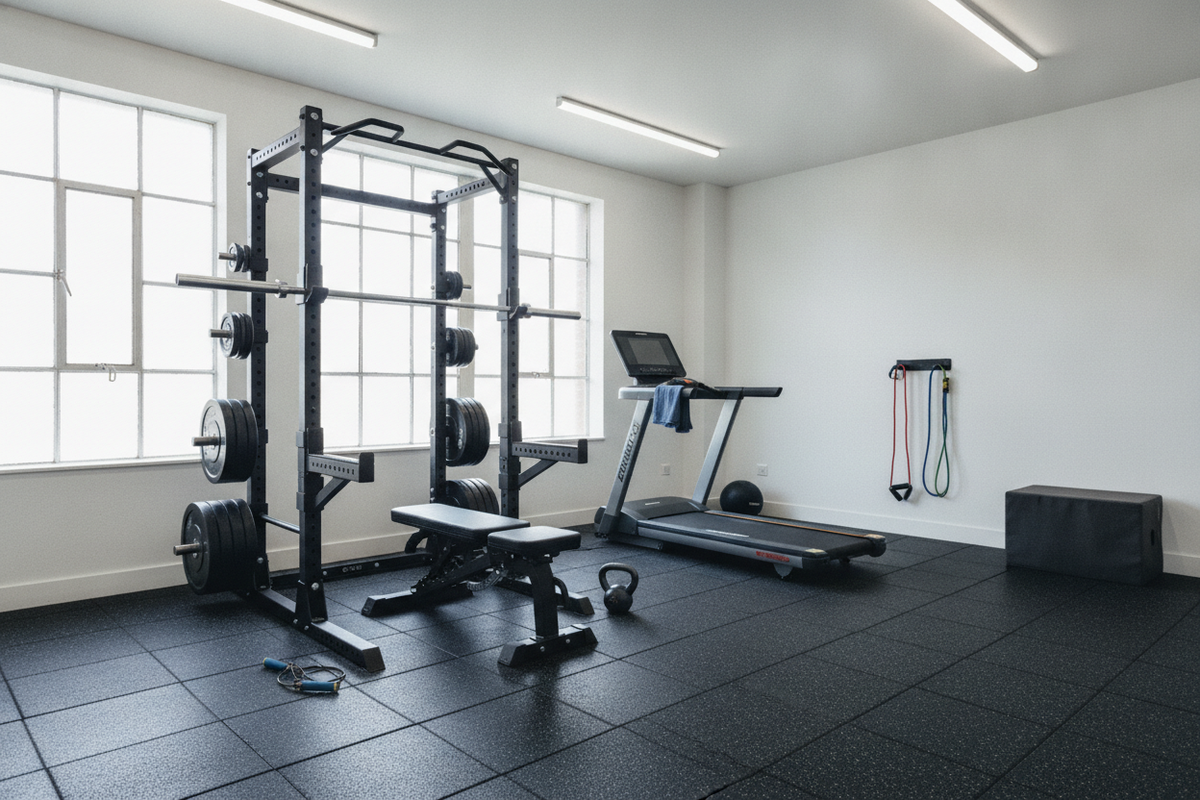
Executing heavy lower-body movements at home requires a solid foundation. Exercises like hip thrusts, heavy lunges, and Romanian deadlifts impose substantial downward and lateral forces on both your body and the subfloor.
Setting up your training station over a dense workout product helps absorb the impact of loaded weights, reduces vibrations through residential subflooring, and provides essential slip resistance during wide-stance squats or split lunges. Furthermore, dedicated protective flooring prevents your weight bench from shifting backward during heavy hip thrusts, maintaining a stable pivot point against your upper back throughout each repetition.
Progressive Overload and Routine Optimization Frameworks
Muscle adaptation requires consistent application of progressive overload over time. While adding external resistance is the most common method, several other variables can drive continued growth without requiring heavier weights:
- Tempo Modulation: Slowing the eccentric phase (the lowering portion) to three or four seconds increases time under mechanical tension.
- Isometric Pauses: Pausing for two seconds at peak contraction (such as the top of a hip thrust) reinforces active muscle recruitment without excessive spinal loading.
- Range of Motion: Increasing movement depth, such as standing on a low platform during lunges or deadlifts, increases stretch-mediated hypertrophy.
- Density and Volume: Gradually completing the same total training volume in less overall time or adding an extra working set per week builds work capacity.
To explore supplementary bodyweight strategies and floor-based conditioning routines, check out our comprehensive booty building workout guide for practical training setups.
Frequently Asked Questions About Glute-Focused Training
How many times per week should glutes be trained for optimal development?
Most lifters find consistent results by training the lower body two to three times per week. Distributing training volume across multiple sessions allows for higher quality execution on heavy compound lifts while providing adequate recovery time between sessions.
Do I need heavy barbells to build glute strength at home?
While barbells allow for straightforward incremental loading, dumbbells, adjustable kettlebells, and heavy resistance bands can provide sufficient stimulus. Utilizing unilateral movements and increasing time under tension allows you to challenge muscle fibers effectively with moderate equipment.
What is the benefit of a large floor mat for lower-body workouts?
A broad, high-density exercise mat provides continuous floor traction across dynamic movements like walking lunges and lateral step patterns. It also offers essential joint cushioning for kneeling exercises, glute bridges, and floor core work while safeguarding hardwood or tile surfaces from dropped dumbbells.