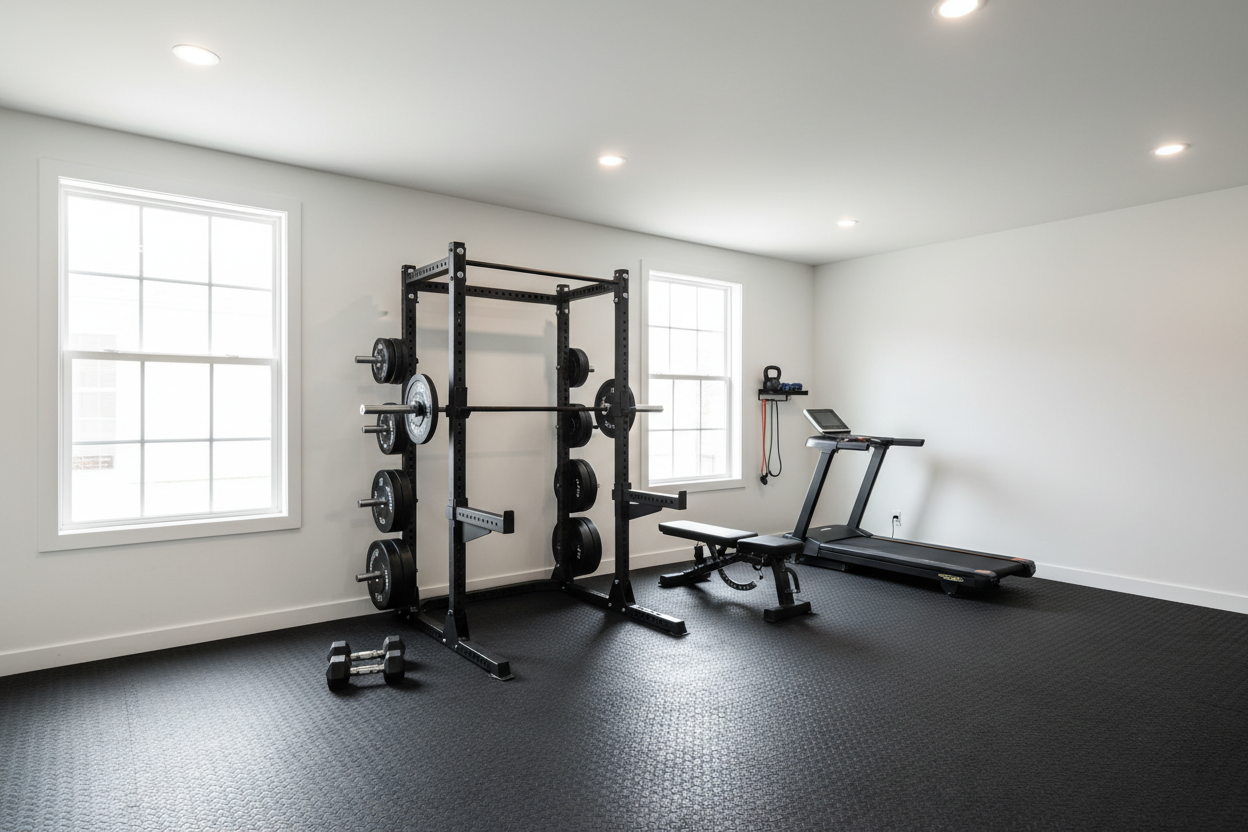
Building a Body Exercise Gym: How to Use Gravity, Not Iron
I remember stepping into a client's 400-square-foot studio apartment a few years ago. They wanted to get strong but barely had room for a coffee table, let alone a power rack and a 300-pound barbell set. That is when I realized we needed to scrap the traditional setup entirely. We built a highly effective body exercise gym right there in the living room, relying on physics instead of cast iron.
You do not need thousands of dollars in metal plates to force your muscles to grow. When you understand how to manipulate your own mass against gravity, a patch of open floor becomes the ultimate training ground.
Quick Takeaways
- Leverage and angles dictate resistance, not just the number on a weight plate.
- Your floor is your bench, anchor, and primary piece of equipment.
- Progressive overload is achieved through unilateral movements and time-under-tension.
- A 6x6 or 6x8 foot dedicated space is all you need for a complete workout.
Rethinking What a Training Space Looks Like
Most people think a home gym requires bulky machines and heavy metal. As a trainer, I have seen clients delay their fitness goals for years because they felt they lacked the budget or space for a squat rack. But your muscles do not know if you are holding a 50-pound dumbbell or if you have simply shifted 50 pounds of your own body weight onto a single limb.
Resistance is simply force applied against muscle tissue. You can generate massive amounts of that force by fighting gravity. A standard push-up is essentially a moving plank that presses about 64 percent of your total body weight. If you weigh 180 pounds, you are pressing roughly 115 pounds.
When you stop looking at your training space as a storage unit for heavy objects and start viewing it as a laboratory for body mechanics, everything shifts. You do not need to buy a heavier dumbbell. You just need to change the angle of your body to make the movement harder.
How to Manipulate Gravity for Muscle Growth
To build muscle, you need progressive overload, which means forcing your muscles to adapt to increasingly difficult stimuli. In a traditional gym, you slide a 5-pound plate onto a bar. In a leverage-based setup, you manipulate gravity.
There are three main ways to do this: adjusting the angle, shifting weight distribution, and reducing stability. Let us look at angles first. If a standard push-up becomes too easy, elevating your feet onto a 12-inch box shifts more of your mass directly over your shoulders and chest. Suddenly, that 115-pound press feels like 140 pounds.
Next is weight distribution. Moving from a standard bilateral squat on two legs to an archer squat, where you shift your weight primarily to one side, forces one leg to handle 80 percent of the load. It is the biomechanical equivalent of throwing another 45-pound plate on the bar without buying a single piece of gear.
Finally, reducing stability forces your central nervous system to recruit more muscle fibers just to keep you upright. Shifting from an equipment-heavy mindset to a mechanics-focused mindset will completely transform your home gym routine. You start seeing every wall, chair, and floor space as a tool for creating muscular tension.
Flooring as Your Primary Piece of Equipment
When your body is the resistance, your connection to the ground is everything. You are not lying on a padded bench or strapping into a seated machine. You are pressing, jumping, and stabilizing directly against the floor.
This makes a high-traction, shock-absorbing surface your absolute non-negotiable foundation. I have tested dozens of setups, and trying to do explosive plyometrics or wide-stance lateral lunges on bare hardwood or cheap foam puzzle tiles is a recipe for joint pain and slipped footing. You need a dedicated Large Exercise Mat For Home Gym to serve as your platform.
In my own training space, I rely on a 6X8Ft Exercise Mat Yoga Mat Gym Flooring For Home Workout. At 7mm thick, it provides enough dense cushioning to protect my knees during heavy lunges without being so squishy that I lose my balance during single-leg deadlifts.
Over the past year, I have logged over 1,000 burpees and heavy kettlebell swings on this exact mat. The high-density PVC has not flaked or compressed, and the traction actually improves slightly as it breaks in. The one honest downside? At around 28 pounds, it is heavy and cumbersome to move once unrolled, so it is best left permanently in place. But that dense weight is exactly why it does not slide around when I am doing aggressive mountain climbers.
Programming Your Gravity-Resisted Workouts
A common mistake I see with bodyweight training is doing 500 push-ups and calling it a day. That leads to severe muscular imbalances. Your routine needs structure across four main pillars: push, pull, squat, and hinge.
For pushing, alternate between horizontal movements like standard or archer push-ups and vertical movements like pike push-ups or handstand holds. This hits the chest, front delts, and triceps evenly.
Pulling is notoriously tricky without weights, but not impossible. If you lack a pull-up bar, use a sturdy table for inverted rows, or use floor sliders on a slick surface to pull your body weight across the ground, heavily targeting the lats and biceps.
For the lower body, progress from bodyweight squats to Bulgarian split squats. For the hinge, which targets hamstrings and the lower back, sliding leg curls or single-leg Romanian deadlifts are brutal and highly effective.
Aim for 3 to 4 sets per movement. Because you are not using heavy iron, you might need to push the rep ranges slightly higher, usually 12 to 20 reps, until you reach technical failure. If you need a structured weekly breakdown, checking out a complete home gym training guide can help you manage volume and recovery days properly.
Scaling Up Without Buying Plates
Eventually, doing 20 reps of a standard movement gets boring and stops yielding muscle growth. When that happens, you scale up through unilateral training and time-under-tension.
Unilateral movements, like pistol squats or one-arm push-ups, double the load on the working limb while demanding extreme core stability. Even if you are working in a tight space, a 6X4Ft Yoga Mat Exercise Mat Gym Flooring For Home Workout provides plenty of high-grip surface area to safely execute these balance-heavy exercises.
If unilateral work is too advanced, manipulate the tempo. Try a 4-second eccentric lowering phase, a 2-second pause at the bottom, and an explosive 1-second concentric pushing phase. A set of 8 push-ups using a 4-2-1 tempo will set your chest on fire and stimulate hypertrophy just as effectively as heavy bench pressing.
Your Body is the Ultimate Training Tool
You do not need to sacrifice half your garage to get in the best shape of your life. By understanding biomechanics, leverage, and tension, you unlock the ability to train anywhere.
Trust the process of leverage-based training. Consistency, effort, and a solid grip on the floor will always outpace expensive gear that ends up doubling as a clothes rack. Master your body weight, and you master your fitness.
Frequently Asked Questions
Can I really build muscle without lifting heavy weights?
Yes. Muscle hypertrophy requires mechanical tension, metabolic stress, and muscle damage. Your body does not know the difference between a barbell and the resistance created by your own mass. Pushing close to failure is what actually matters.
How much space do I actually need?
A clear 6x6 or 6x8 foot area is ideal. This gives you enough room to fully extend your arms and legs for movements like burpees, bear crawls, and lateral lunges without kicking a wall or knocking over a lamp.
What if I cannot do a standard push-up yet?
Use leverage to your advantage in reverse. Elevate your hands on a sturdy chair, bench, or wall. This shifts the weight back onto your feet, reducing the load on your upper body. As you get stronger, slowly lower the incline until you are flat on the floor.