Build Strong Legs in Your Living Room: A Simple Routine for Beginners
You don't need a squat rack, heavy dumbbells, or an expensive gym membership to build lower body strength. In fact, relying on complex machinery often creates a barrier to entry that stops people from starting at all. If you are looking for easy at home leg exercises, the most effective approach is to master bodyweight movements that utilize your own gravity for resistance. By focusing on form and consistency with foundational movements like squats, lunges, and bridges, you can tone your legs and improve mobility right in your living room.
Many people complicate fitness. They believe that without a barbell on their back, they aren't working hard enough. That isn't true. Your legs carry your body weight all day, and manipulating how you move that weight can stimulate muscle growth and endurance. This guide breaks down a routine designed for small spaces and zero equipment, perfect for anyone wanting to start moving again.
Why Bodyweight Training Works
I remember a specific period a few years ago when I was traveling extensively for work. I spent weeks in hotels with barely enough floor space to open a suitcase, let alone set up equipment. I felt my fitness slipping, so I decided to commit to 20 minutes of bodyweight training every morning before checking my emails. I utilized the edge of the bed for stability and focused purely on tension—moving slowly rather than rushing. Surprisingly, after a month, my joint pain had decreased, and my definition had actually improved. It taught me that the "fancy" stuff often distracts us from the basics. You can achieve significant results just by being intentional with simple movements.
When you strip away the heavy iron, you are forced to focus on your biomechanics. You learn how your hips hinge and how your knees track. This body awareness is invaluable. Easy home leg workouts aren't just about "taking it easy"; they are about making fitness accessible and sustainable. When the barrier to entry is low, your adherence to the program skyrockets.
The Essential Living Room Leg Routine
This routine is designed to hit the quadriceps, hamstrings, glutes, and calves. You can perform these as a circuit, moving from one exercise to the next with little rest, or complete all sets for one exercise before moving on.
1. The Chair Squat (Box Squat)
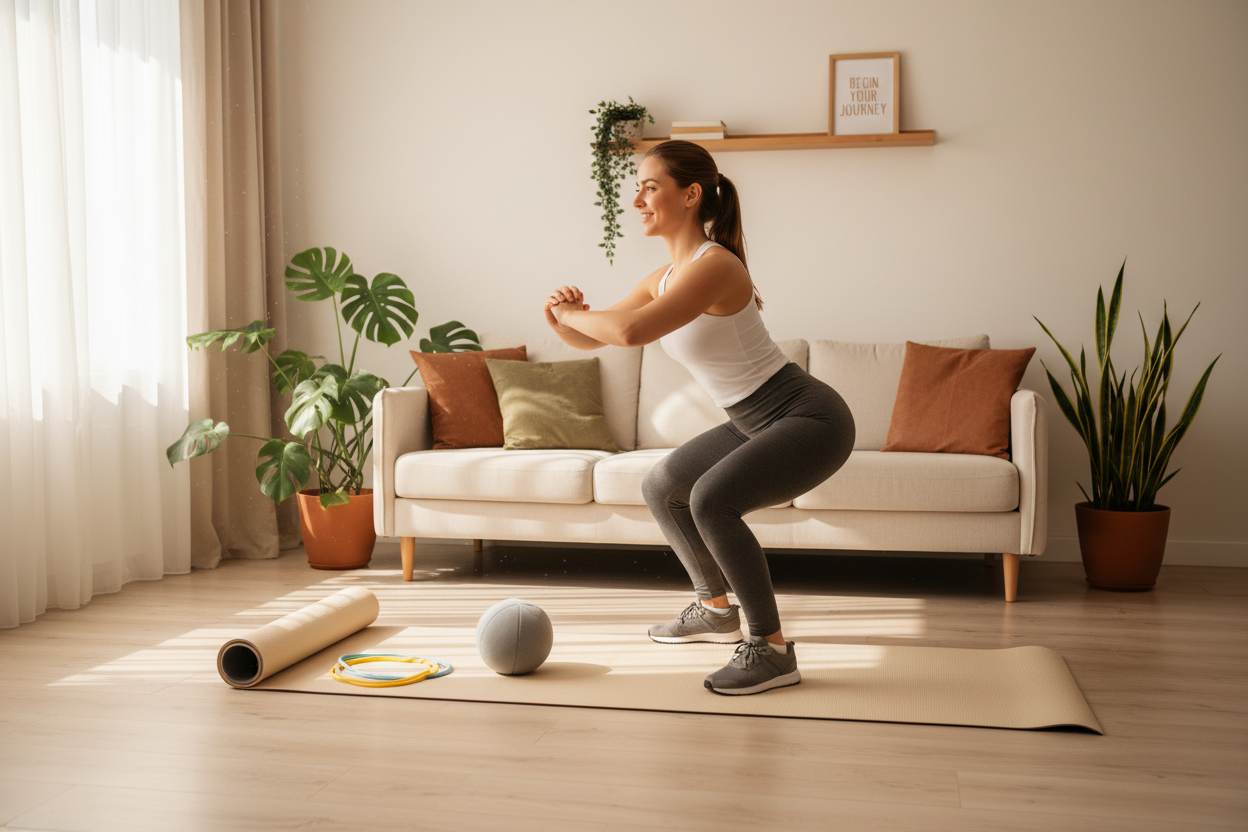
The squat is the king of leg movements, but it is also the one most people do incorrectly. If you are looking for easy at home workouts for legs, start with the chair squat. It removes the fear of falling backward and ensures you hit the proper depth.
Stand in front of a sturdy chair or your couch with your feet shoulder-width apart. Toes should point slightly outward. Extend your arms in front of you for counterbalance. Initiate the movement by pushing your hips back as if you are reaching for the seat behind you, rather than bending your knees first. Lower yourself until your glutes barely touch the seat, then drive back up through your heels. Do not rest your full weight on the chair; just tap it.
Keep your chest proud throughout the movement. If you collapse your upper body, you lose the core engagement. Aim for 3 sets of 12 to 15 repetitions.
2. Stationary Lunges
Lunges are fantastic for balance and addressing muscle imbalances, as they force each leg to work independently. For easy home leg exercises that challenge your stability, the stationary lunge is safer than the walking lunge because there is less momentum involved.
Take a large step back with your right foot. Keep your feet hip-width apart—imagine you are standing on railroad tracks, not a tightrope. Lower your back knee straight down toward the floor. Your front thigh should be parallel to the ground, and your front knee should not drift drastically past your toes. Push through your front heel to return to the starting position. Complete all reps on one leg before switching to the other.
If balance is an issue, perform this next to a wall or a sturdy piece of furniture so you can rest your hand on it for support. This turns a difficult move into an easy leg workout at home that anyone can do.
3. Glute Bridges
We spend so much time sitting that our glutes often "forget" how to fire. This exercise wakes them up without putting stress on the lower back. It is one of the most effective simple exercises for legs at home.
Lie on your back on the floor (a yoga mat or carpet helps for comfort). Bend your knees and plant your feet flat on the floor, hip-width apart. Your heels should be close enough to your glutes that you can almost tickle them with your fingertips. Press your lower back into the floor to engage your core, then drive through your heels to lift your hips toward the ceiling. Squeeze your glutes hard at the top for a one-second count. Lower your hips back down with control.
Avoid over-arching your back. The movement should come from the hips, not the spine. Aim for 3 sets of 15 to 20 reps.
4. Standing Calf Raises
The calves are often neglected in easy home leg workouts, but they are vital for ankle stability and circulation. Stand with your feet hip-width apart. You can hold onto a wall or doorframe for balance. Slowly rise onto the balls of your feet, lifting your heels as high as possible. Hold the top position for a brief moment, then lower your heels slowly until they touch the floor.
To make this more challenging without weights, try doing it on a single leg. Hook one foot behind the other ankle and perform the raise. This simple adjustment doubles the resistance.
5. Side Leg Raises
This movement targets the outer hips and glutes, areas that squats and lunges sometimes miss. Lie on your side with your legs stacked straight on top of each other. You can support your head with your arm. Keeping your top leg straight, lift it toward the ceiling. The key here is to keep your toes pointing forward, not up. If you rotate your toe toward the ceiling, you start using your hip flexors instead of your glutes.
Lower the leg back down without letting it completely rest on the bottom leg before starting the next rep. This keeps constant tension on the muscle.
Tips for Progress and Safety
Consistency beats intensity when you are starting out. Performing this routine two to three times a week is plenty to see changes. The beauty of an easy leg workout at home is that you can do it while watching TV or listening to a podcast. There is no commute and no waiting for machines.
If the exercises start to feel too easy, you do not necessarily need to buy weights. You can increase the difficulty by slowing down the tempo. Instead of bobbing up and down, take three full seconds to lower yourself into the squat, pause for one second at the bottom, and take one second to stand up. This increases "time under tension," which signals your muscles to grow stronger even without heavy loads.
Another modification is to reduce the rest time between sets. If you usually rest for 60 seconds, cut it down to 30. This keeps your heart rate up and turns the strength session into a mild cardio workout as well. Fitness is rarely linear, but as long as you are moving with intention, you are making progress.
Common Mistakes to Avoid
Even with simple exercises for legs at home, form errors can lead to nagging pains. Watch out for "knee valgus," which is when your knees collapse inward toward each other during a squat or lunge. Think about pushing your knees outward against an invisible band. This engages the hips and protects the knee joints.
Also, ensure you are breathing. It sounds obvious, but many beginners hold their breath when concentrating. Exhale as you exert effort (standing up from the squat) and inhale as you lower yourself. Proper oxygen flow helps you perform more reps and keeps your blood pressure stable.
Frequently Asked Questions
How often should I do these leg exercises?
For most beginners, performing this routine 2 to 3 times per week is ideal. Your muscles need about 48 hours to recover and repair after a workout, so try to have a rest day or an upper-body day in between your leg sessions.
Can I really build muscle without weights?
Yes, especially if you are a beginner or returning to fitness. By increasing the repetitions, slowing down your movement speed (tempo), or reducing rest times, you can create enough stimulus to build muscle tone and strength using only your body weight.
What should I do if my knees hurt during squats?
Knee pain often comes from poor form or lack of strength. Try reducing the range of motion by not going as low, or rely more on the "Chair Squat" variation to ensure you are sitting back into your hips rather than pushing your knees forward. If pain persists, consult a physical therapist.