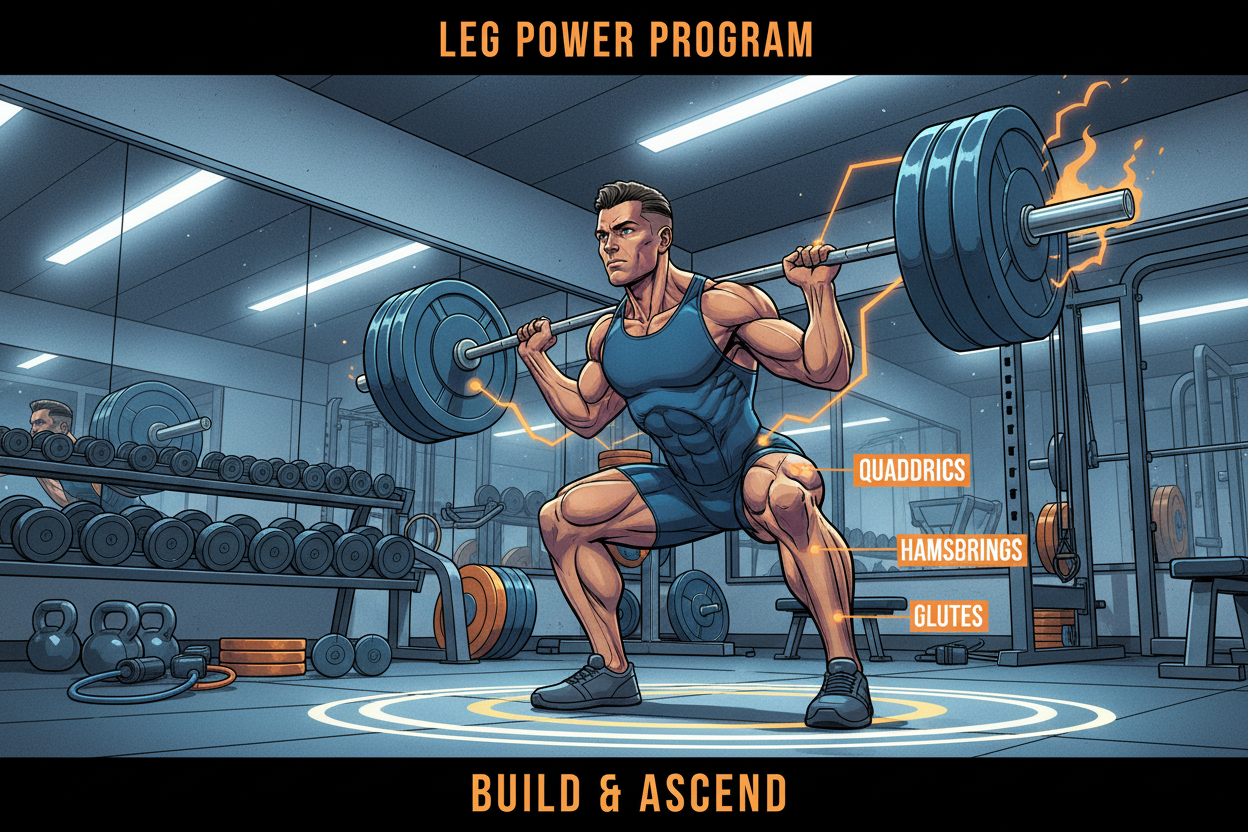
Build Serious Leg Power With This Proven Squat Exercise Program
Most lifters treat leg day as a chore rather than a strategic opportunity. You walk into the gym, load up the bar, and hope for the best. But hope isn't a strategy. To see significant changes in your lower body strength and hypertrophy, you need a structured squat exercise program that prioritizes progressive overload and proper recovery.
If you are tired of hitting plateaus or dealing with nagging knee pain from poor programming, you are in the right place. We are going to break down exactly how to structure your training for maximum output.
Key Takeaways
- Frequency Matters: Squatting 2-3 times per week yields better strength gains than a single "leg day."
- Periodization is King: Rotate between high-volume (hypertrophy) and high-intensity (strength) blocks.
- Accessory Work: A solid squat routine must include hamstring and glute isolation to prevent imbalances.
- Recovery: Your squat exercise plan fails without adequate sleep and caloric surplus during heavy phases.
The Science Behind a Successful Squat Routine
Randomly adding weight to the bar works for novices, but that linear progression stops quickly. A true squat routine relies on periodization. This involves manipulating volume (total reps) and intensity (weight on the bar) over specific cycles.
When you squat, you aren't just training muscles; you are training your central nervous system (CNS). High-frequency squatting greases the neurological groove, making the movement pattern more efficient. This efficiency is often mistaken for raw strength, but it is actually skill acquisition.
Phase 1: Accumulation (The Foundation)
Your squat workout routine should start with an accumulation phase. Here, the goal is building work capacity. You aren't testing your one-rep max (1RM); you are building the engine.
Focus on sets of 6 to 10 reps at 65-75% of your max. This forces physiological adaptations in the muscle tissue, increasing the cross-sectional area of the quads and glutes.
Phase 2: Intensification (The Strength)
Once you have built the muscle, you need to teach it to fire forcefully. In this phase of your squat exercise plan, drop the reps to the 3-5 range and bump the intensity to 80-90%.
This shift recruits high-threshold motor units. These are the muscle fibers responsible for moving heavy loads explosively.
Designing Your Weekly Schedule
You shouldn't squat heavy every session. That is a recipe for burnout. A sustainable schedule balances stress and recovery.
- Day 1 (Heavy): Competition style back squat. 5 sets of 3-5 reps.
- Day 2 (Variation/Volume): Front squats or High-bar squats. 3 sets of 8-10 reps. Focus on depth and posture.
- Day 3 (Dynamic/Speed): Box squats. 8 sets of 2 reps at 50-60%. Move the bar as fast as possible.
Common Mistakes That Kill Progress
Ignoring Bio-Feedback
A rigid squat exercise program looks good on paper, but your body doesn't care about your spreadsheet. If your lower back feels like it's made of glass, you need to auto-regulate. Swap a heavy session for a technique day. Pushing through "bad pain" (joint stress) versus "good pain" (muscle fatigue) is how careers end early.
Neglecting the "Brakes"
Your quads are the gas pedal, but your hamstrings are the brakes. If you neglect posterior chain work (like RDLs or leg curls), you risk knee instability. A balanced squat workout routine always includes significant hamstring volume to counterbalance the quad dominance of squatting.
My Training Log: Real Talk
I want to be honest about what a high-volume squat exercise program actually feels like. It isn't just the soreness; it's the systemic fatigue.
During my last 12-week intensification block, I recall the specific, sharp pinch of my leather lifting belt digging into my hip bone on the bottom of a heavy rep. It left a bruise that stayed for weeks. There is also a distinct, metallic taste—almost like sucking on a penny—that hits the back of your throat when you grind through a rep that takes five full seconds to lock out.
On Week 8, walking down the stairs wasn't painful, but my legs felt like heavy sandbags. That wobble you feel when stepping off a curb? That's how you know the volume is actually working. If you finish a program and your lifting belt doesn't feel a notch tighter from the core bracing (or the necessary food intake), you probably didn't push hard enough.
Conclusion
Building a massive squat doesn't happen by accident. It happens by adhering to a squat exercise program that respects physiology and demands consistency. Trust the process, respect the heavy days, and don't skip the accessories.
Frequently Asked Questions
How often should I change my squat routine?
You should stick to a specific squat workout routine for at least 8 to 12 weeks. Jumping between programs too frequently prevents you from realizing the benefits of the accumulation and intensification phases.
Can I squat every day?
While "Squat Every Day" programs exist, they are generally reserved for advanced lifters with exceptional recovery protocols. For 95% of the population, squatting 2 to 3 times a week allows for optimal recovery and strength gains.
What should I do if my knees hurt during the plan?
Knee pain often stems from poor hip mobility or ankle restrictions, not the squat itself. Regress to a box squat to control range of motion and dedicate 10 minutes pre-workout to ankle dorsiflexion drills.