Build Powerful Legs at Home: No Weights or Gym Required
You do not need a squat rack or a leg press machine to build strength and definition in your lower body. The most effective way to train legs without equipment relies on manipulating gravity, increasing time under tension, and utilizing unilateral (single-leg) movements. By shifting the focus from moving external heavy objects to mastering your own body weight, you can stimulate significant muscle growth and endurance anywhere.
Many people believe that bodyweight training hits a ceiling quickly, but that usually happens because they stop challenging the muscle. If you perform 50 fast, sloppy air squats, you are doing cardio, not strength training. To get results, you must slow down the movement, focus on the eccentric (lowering) phase, and isolate each leg to double the load. This approach forces your muscles to adapt just as they would under a barbell.
My Crash Course in Gravity
A few years ago, I suffered a rotator cuff injury that kept me out of the weight room for months. I couldn't hold a dumbbell, let alone rack a barbell across my back. I was terrified I would lose all the lower body strength I had spent years building. That forced me to get creative with leg exercises without using arms. I started experimenting with pistol squat progressions and slow-tempo lunges. To my surprise, my legs didn't shrink. In fact, my balance improved, my knee pain vanished, and I developed a level of muscle definition I hadn't achieved with heavy weights alone. It was a humbling lesson that intensity isn't always about how much iron you lift, but how you lift yourself.
The Mechanics of Leg Growth Without Iron
When you look for information on how to tone legs without weights, you often find advice suggesting endless repetitions. While high reps have their place, mechanical tension is what drives change. Since you cannot add external weight, you must change the leverage.
The secret lies in unilateral training. Standing on two legs splits your body weight 50/50. Standing on one leg forces that single limb to support 100% of your load, effectively doubling the intensity. Furthermore, bodyweight training demands superior stabilizer engagement. Your glutes, adductors, and core have to work overtime to keep you upright, providing a functional workout that machines cannot replicate.
Essential Leg Muscle Exercises Without Equipment
To build a comprehensive routine, you need to hit the quadriceps, hamstrings, glutes, and calves. Here are the foundational movements that should anchor your training.
The Bulgarian Split Squat
This is arguably the king of bodyweight leg exercises. It places immense tension on the quads and glutes while stretching the hip flexors of the rear leg. Place your rear foot on a couch, chair, or sturdy box. Step the other foot out far enough so that when you lower your hips, your front knee stays aligned with your toes. Lower yourself until the rear knee almost touches the floor, then drive back up. If you do these correctly, 10 to 12 reps will feel grueling.
The Single-Leg Glute Bridge
Most bodyweight routines neglect the posterior chain (hamstrings and glutes). Lie on your back with knees bent and feet flat. Lift one leg in the air, then drive through the heel of the grounded foot to lift your hips toward the ceiling. Squeeze hard at the top. This targets the glutes and hamstrings directly without putting stress on the lower spine.
The Nordic Hamstring Curl (Negative)
This is an advanced move for the hamstrings. You will need to anchor your feet under a couch or have a partner hold them. Kneel on a soft surface with your body straight from knees to head. Slowly lower your torso toward the floor using only your hamstrings to control the descent. Catch yourself with your hands when you can no longer hold the tension. Push back up and repeat. Even controlling the descent for 3-4 seconds creates massive stimulus.
Training Legs Without Using Arms
Whether you are nursing an upper-body injury or simply want to improve your balance, performing leg exercises without using arms increases the difficulty significantly. Removing arm momentum forces your core and legs to do all the work.
The Prisoner Squat is a classic example. Interlace your fingers behind your head, pull your elbows back to engage the upper back, and perform a standard squat. This posture prevents you from rounding your back and shifts the center of gravity slightly, forcing the quads to work harder. You can apply this same hand placement to lunges and step-ups.
Another excellent hands-free option is the Step-Up. Find a sturdy surface like a bench or a high step. Place your hands on your hips. Drive through the foot on the bench to lift your body up, avoiding any push-off from the foot on the floor. Control the descent strictly. Without arms to swing for momentum, your lead leg bears the full brunt of the movement.
How to Train Legs Without Equipment for Maximum Results
Knowing the exercises is only half the battle. How you structure the workout determines your success. Since you are not limited by the availability of plates or dumbbells, you can use density and tempo to create overload.
Utilize Tempo Manipulation
Instead of a standard 1-second up, 1-second down rhythm, try a 3-1-3 tempo. Lower yourself for three seconds, pause for one second at the bottom (removing the stretch reflex), and take three seconds to stand back up. This increases the time under tension significantly, making a simple air squat feel heavy.
Plyometrics for Power
If your goal is athletic performance, incorporate explosive movements. Jump squats and alternating jump lunges recruit fast-twitch muscle fibers that are usually only activated by heavy lifting. Perform these at the beginning of your workout when your legs are fresh. Aim for maximum height and soft landings.
Sample No-Gear Leg Routine
Perform this circuit 3 to 4 times with 90 seconds of rest between rounds.
- Bodyweight Squats (Tempo 3-1-3): 15 reps
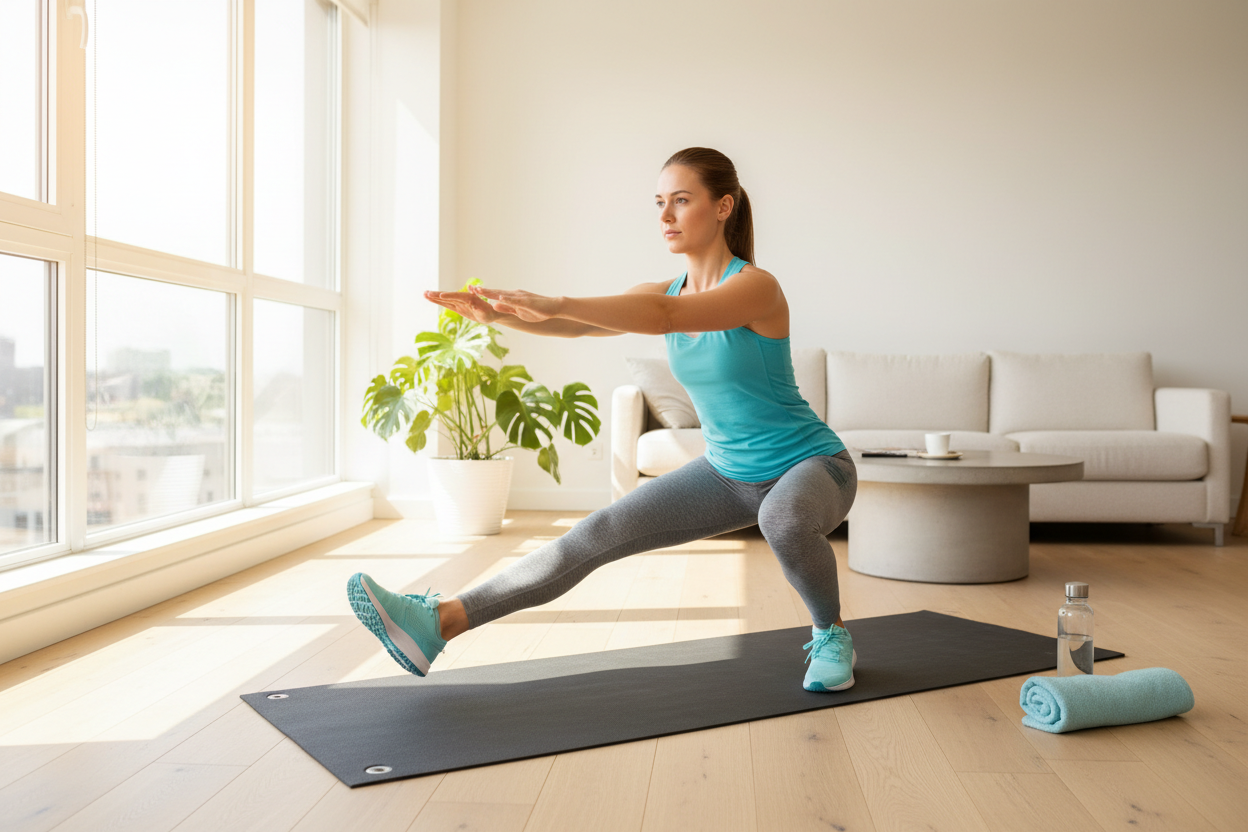
- Alternating Reverse Lunges: 12 reps per leg
- Single-Leg Glute Bridges: 15 reps per leg
- Wall Sit: Hold until failure
- Calf Raises (on a step edge): 20 reps
Progressive Overload Without Weights
You might wonder how to keep progressing once these exercises become easy. The answer is complexity. Move from a split squat to a skater squat (where the back foot hovers and doesn't touch the ground). Move from a regular squat to a pistol squat. You can also decrease rest times between sets or increase the total volume of work within a specific timeframe. The body does not know the difference between a metal plate and mechanical disadvantage; it only understands tension.
Frequently Asked Questions
Can I actually build muscle mass without weights?
Yes, you can build muscle mass using bodyweight exercises, especially if you are a beginner or intermediate trainee. The key is to take sets close to failure and use difficult variations like single-leg squats to ensure the resistance is sufficient to stimulate hypertrophy.
How often should I train my legs if I'm not using equipment?
Because bodyweight training generally causes less systemic fatigue than heavy spinal loading, you can train legs more frequently. A frequency of 2 to 3 times per week is effective, allowing at least 48 hours of recovery between sessions to let the muscles repair and grow.
What if I have bad knees?
Bodyweight training is often safer for knees than heavy lifting, but form is paramount. Focus on posterior chain exercises like glute bridges and box squats where you sit back onto a surface. Avoid explosive plyometrics until you have built up sufficient stability and strength.