
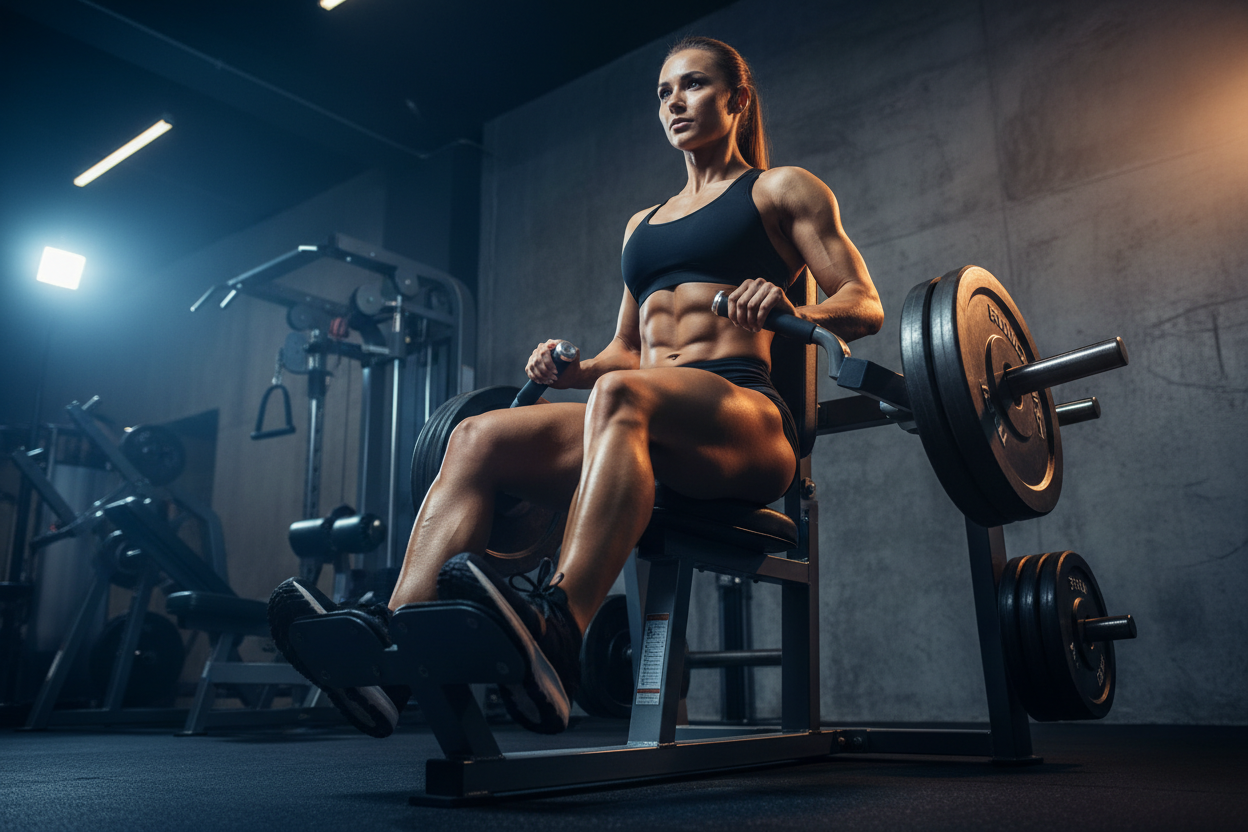
Build Powerful Hips With the Plate-Loaded Abductor Adductor Machine
Most leg days prioritize the big movers: squats, deadlifts, and leg presses. But if your knees cave in during a heavy squat or your hips feel unstable during a lunge, your prime movers aren't the problem. The issue usually lies in the stabilizers.
While selectorized (pin-loaded) machines are the industry standard, they often cap out on weight or suffer from friction drag. This is where the plate-loaded hip abductor and adductor exercise machine changes the game. It allows for a smoother strength curve, higher loading potential, and a level of isolation that cable stacks simply cannot match.
Key Takeaways
- Unlimited Progressive Overload: Unlike weight stacks that cap at 200-300 lbs, plate-loaded machines let you load as much as the pegs (and your hips) can handle.
- True Strength Curve: The leverage system provides consistent tension without the mechanical friction often found in cable-pulley systems.
- Stability Focus: Direct loading forces the glute medius (abduction) and adductor magnus (adduction) to stabilize the load immediately, reducing momentum cheating.
- Unilateral Capability: Many plate-loaded designs allow for single-leg work, correcting imbalances between the left and right hip.
Why Choose Plate-Loaded Over Weight Stacks?
Walk into most commercial gyms, and you'll see a line for the pin-loaded hip machine. It's convenient. You sit down, move a pin, and go. However, convenience often comes at the cost of biomechanical efficiency.
The Friction Factor
Pin-loaded machines rely on cables, pulleys, and guide rods. Over time, these components create drag. When you push out, you're fighting friction; when you return the weight, the friction aids you, effectively reducing the eccentric (negative) load. A plate-loaded machine operates on a pure leverage pivot point. What you lift is exactly what you feel on the way down, leading to greater muscle damage and growth stimulus.
Breaking the Weight Cap
For advanced lifters, maxing out the stack on a standard abduction machine is common. Once you hit that ceiling, progression stops. A plate-loaded design removes this ceiling. If you need to add a 2.5lb micro-plate or slap on another 45lb wheel, you can. This infinite scalability is essential for strength athletes.
Mastering the Setup
Because these machines are often built with heavy-duty leverage arms, your setup dictates your safety. Misalignment here is more punishing than on a cable machine.
Hip Alignment
Your hip joint needs to be directly in line with the machine's pivot point. If you sit too far forward or backward, you create sheer force on the knee rather than torque on the hip. Adjust the back pad until the axis of rotation runs specifically through your hip socket.
Foot Placement
Don't just rest your feet on the pegs. Drive through them. For abduction (pushing out), focus on driving through the heels to engage the glutes. For adduction (squeezing in), maintain flat foot contact to recruit the entire inner thigh musculature.
Programming for Hypertrophy vs. Stability
How you use this machine depends on your goal. It is versatile enough to handle heavy, low-rep work, which is risky on cable machines due to cable snapping potential.
For Strength: Perform 4 sets of 6–8 reps. Use a slow, 3-second eccentric phase. The plate-loaded mechanism shines here because the weight won't "catch" or jerk.
For Metabolic Stress: Perform 3 sets of 15–20 reps with short rest periods. The smooth pivot allows for a continuous rhythm, keeping constant tension on the muscle belly.
My Training Log: Real Talk
I want to be honest about the transition from cables to plates. The first time I used a Hammer Strength plate-loaded hip machine, I humbled myself quickly. On the cable stack, I was moving the whole stack comfortably. I threw two 45lb plates on each side of the lever machine, thinking it would be easy.
I was wrong. The dead-stop inertia is totally different. With cables, you can use a little "body English" to get the weight moving. With the plate-loaded arm, that weight is dead static. You have to grind out of the starting position.
Also, a small detail nobody mentions: the loading geometry. On some of these machines, the weight horns are positioned low and awkwardly behind the seat. Changing weights between sets—especially when your adductors are trembling from a drop set—is a workout in itself. You have to waddle around the machine, squat down, and slide the iron on. It’s gritty, it’s annoying, and it works. The soreness I felt in my upper glute shelf the next day was unlike anything I'd gotten from the selectorized version.
Conclusion
If you have access to a plate-loaded hip abductor and adductor exercise machine, stop ignoring it in favor of the convenient stack machine. The setup takes a minute longer, and loading the plates requires effort, but the payoff in hip stability and glute development is undeniable. Treat it as a primary accessory movement, load it heavy, and control the eccentric.
Frequently Asked Questions
Is the plate-loaded version safer than the cable machine?
Generally, yes. While it allows for heavier loads, the fixed pivot point reduces the risk of cable snaps or mechanical failure under load. However, because it allows for heavier weight, ensuring your hips are aligned with the pivot point is critical to prevent joint strain.
Can I use this machine if I have hip pain?
It depends on the source of the pain. For muscular weakness, this machine is excellent for rehabilitation because you can control the load precisely with micro-plates. However, if you have hip impingement, the fixed range of motion might aggravate it. Always consult a physiotherapist first.
How often should I train hip abduction and adduction?
Since these are smaller muscle groups compared to the quads or hamstrings, they recover relatively quickly. You can train them 2-3 times per week, ideally at the end of your leg workout to ensure your stabilizers aren't pre-fatigued for your heavy compound lifts.


