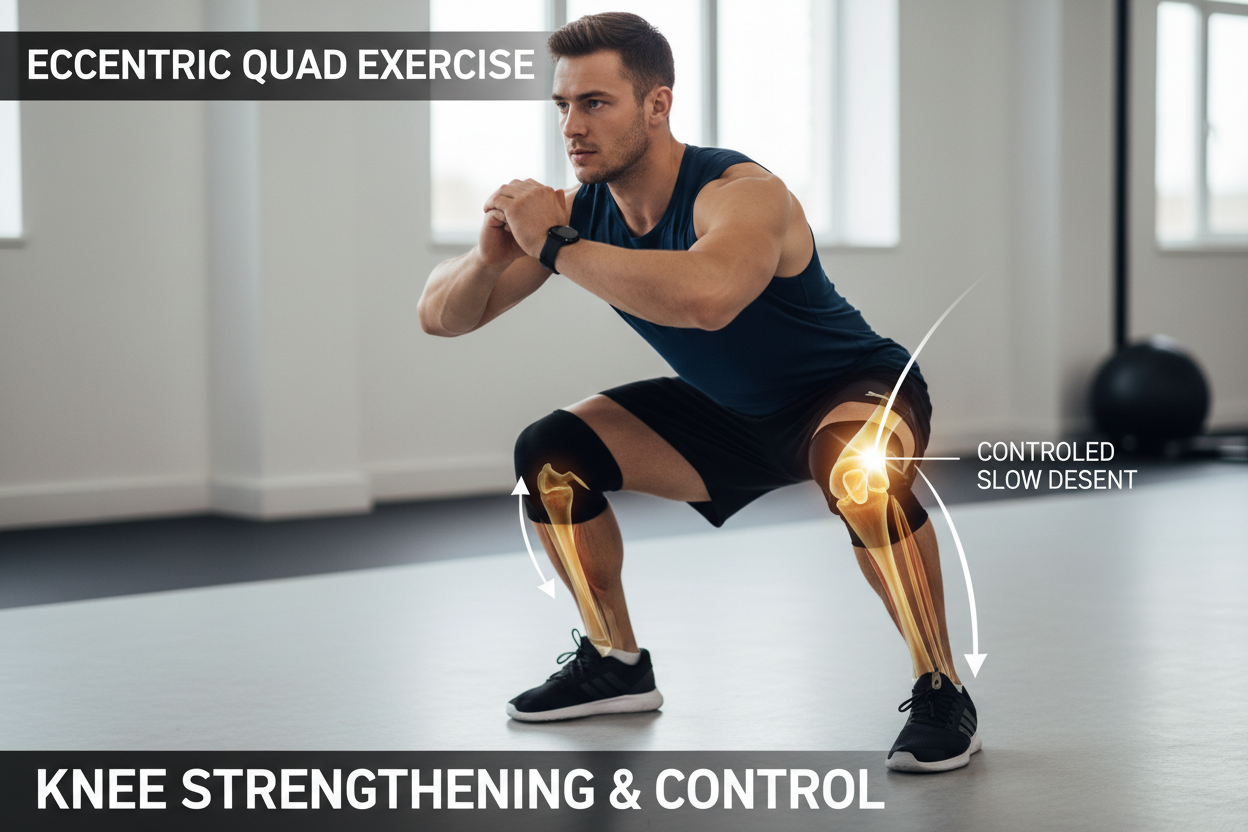
Build Bulletproof Knees: The Truth Behind Eccentric Quad Exercises Images
You have likely spent hours scrolling through eccentric quad exercises images, trying to decipher the perfect form to fix that nagging patellar tendonitis or break through a strength plateau. But here is the problem with static photos: they capture a moment, not the movement.
Eccentric training is all about the "negative" phase—the lengthening of the muscle under tension. A picture cannot show you the three-second count, the specific tremor in the vastus medialis, or the exact moment your hips want to cheat to relieve the pressure. To get the results you want, you need to understand the mechanics that those images are trying to convey.
Key Takeaways: Mastering the Eccentric Phase
Before you hit the gym, keep these core principles in mind. This is what separates effective rehab from wasted effort.
- Tempo is Everything: The "magic" happens during a 3-5 second lowering phase. If you drop too fast, you lose the benefit.
- Pain Monitoring: In eccentric quad exercises physical therapy contexts, a pain level of 3-4/10 is often acceptable, but it should not persist the next day.
- Vertical Shin Angle: Many eccentric quad movements require pushing the knees over the toes, contrary to old-school lifting advice.
- Isolation over Load: You do not need heavy weights. Bodyweight or light dumbbells are often sufficient when the tempo is strict.
Why Static Images Fail to Show the Whole Story
When you look at a diagram of a reverse Nordic curl or a step-down, you are seeing the end range. You aren't seeing the tension.
The science of eccentric loading focuses on lengthening the muscle fibers while they are contracting. This process creates micro-trauma that signals the body to repair the tissue stronger and in a more linear fashion. This is why it is the gold standard for treating tendinopathy.
If you just mimic the position in a photo without adhering to the tempo, you are merely stretching, not training.
The Best Eccentric Quad Exercises (And How to Visualize Them)
Since we are discussing the reality behind the visuals, let’s break down the best eccentric quad exercises and the specific cues you should look for.
1. The Poliquin Step-Up
In photos, this looks like a regular step-up. It isn't.
The Visual Cue: Look at the heel of the working leg. It should be elevated (often on a slant board or a plate). The non-working leg shouldn't just step down; it should reach forward, tapping the heel gently on the floor.
The Feeling: You should feel the burn directly above the kneecap (the VMO). If you are pushing off the back leg, you are cheating.
2. The Decline Single-Leg Squat
You will often see images of athletes on a slant board for this one. The board is crucial because it takes the ankle mobility out of the equation and puts 100% of the load on the quads.
The Visual Cue: The torso remains upright, almost rigid. If the image shows the athlete leaning forward, they are engaging their glutes and lower back, defeating the purpose.
3. The Reverse Nordic Curl
This is the king of eccentric movements but also the most dangerous if done incorrectly.
The Visual Cue: A straight line from knee to shoulder. The hips must remain extended. If the image shows a "break" at the hips (sitting down), the tension leaves the quads.
Physical Therapy Applications
When incorporating eccentric quad exercises physical therapy protocols, the goal isn't hypertrophy; it's tissue remodeling.
Tendons have poor blood flow. They respond best to mechanical load. The slow, grinding nature of eccentric movement forces the collagen fibers in the tendon to align correctly. Think of it like combing tangled hair; you have to go slow and straight to smooth it out.
My Training Log: Real Talk
Let me be honest about my experience with these movements. I spent six months rehabbing a jumper's knee issue, and the diagrams I found online didn't prepare me for the sensation of a true eccentric squat on a slant board.
The first time I did a proper 4-second descent on a 25-degree decline board, my leg started shaking violently halfway down. It wasn't just fatigue; it was a neurological panic. The specific "ratchet-like" feeling in the knee as I lowered myself was terrifying at first.
Also, nobody tells you about the friction. I was using a cheap wooden slant board, and the grip tape was so aggressive it actually started shredding the bottom of my socks because I was driving my toes into the board so hard to maintain balance. That's the detail the photos miss: the sheer amount of foot pressure required to keep your torso upright while your knees travel that far forward. The burn isn't a broad muscle pump; it's a very specific, hot sensation right at the insertion point of the quad.
Conclusion
Don't just collect eccentric quad exercises images on your phone. Analyze them. Look for the vertical torso, the forward knee travel, and the controlled descent. Whether you are an athlete looking for explosive power or a patient looking to walk without pain, the magic is in the slow, uncomfortable control of the movement.
Frequently Asked Questions
How often should I perform eccentric quad exercises?
For rehab purposes, high frequency is often used, sometimes daily or every other day. However, for general strength, treat them like any other heavy lift: 2-3 times per week to allow for recovery.
Can I do these if I have bad knees?
Generally, yes. Eccentrics are often the cure for "bad knees" (tendinopathy). However, you must respect your pain threshold. If pain exceeds a 4/10, reduce the range of motion or the load.
What is the difference between concentric and eccentric?
Concentric is the shortening of the muscle (lifting the weight), while eccentric is the lengthening (lowering the weight). Eccentric phases can handle significantly more load and are better for strengthening tendons.