Build a Massive Torso: The Ultimate Chest and Back Machine Workout
There is a persistent myth in the fitness industry that you must live and die by the barbell to build size. While free weights have their place, relying on them exclusively leaves a lot of growth potential on the table. If you want to isolate muscles without wasting energy on stabilization, a dedicated chest and back machine workout is often the superior choice for hypertrophy.
Machines provide a fixed path of motion. This stability allows you to drive every ounce of effort directly into the target muscle fibers rather than worrying about balancing a heavy bar over your neck. Let’s break down how to structure this training session for maximum width and thickness.
Key Takeaways
- Stability Equals Output: Machines remove the need for stabilization, allowing for higher mechanical tension on the pecs and lats.
- Antagonist Pairing: Alternating pushing and pulling movements reduces fatigue and keeps the pump localized in the torso.
- Safety at Failure: You can push to absolute muscle failure safely without a spotter.
- Volume Control: Machines allow for quicker drop sets and intensity techniques compared to plate-loaded bars.
Why Pair Chest and Back?
Pairing these two major muscle groups isn't just an old-school bodybuilding tactic; it is physiologically efficient. Chest and back are antagonist muscle groups. When your chest contracts (pushes), your back relaxes, and vice versa.
By utilizing this "Arnold Split" style, you flood the entire upper body with blood. This creates a massive pump that stretches the fascia, potentially aiding in muscle growth. Furthermore, because machines stabilize the load for you, you don't suffer from the core fatigue that usually ruins a free-weight chest and back session.
Selecting the Right Hardware
Not all equipment is created equal. When planning your chest and back workout gym machines selection, look for pieces that offer converging or diverging lines of motion. These mimic natural mechanics better than older, linear machines.
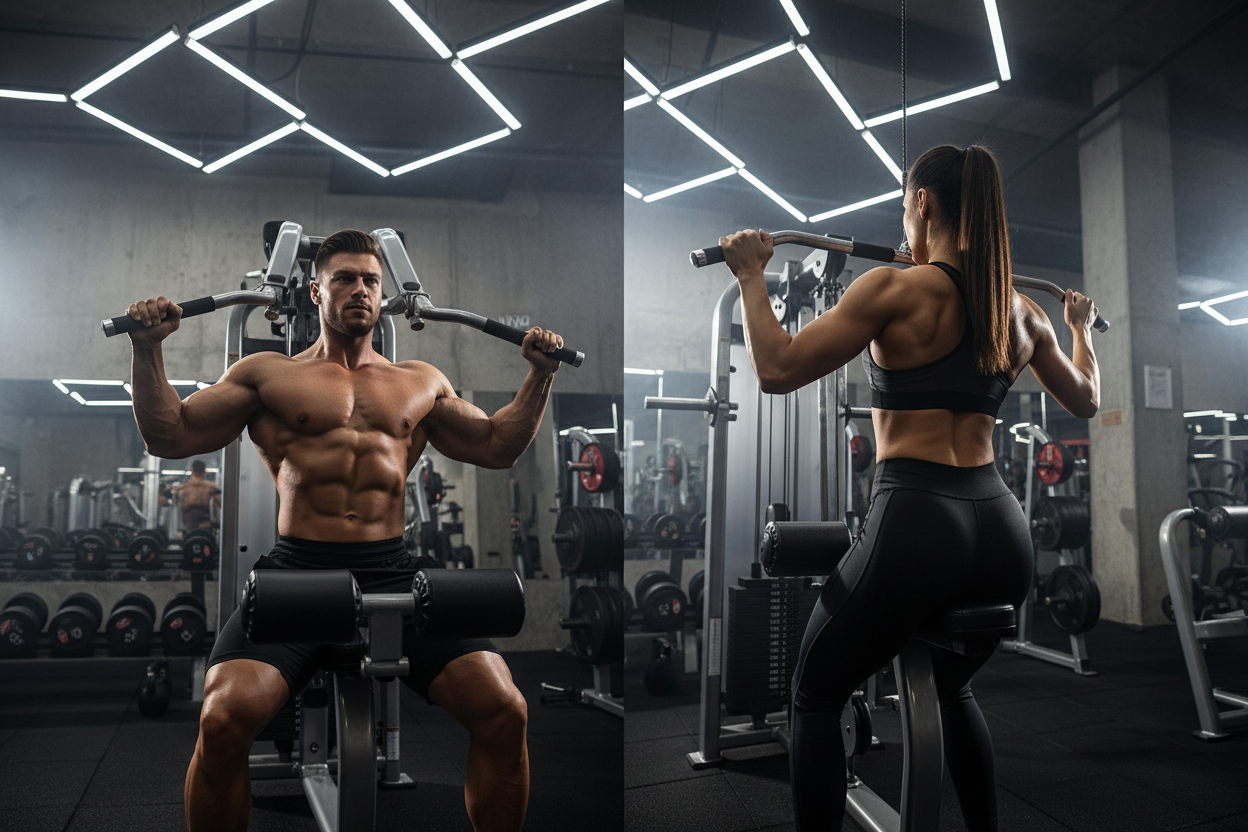
1. The Converging Chest Press
Standard bench presses lock your shoulders in a fixed position. A high-quality machine press allows your hands to come together at the top of the movement. This peak contraction is where the pectoral muscles work hardest.
The Cue: Don't just push the weight away. Imagine you are trying to bring your biceps together across your chest. Keep your elbows tucked slightly, not flared out at 90 degrees, to protect your rotator cuffs.
2. The Chest-Supported Row
This is the king of back thickness. Because your torso is pressed against a pad, you cannot cheat by using momentum from your hips (a common error with barbell rows).
The Cue: Initiate the pull by driving your elbows back, not by curling with your biceps. Squeeze your shoulder blades together at the peak like you are trying to crack a walnut between them.
3. The Machine Fly (Pec Deck)
Unlike dumbbell flyes, where tension is lost at the top of the rep, the machine fly provides constant tension throughout the entire range of motion.
The Cue: Keep a slight bend in your elbows. Visualize hugging a large tree barrel. Do not let the weight stack touch down between reps; keep the tension alive.
4. The Lat Pulldown
While technically a cable machine, it is a staple in the machine section. It targets the width of the back.
The Cue: Use a thumbless grip (hooks). Pull the bar down to your upper chest, not your belly button. If you have to lean back excessively to move the weight, it is too heavy.
Structuring the Session
To maximize efficiency, perform this workout using "Antagonist Paired Sets." Do a set of chest work, rest 60 seconds, then do a set of back work.
- A1: Converging Chest Press - 3 sets of 10-12 reps
- A2: Chest-Supported Row - 3 sets of 10-12 reps
- B1: Incline Machine Press - 3 sets of 12-15 reps
- B2: Lat Pulldown - 3 sets of 12-15 reps
- C1: Machine Fly (Pec Deck) - 3 sets of 15-20 reps
- C2: Machine Reverse Fly (Rear Delts) - 3 sets of 15-20 reps
My Training Log: Real Talk
I want to be transparent about what this workout actually feels like because the textbook diagrams don't tell you everything. I’ve spent years grinding on these machines, and there is a specific discomfort you need to prepare for.
Specifically, on the chest-supported row—the one I used for years was an old Hammer Strength plate-loaded iso-row. The padding was stiff, almost like concrete wrapped in vinyl. When you really load that machine up to hit failure in the 8-rep range, the pressure on your sternum is intense. It literally compresses your chest cavity.
I learned the hard way that you have to time your breathing perfectly. If you hold your breath while the pad is crushing your chest, you get lightheaded fast. I actually grayed out once mid-set because I wasn't exhaling on the pull. Also, let's talk about the machine chest press handles. Without chalk, once you start sweating during that third superset, those rubber grips get slick. I started bringing a small towel just to drape over the handles so I didn't lose force transfer due to slipping. It’s not glamorous, but that grip friction makes a difference between a mediocre set and a growth-inducing one.
Conclusion
Switching to a machine-focused split doesn't mean you are taking the easy way out. It means you are choosing precision over ego. By stabilizing your body and focusing on the pump, you can force growth in stubborn areas. Give this routine a run for six weeks, focus on progressive overload, and watch your shirt size change.
Frequently Asked Questions
Can I do this workout twice a week?
Yes, this volume is manageable for a twice-weekly frequency (e.g., Monday and Thursday). Because machines cause less systemic fatigue and central nervous system stress than heavy free weights, your recovery time is generally faster.
Is this suitable for beginners?
Absolutely. In fact, it is often better for beginners. Learning motor patterns on machines is safer and helps build a mind-muscle connection before moving to complex compound movements like barbell rows or bench presses.
Should I add arm work to this day?
You can, but be cautious. Your triceps take a beating during the chest presses, and your biceps are heavily involved in the rows and pulldowns. If you add arms, keep it to one isolation exercise per muscle group at the very end of the session.