Bodyweight Exercise Reddit Guide: The Recommended Routine Architecture and Home Training Setup
Online communities have fundamentally reshaped modern fitness culture, and nowhere is this clearer than the calisthenics community on Reddit. Centered largely around the r/bodyweightfitness forum, thousands of practitioners share training logs, form reviews, and progression notes. The centerpiece of this community knowledge is commonly referred to as the Recommended Routine, or simply the RR. For those stepping into bodyweight training, consulting a beginner workout plan guide helps clarify forum shorthand and training conventions before starting a dedicated regimen.
Understanding the Reddit Calisthenics Phenomenon and the Recommended Routine
Rather than relying on arbitrary collections of jumping jacks or high-repetition exhaustion circuits, the Reddit bodyweight fitness community built a structured, strength-oriented program. The routine emphasizes structural balance, progressive overload via leverage, and skill development that translates directly into functional capacity.
Core Principles of the r/bodyweightfitness Movement Architecture
At the center of the Reddit bodyweight routine is a comprehensive full-body approach. The movement architecture arranges exercises into opposing vectors: horizontal pushing against horizontal pulling, and vertical pushing against vertical pulling. When combined with leg strength and midline stabilization, this structure mirrors classical resistance training balance. Those seeking a broader perspective on structured splits can review a companion body weight workout guide to see how leverage-based routines mirror barbell training outcomes.
The Logic of Antagonistic Pairing in the RR Workout
A distinctive feature of the Recommended Routine is its reliance on antagonistic paired sets. Instead of completing all sets of one exercise before moving to the next, trainees alternate between opposing movement patterns, such as pairing pull-ups with dips or parallel bar push-ups with horizontal rows. By resting briefly between opposing movements, one muscle group recovers while its antagonist works. This technique preserves output quality, maintains movement velocity, and reduces the total duration of the workout without sacrificing recovery between high-effort sets.
Deconstructing the Routine: Core Movement Progressions
Progressive overload in calisthenics does not depend on adding external iron plates. Instead, resistance is scaled by manipulating mechanical leverage, adjusting joint angles, altering limb length, or modifying the body's center of gravity relative to the pivot point.
Upper-Body Vertical and Horizontal Vectors
The upper-body progression ladders represent the core strength builder of the routine. For horizontal pulling, trainees begin with incline rows on rings or bars, gradually lowering the angle until the torso is parallel to the ground, eventually progressing to feet-elevated inverted rows. Horizontal pushing moves from standard push-ups to diamond push-ups, pseudo planche push-ups, and ring dips.
Vertical mechanics follow a similar trajectory. Vertical pulling begins with negative pull-ups, progressing toward full dead-hang pull-ups and chest-to-bar variations. Vertical pushing transitions from pike push-ups on elevated surfaces toward wall-supported handstand push-ups. Each step systematically shifts more of the trainee's total body weight onto the working musculature.
Squat and Hinge Foundations for Calisthenics Athletes
Lower-body bodyweight training requires deliberate exercise selection to ensure sufficient mechanical tension. The community routine relies on unilateral variations to scale difficulty. Trainees advance from standard bodyweight squats to Bulgarian split squats, Cossack squats, and ultimately full single-leg pistol squats or shrimp squats. For the posterior chain, single-leg Romanian deadlifts and sliding hamstring curls challenge the hamstrings and glutes through extended ranges of motion.
Core Compression and Joint Conditioning
Calisthenics demands high levels of core compression and connective tissue resilience. The routine incorporates specialized floor positions, including hollow body holds, arch holds, and support holds on parallel bars or gymnastic rings. Static holds teach the athlete to maintain whole-body tension and reinforce neutral spinal positioning under load. Practicing these holds on an interval structure, as outlined in a beginner exercise workout guide, builds steady endurance without relying on chaotic movement patterns.
Designing a Calisthenics-Friendly Home Training Space
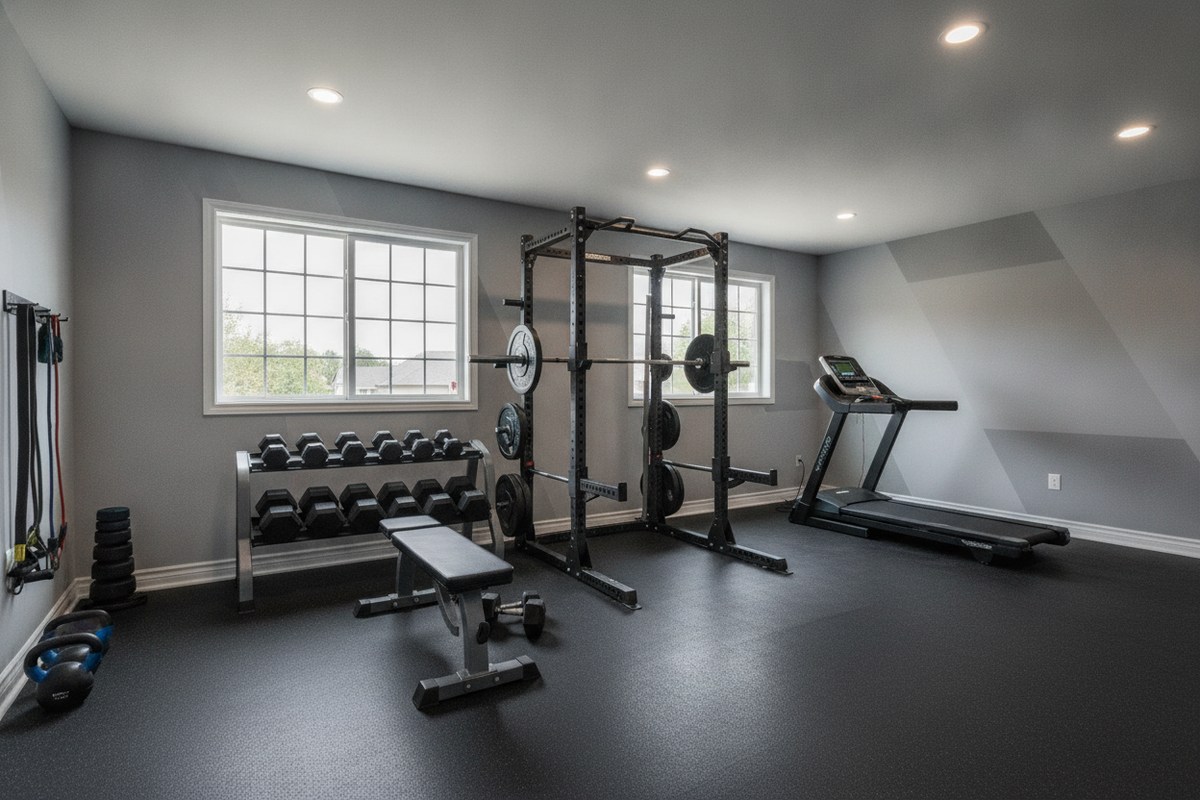
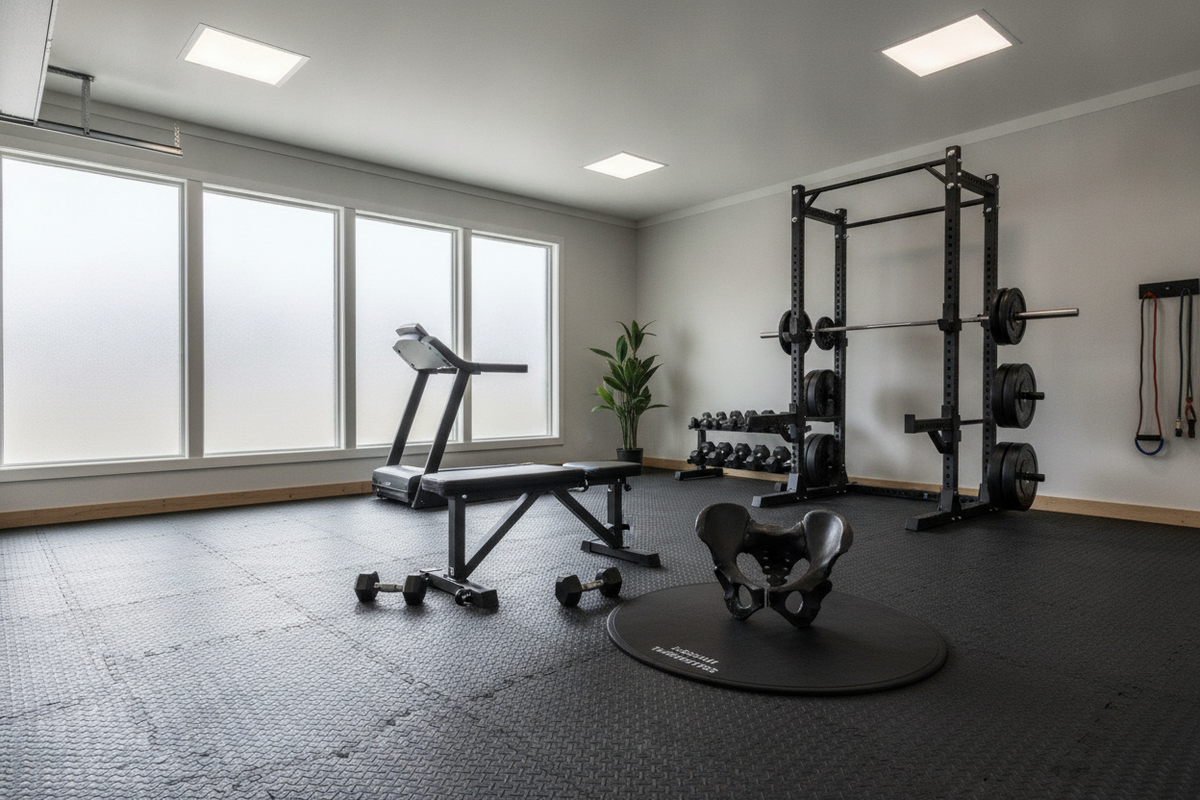
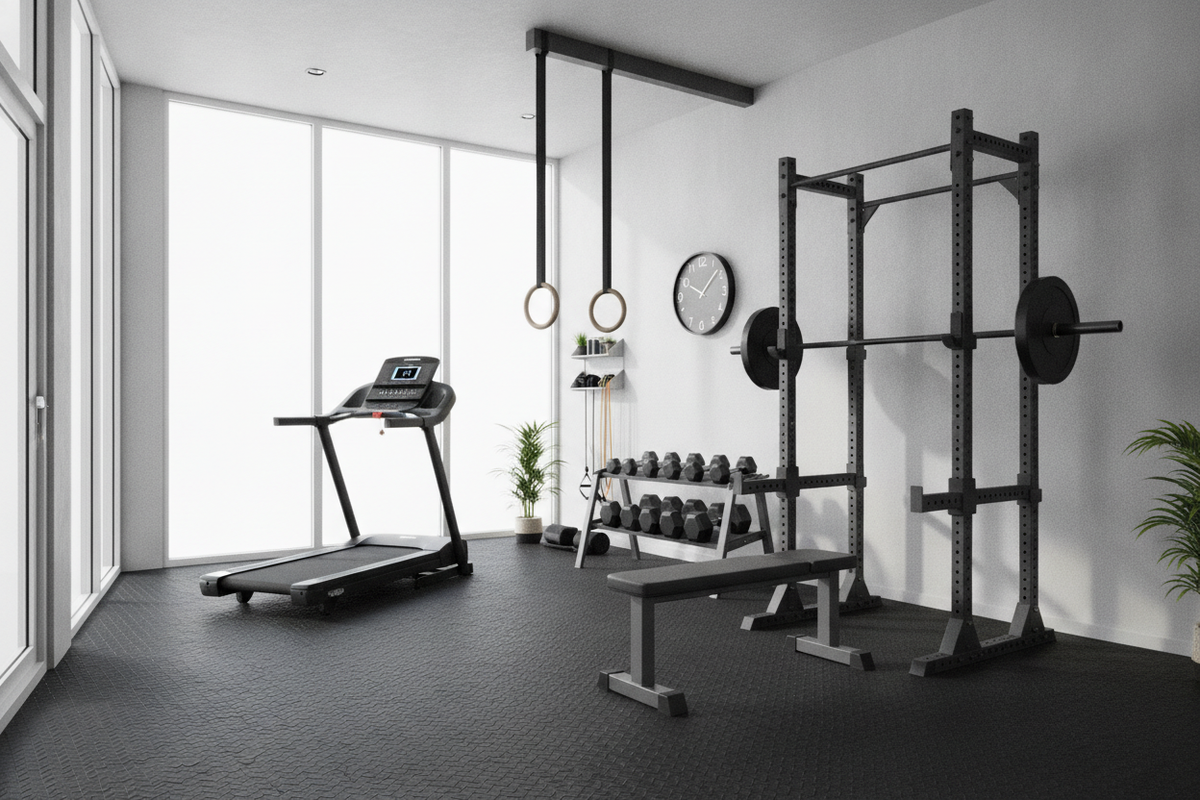
While calisthenics requires minimal gear, practicing dynamic leverage progressions on bare domestic floors can lead to discomfort, slippage, and premature wear on structural surfaces. Designing a stable home training area makes bodyweight movements safer and more repeatable.
Traction and Cushioning for High-Leverage Floor Exercises
Floor-based exercises such as push-ups, hollow body compressions, and handstand kick-ups require a reliable interface between the body and the floor. Slick hardwood or tile surfaces can cause the hands or feet to drift during loaded holds, breaking alignment and straining the wrists. A firm, high-density surface provides the necessary frictional grip while offering joint cushioning under palms, elbows, and knees. Setting up a dedicated training zone using an exercise resource like a broad, textured gym mat ensures a consistent foundation for complex floor transitions.
Subfloor Protection Around Pull-Up Stations and Parallettes
Many practitioners set up portable doorway pull-up bars, free-standing power towers, or low parallettes. High-friction floor mats shield the underlying residential floor from point loading and hardware scuffs. Moreover, dismounting from a pull-up bar or ring support generates focal impact forces. High-density floor padding absorbs these landings, reducing noise transmission across living quarters and buffering repetitive joint stress upon foot strike.
Programming Adjustments: From Beginner Foundations to Sustained Progress
Sustained success with the Reddit bodyweight routine depends on intelligent volume management and consistent movement execution rather than rushing through progression tiers.
Managing Frequency and Session Recovery
The standard framework suggests performing the full routine three times per week, with at least one rest day between training sessions. Calisthenics movements place unique stresses on tendons, particularly around the elbows and shoulders, which adapt more slowly than muscular tissue. Respecting non-training days and incorporating light mobility work prevents overuse fatigue and maintains joint health across long training cycles.
Troubleshooting Plateaus and Form Deviations
When progress halts on a specific movement step, the most common culprit is form breakdown or attempting to jump across progression tiers too quickly. Trainees can troubleshoot stagnation through simple programming adjustments:
- Regression for Volume: Step back to an earlier progression variation to accumulate clean, high-quality volume before retesting the challenging progression.
- Tempo Control: Introduce controlled eccentric phases, such as lowering over three to four seconds, to strengthen joint control throughout the range of motion.
- Isometric Pauses: Add brief static pauses at the most mechanically disadvantaged point of the movement, such as the bottom of a push-up or row.
Best Practices for Maintaining Home Calisthenics Equipment and Matting
Preserving the durability and hygiene of calisthenics equipment requires straightforward, regular upkeep. Wooden gymnastic rings should be kept dry and stored away from excess humidity to prevent splintering or warping. Doorway pull-up bars require regular bolt inspection to confirm secure anchoring.
For protective flooring and floor mats, maintaining surface cleanliness preserves traction. Sweat, ambient dust, and chalk can degrade surface grip over time. Wiping surfaces down with a mild detergent and water solution keeps the material grippy and hygienic. When planning long-term installations, reviewing material details on an exercise resource page will help you choose mats that resist tearing from athletic footwear while remaining simple to sanitize.