Best Workout for Buttocks and Thighs: Biomechanical Movement Pillars, Lower-Body Sequencing, and Floor Staging
Designing an effective lower-body routine requires more than cycling through random leg movements. The best workout for buttocks and thighs balances movement planes, joint actions, and muscular tension across the entire lower kinetic chain. By organizing exercises around distinct biomechanical vectors—knee-dominant squats, hip-dominant hinges, unilateral split stances, and targeted pelvic thrusts—you can build balanced strength in the gluteal complex, quadriceps, hamstrings, and adductors while maintaining joint integrity.
Understanding Lower-Body Biomechanics: The Glute and Thigh Synergy
The glutes and thighs operate as an integrated functional unit. The gluteus maximus serves as the primary hip extensor and external rotator, working in tandem with the hamstrings along the posterior chain. Simultaneously, the quadriceps drive knee extension, while the adductor group stabilizes the pelvis and assists hip flexion and extension depending on joint angle.
When developing balanced workouts for buttocks and thighs, training must address both vertical and horizontal force vectors. Knee-dominant patterns place significant load on the anterior thighs, whereas hip-dominant patterns shift the mechanical demand toward the posterior thighs and gluteal structures. Integrating both ensures symmetrical muscular development and healthy movement mechanics throughout daily activities and athletic pursuits.
Core Movement Pillars for Buttocks and Thighs
To establish a reliable routine, exercises should be categorized by their primary movement mechanics. Selecting movements from each category creates a balanced structure that targets every major lower-body muscle group without creating overuse patterns. For deeper coaching insights on movement selection, review our guide to the best exercise for thighs and buttocks.
Knee-Dominant Foundations: Squat Variations and Step Patterns
Knee-dominant exercises emphasize quadriceps recruitment while challenging the glutes through deep hip flexion. Goblet squats and front-loaded squat variations encourage an upright torso, shifting tension onto the front of the thighs while requiring active glute engagement at the bottom of the descent. Step-ups on an elevated platform extend this stimulus by isolating each leg through full hip and knee extension. Exploring various exercises for thighs and bum helps identify which squat variations best match individual mobility levels.
Hip-Dominant Anchors: Hinges and Thrusts
Hinge and thrust movements form the core of posterior-chain training. Romanian deadlifts load the hamstrings and glutes in an elongated, stretched position, demanding strong pelvic control and hamstring flexibility. In contrast, barbell or dumbbell hip thrusts load the gluteus maximus in its fully shortened state at peak hip extension. Combining a lengthened-position hinge with a shortened-position thrust provides comprehensive tension across the hips, representing some of the best thigh and buttocks exercises available for home or commercial gym setups.
Unilateral Stability: Split Squats and Dynamic Lunges
Single-leg exercises address side-to-side strength discrepancies while recruiting the gluteus medius and adductors for pelvic stabilization. Bulgarian split squats place the rear foot on an elevated surface, creating deep stretch and tension in both the working glute and quadricep. Reverse lunges and lateral lunges offer dynamic options that train the lower body across multiple planes, making them staple best thigh and bum exercises for functional strength.
Structuring the Complete Lower-Body Training Framework
An organized workout session follows a logical sequence from complex multi-joint movements to focused single-joint or unilateral exercises. Here is an actionable framework for organizing a complete lower-body training session:
- Preparation and Activation: Dynamic hip openers, bodyweight glute bridges, and ankle mobility drills to prepare the joints.
- Primary Compound Anchor: Heavy bilateral movement such as a back squat, goblet squat, or barbell hip thrust to build base strength.
- Secondary Posterior Hinge: Romanian deadlift or stiff-leg deadlift targeting hamstring length and glute tension.
- Unilateral Builder: Bulgarian split squat, walking lunge, or high step-up to challenge balance, pelvic stability, and individual leg power.
- Targeted Finisher: Lateral band walks, cable kickbacks, or lying leg curls to thoroughly fatigue supporting muscle fibers under controlled tempos.
Managing rest intervals and maintaining controlled eccentric phases throughout each movement ensures high-quality muscle recruitment without relying on momentum.
Floor Staging and Joint Comfort for Lower-Body Workouts
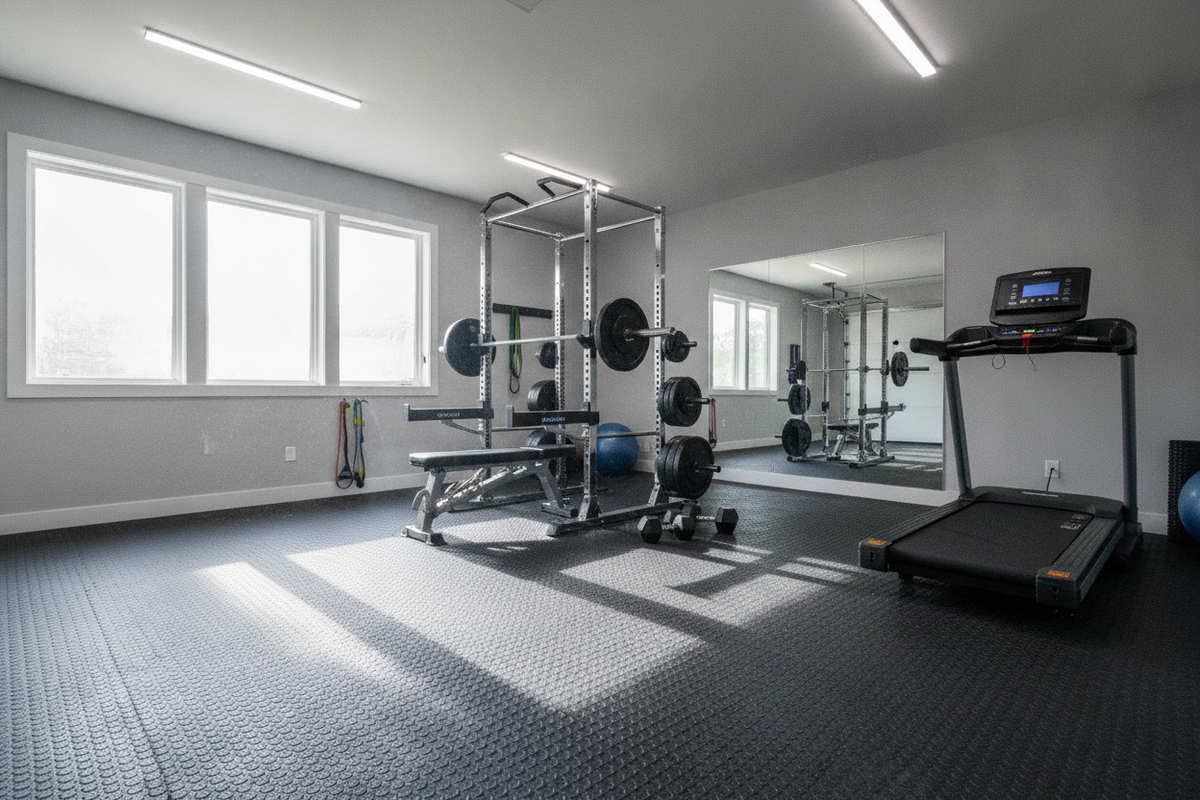
Lower-body workouts demand a stable, supportive ground interface. Deep lunges, kneeling hip thrusts, and heavy barbell setups exert concentrated force on the floor and place pressure on contact points such as the knees and hips. Performing these movements on hard, slick surfaces can lead to joint discomfort and slipping, while overly soft foam can compromise ankle stability during heavy squats.
Using a dedicated large exercise mat provides a non-slip foundation that keeps your feet firmly planted during wide-stance squats and lunges. Furthermore, outfitting your training space with high-density gym flooring cushions joints during ground-contact exercises, absorbs the impact of dropped free weights, and protects the underlying subfloor from wear over time.
Equipment Layout and Mat Maintenance for Home Gyms
To maintain a smooth workout flow, arrange your equipment logically across your workout floor. Position benches and weight racks along the perimeter of your mat space, leaving a clear central area for dynamic movements like walking lunges and Romanian deadlifts. Ensure that free weights, resistance bands, and collars are easily accessible to keep transition times efficient.
Maintaining gym flooring is straightforward. Wipe down mat surfaces regularly with a mild, non-abrasive soap solution and water after intense sessions to remove sweat and dust. Allowing the flooring to air-dry fully preserves traction and keeps your training environment clean and functional for every session.