Best Weight to Start Lifting: Baseline Selection Frameworks, Movement Calibration, and Home Setup
Baseline Selection: How to Determine What Weight to Start Lifting
Choosing an appropriate initial resistance level is one of the most critical decisions when beginning a strength routine. Selecting an arbitrary load based on what others lift often leads to compromised mechanics, whereas picking an overly conservative resistance without a plan can stall early adaptation. The goal during your introductory sessions is not to test maximum output, but to establish a dependable baseline where technique remains consistent through every repetition.
A practical method for determining what weight to start lifting involves qualitative assessment tools such as the Repetitions in Reserve framework. Under this concept, a working baseline is defined as a weight that allows you to complete a target set while feeling confident that you could execute several additional clean repetitions with identical posture and control. Combining this self-assessment with smooth movement speed ensures that the central focus stays on motor learning. For a comprehensive overview of structuring your introductory training schedule, exploring a start lifting guide provides structured guidance on session layout and weekly frequency.
Starting Weight Frameworks Across Movement Archetypes
Different movement patterns utilize distinct muscle groups, joint configurations, and leverage points. As a result, the best weight to start lifting varies substantially depending on whether the exercise is a multi-joint compound movement or a single-joint isolation drill. Categorizing movements into archetypes helps establish sensible starting boundaries.
Lower Body Compound Patterns: Hip Hinges and Squats
Lower body multi-joint movements, such as goblet squats, barbell back squats, and Romanian deadlifts, engage large muscle groups across the hips, thighs, and posterior chain. Despite the capacity of these muscle groups to handle higher loads, beginners benefit from starting with unweighted variations or light external implements such as a single moderate dumbbell or an empty bar.
Beginning with minimal external resistance allows you to map out your full range of motion, confirm proper knee tracking, and stabilize the torso before adding progressive loads. When exploring options across a dedicated weight lifting collection or setting up free weights, beginning with foundational movement drills ensures joint alignment is dialed in before increasing resistance.
Upper Body Push and Pull Patterns
Upper body compound exercises encompass vertical and horizontal presses alongside overhead and horizontal rows. Upper body muscle groups generally have smaller cross-sectional areas and different leverage dynamics compared to lower body musculature. Consequently, starting loads for overhead presses and dumbbell bench presses should be calibrated more conservatively.
A common starting point for upper body presses involves light dumbbells or an empty training bar, allowing the shoulder girdle and scapular stabilizers to move freely through their full, natural range. For pulling movements such as chest-supported rows or lat pulldowns, select a resistance that permits a momentary hold at peak contraction without requiring momentum from the lower back.
Isolation and Accessory Movements
Single-joint exercises, including lateral raises, bicep curls, and tricep extensions, focus on individual muscle groups and place direct demand on single joints. These exercises require strict load management because excessive weight quickly prompts compensatory body swing.
- Lateral raises: Begin with very light dumbbells where the arms can elevate in the scapular plane with zero torso sway.
- Arm flexors and extensors: Select a load that permits controlled eccentric lowering over a steady tempo.
- Core accessories: Prioritize static stability and controlled breathing patterns before introducing weighted resistance.
Step-by-Step Calibration Protocol for Your First Session
Rather than guessing your working weights ahead of time, apply a sequential ramp-up protocol during your initial training day to pinpoint precise baselines for each movement.
- Movement Rehearsal: Perform a warm-up set using only bodyweight or an unloaded bar to confirm joint path and comfort through full range.
- Incremental Resistance Addition: Introduce a modest increment of external load and complete a short set, evaluating balance, stability, and tempo.
- Velocity and Form Assessment: If bar speed remains steady and posture does not falter, evaluate your perceived effort. If the effort feels light, add another modest increment.
- Baseline Identification: Stop adding weight when the set feels moderately challenging yet you retain the ability to perform multiple additional clean repetitions. Record this load as your starting working weight.
Progressive Overload Rules for Beginners
Once you establish your baseline weights, progress should follow a steady, systematic structure rather than rapid day-to-day jumps. A widely adopted approach for new lifters is double progression, which prioritizes repetition volume before increasing external resistance.
Under double progression, you work within a target repetition window, such as eight to twelve repetitions per set. You maintain your established baseline weight across consecutive workouts until you can complete the upper repetition threshold with consistent form on all prescribed sets. Only after reaching that mark do you introduce the smallest available weight increment and reset back to the lower end of the repetition range. This conservative progression protects movement quality and builds confidence across sessions.
Home Training Floor Staging and Environmental Protection
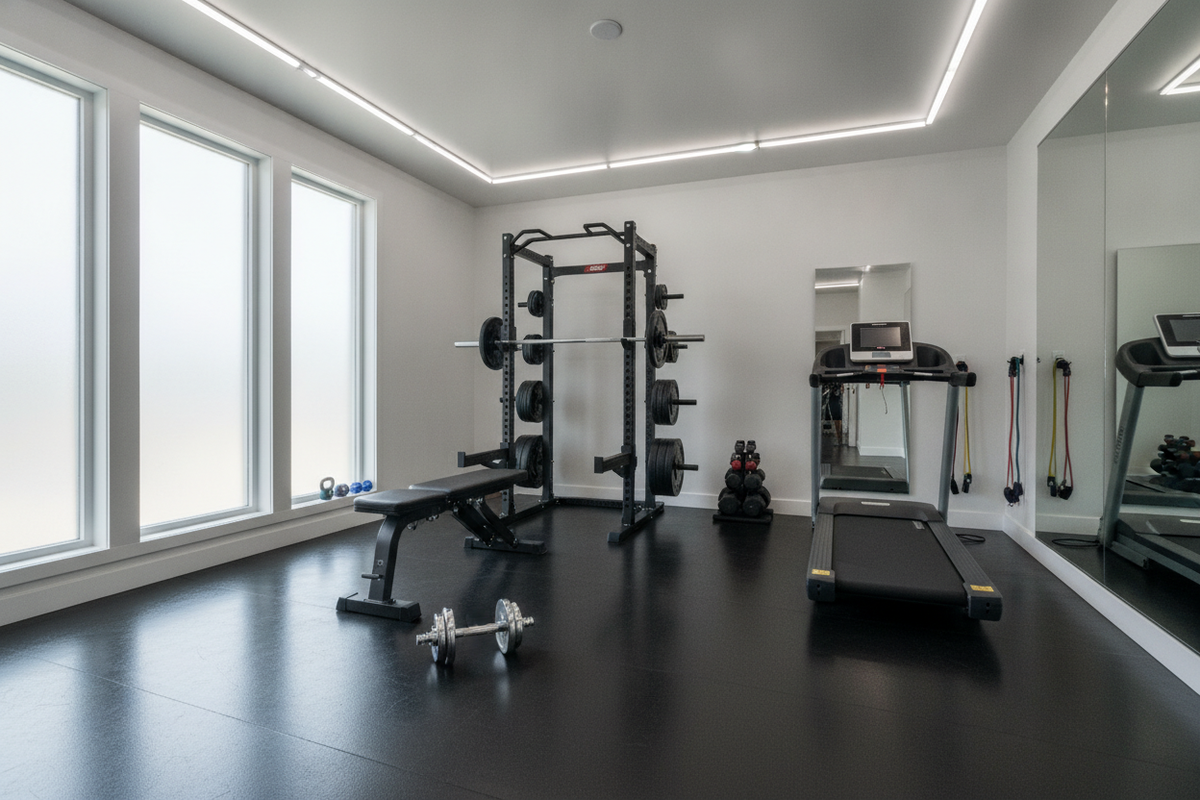
Calibrating starting weights in a home training environment requires proper flooring and equipment staging. When testing unfamiliar loads, stable footing and predictable traction are necessary to maintain balance during compound squats and presses.
High-density gym mats provide a firm, non-yielding foundation that prevents foot slippage and supports balanced force transfer through the floor. In addition, appropriate matting buffers incidental contact between dropped plates, dumbbells, and underlying subfloors during unexpected re-racking or fatigue. Arranging your training zone with dedicated plate storage, uncluttered walking paths, and level floor coverage creates a controlled space for baseline testing. For detailed floor planning and layout advice, consulting an in-depth weight lifting guide helps you optimize your home gym footprint.
Common Beginner Load Mistakes and Practical Fixes
Many common setbacks during the first months of training stem from simple weight selection oversights. Recognizing these patterns early allows for smooth adjustments.
- Premature Load Escalation: Adding weight each session regardless of execution quality often results in abbreviated ranges of motion. Fix: Keep the weight constant until every repetition achieves full, uncompromised depth.
- Ignoring Accessory Load Scaling: Attempting to increase isolation exercise weights at the same rate as compound lifts can overload smaller muscle groups. Fix: Use smaller micro-increments or add repetitions instead of heavy plate jumps on accessory work.
- Inconsistent Rest Periods: Testing baseline weights with erratic rest intervals skews perceived exertion. Fix: Standardize rest periods to keep fatigue levels predictable during calibration sets.