Best Resistance Training Exercises: Movement Blueprints, Program Design, and Home Floor Setup
Foundational Mechanics of Effective Resistance Training
Structured resistance training relies on mechanical principles that govern how muscles produce force against external loads. By understanding how tension distributes across muscle groups and joints, lifters can select movements that promote balanced strength development and durable movement mechanics.
Compound Movement Patterns vs. Single-Joint Isolation
Multi-joint compound movements recruit several muscle groups across multiple articulations simultaneously. These foundational exercises allow for greater load management and reinforce natural coordination patterns. While single-joint isolation movements have utility for focused muscular emphasis, multi-joint lifts typically serve as the primary framework for efficient, time-tested strength routines.
Balancing Bilateral Stability with Unilateral Mechanics
Bilateral movements involve both limbs working simultaneously, providing an inherently stable base that allows for substantial total loading. Conversely, unilateral movements train one limb independently, challenging rotational stability and exposing subtle side-to-side discrepancies. A well-rounded regimen integrates both approaches to build symmetrical control and resilient joint mechanics.
The Best Resistance Training Exercises by Movement Vector
Categorizing resistance exercises by their primary biomechanical force vector ensures that all major kinetic chains receive adequate stimulus. This structural approach simplifies workout construction and ensures balanced muscular development.
Knee-Dominant Patterns: Squat and Lunge Variations
Knee-dominant movements primarily load the quadriceps, glutes, and adductors while demanding upright trunk control. The barbell back squat serves as a cornerstone for lower-body power, while the front squat places greater emphasis on anterior core rigidity and quadriceps recruitment. For home lifters working with dumbbells or kettlebells, goblet squats offer an accessible way to master depth and torso positioning. Unilateral variations like reverse lunges and split squats challenge balance while strengthening each leg independently. For expanded lower-body mechanics, review this resistance training exercise guide.
Hip-Dominant Patterns: Deadlifts and Hip Thrusts
Hip-dominant movements emphasize the posterior chain, including the hamstrings, gluteal complex, and spinal erectors. Romanian deadlifts reinforce hip-hinge mechanics by loading the hamstrings under controlled tension. Conventional deadlifts build total-body pulling power from the floor. Barbell or dumbbell hip thrusts isolate hip extension with minimal spinal compression, making them an effective tool for targeted glute development.
Upper-Body Push: Overhead and Horizontal Pressing
Upper-body pressing movements develop the pectoral muscles, anterior deltoids, and triceps. The flat barbell bench press and dumbbell floor press provide horizontal pressing vectors that build upper-torso mass and pressing control. Standing overhead presses demand shoulder strength and dynamic core stabilization. To explore broader pressing variations, examine this workout exercise training guide.
Upper-Body Pull: Rows and Vertical Traction
Pulling exercises balance pressing volume by targeting the latissimus dorsi, rhomboids, trapezius, and posterior deltoids. Bent-over barbell rows and chest-supported dumbbell rows train horizontal pulling strength while reinforcing scapular retraction. Vertical pulling exercises, such as strict pull-ups and lat pulldowns, develop back width, shoulder stability, and grip endurance.
Loaded Carries and Anti-Rotation Core Stability
Core stability involves resisting unwanted spinal movement under load rather than simply flexing the torso. Loaded carries, including farmer walks and single-arm suitcase carries, challenge grip strength and dynamic trunk stabilization. Exercises like the Pallof press teach the body to resist rotational forces. For additional core-focused perspectives, consult this exercise training guide.
Designing a Balanced Resistance Training Program
Structuring exercises into a consistent schedule requires balancing training frequency, recovery intervals, and progressive overload principles. Choosing appropriate equipment from a dedicated training collection supports consistent workout execution.
Full-Body vs. Upper-Lower Workout Splits
Full-body routines hit every major movement pattern across several weekly sessions, making them efficient for lifters with limited training days. Upper-lower splits divide training sessions by region, allowing for higher volume per muscle group with dedicated recovery windows. Lifters comparing training frequencies can reference this resistance training exercise guide to assess which structure best matches their schedule.
Progression Strategies and Volume Management
Long-term progress requires systematically increasing training stimulus over time. Rather than changing exercises frequently, lifters can progress by gradually increasing resistance, adding repetitions, improving movement control, or modifying tempo while keeping overall set volume within manageable recovery limits.
Home Gym Floor Staging and Equipment Layout for Heavy Lifting
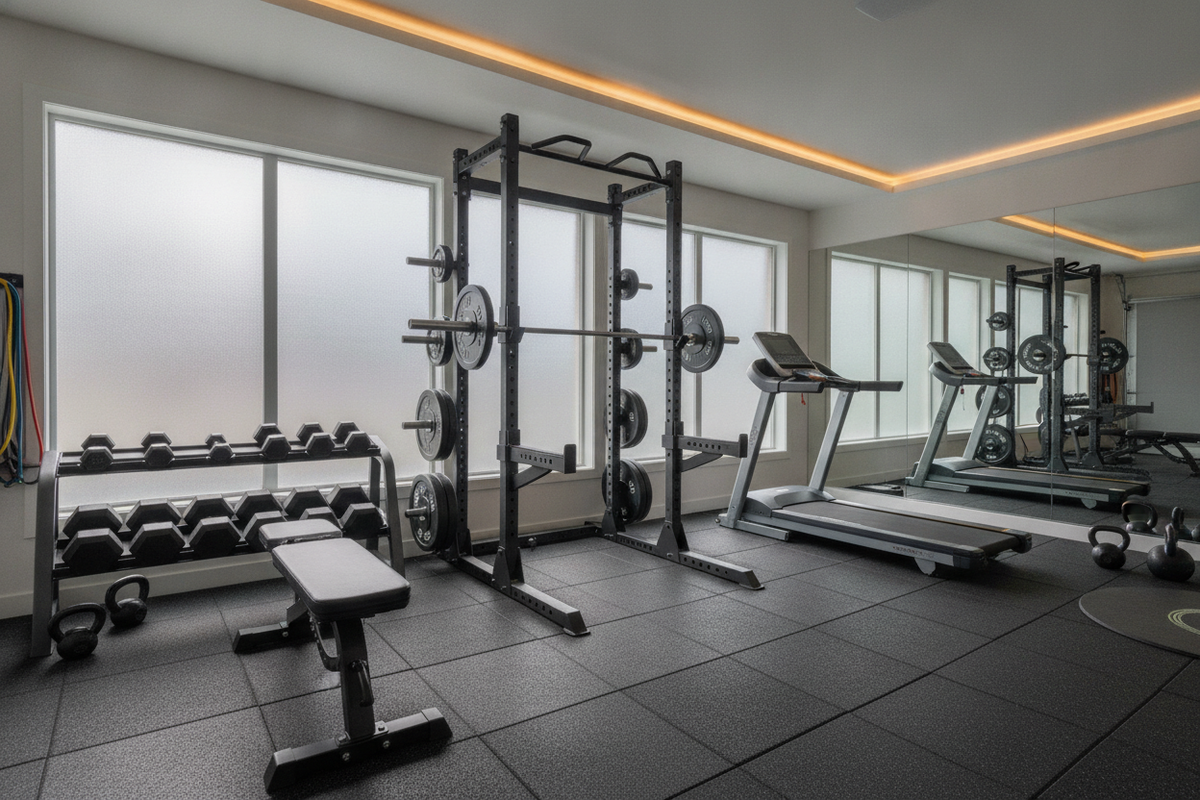
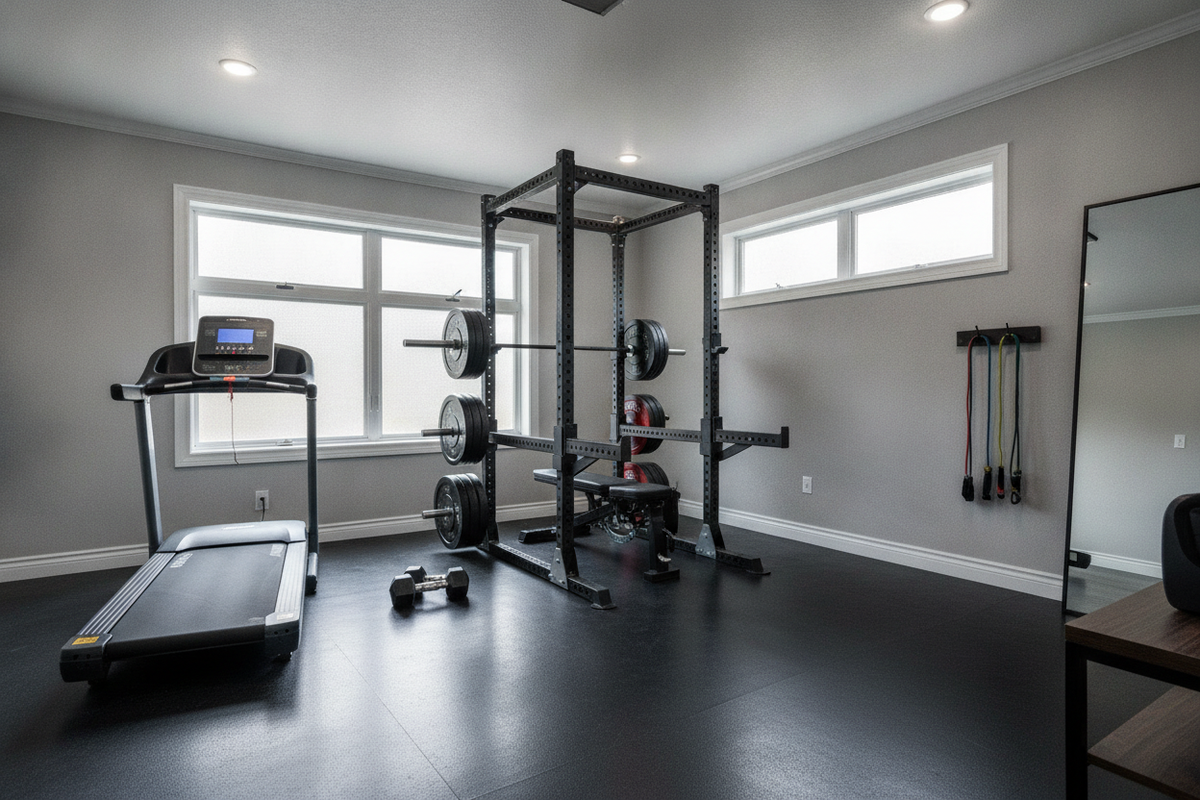
Lifting heavy weights at home introduces specific environmental requirements. A dedicated, protected floor surface ensures proper footing and guards residential subfloors against point-loading stress.
Subfloor Protection and Dense Matting Selection
Heavy barbells, dumbbells, and weight racks concentrate substantial force onto small surface areas. Dense rubberized flooring distributes this weight across a wider footprint, helping protect concrete or wooden subfloors from cracking, scratching, or structural wear.
Traction, Stability, and Footwear Grounding
Executing heavy compound lifts requires a firm, unyielding base. High-traction, non-slip mat surfaces prevent foot slippage during maximal efforts, heavy squats, and loaded carries. Pairing stable matting with flat, non-compressible footwear maximizes force transfer from the floor through the kinetic chain.
Mat Maintenance and Cleanliness in High-Tension Zones
Sweat, chalk, and dust can accumulate in high-traffic lifting zones, potentially degrading surface grip over time. Regular sweeping and wiping with mild, non-corrosive cleaning solutions maintain surface texture, preserve rubber durability, and ensure a clean training space.