Best Machine Exercises: The Ultimate Guide to Hypertrophy
For years, the fitness industry has perpetuated a myth: if you aren't clanging heavy iron, you aren't growing. But looking at the training regimens of top bodybuilders and exercise scientists reveals a different truth. Stability is the precursor to force production. By removing the need to balance a heavy barbell, the best machine exercises allow you to direct 100% of your effort into the target muscle, often leading to superior stimulus and growth.
If your goal is pure hypertrophy (muscle growth) rather than specific powerlifting strength, machines aren't just an alternative; they are often the superior tool. This guide strips away the stigma and focuses on the mechanics of machine-based training.
Key Takeaways
If you are looking for the most effective movements to include in your routine, here is the shortlist of high-ROI machine exercises:
- Hack Squat: targets quads with high intensity while sparing the lower back.
- Seated Hamstring Curl: Superior to lying curls due to the stretched position of the hamstrings.
- Converging Chest Press: Allows for a greater range of motion and safer failure point than bench pressing.
- Chest-Supported Row: Eliminates momentum and lower back fatigue for pure lat/rhomboid isolation.
- Cable Lateral Raise: Provides constant tension throughout the entire movement curve compared to dumbbells.
The Science: Why Stability Matters
The primary argument for a best machine workout is the stability profile. When you squat with a barbell, your nervous system spends significant energy stabilizing your core, hips, and ankles. When you use a machine, that stability is provided externally.
This means the limiting factor of the set becomes the actual strength of the target muscle, not your ability to balance. This creates a higher "mechanical tension"—the main driver of muscle growth—with less systemic fatigue.
The Upper Body Essentials
The Converging Chest Press
Forget the flat bench for a moment. The standard barbell locks your hands in a fixed position, which isn't how your pecs naturally function. The pecs want to bring the arm across the body (adduction).
A high-quality converging chest press machine allows your hands to start wide and finish close together. This mimics the natural function of the chest fibers. Look for a machine with a foot pedal to help you get the handles into position; this saves your rotator cuffs before the set even begins.
The Chest-Supported Row
The bent-over barbell row is a classic, but it is often limited by lower back endurance rather than lat strength. By the time your lats are close to failure, your spinal erectors are screaming.
The chest-supported row fixes this. By bracing your torso against a pad, you eliminate momentum (cheating) and remove the load from your spine. This ensures that when you end the set, it's because your back muscles are exhausted, not because your posture gave out.
The Lower Body Builders
The Hack Squat
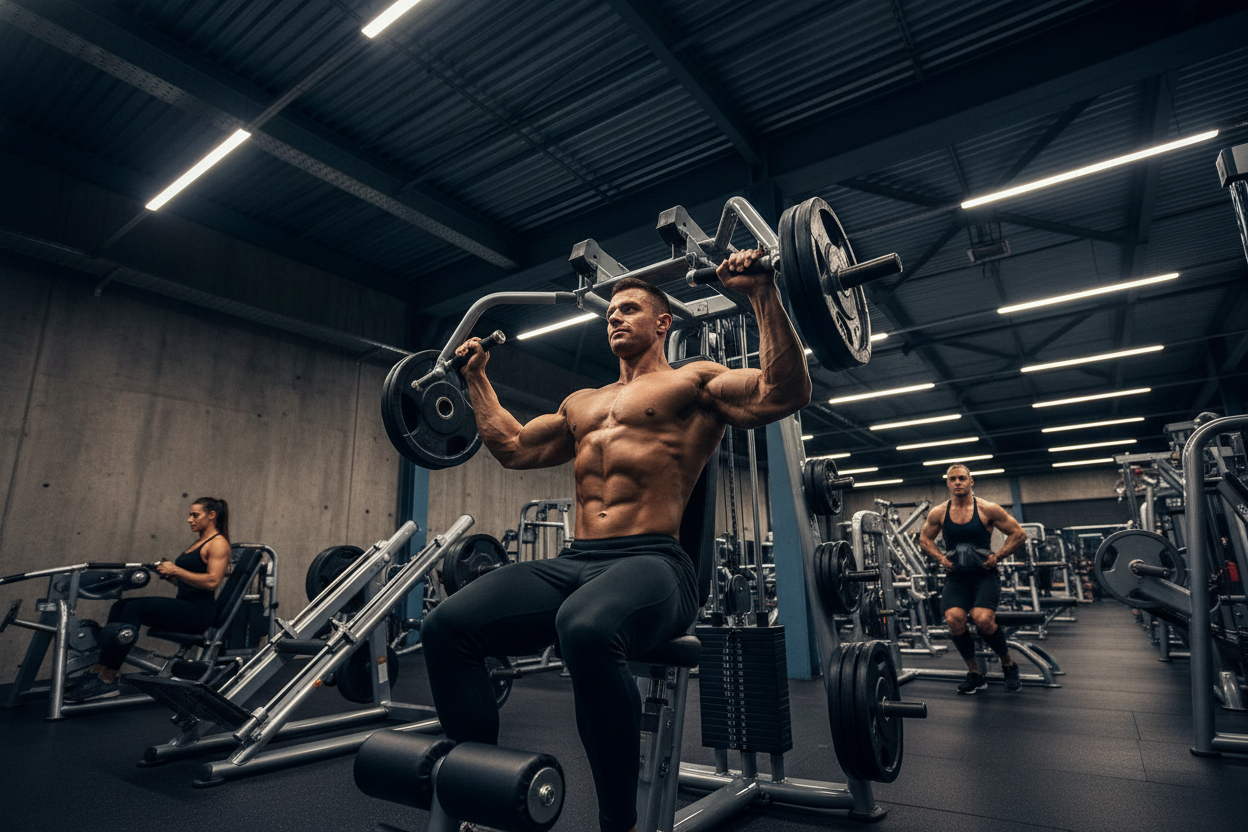
This is arguably the king of leg development. The best workout with machines must include a squat pattern. The Hack Squat allows you to place your feet lower on the platform to emphasize the quads without the risk of falling forward.
Because the load is on your shoulders and guided by rails, you can push to absolute mechanical failure safely. Doing this with a free-weight squat is dangerous without experienced spotters; on a Hack Squat, you simply rack the safety handles.
Seated vs. Lying Hamstring Curl
Here is a nuance many miss: the seated hamstring curl is biomechanically superior to the lying version. The hamstrings cross both the knee and the hip. Sitting down flexes the hip, which places the hamstrings in a stretched position.
Training a muscle at long muscle lengths has been shown to produce more hypertrophy. If you have to choose one, take the seat.
Constructing Your Routine
You don't need to switch to machines exclusively, but they should anchor your hypertrophy work. A solid approach is to start with a compound machine movement (like the Hack Squat or Press) where you can safely load heavy, then move to free weights or cables for accessory work.
My Training Log: Real Talk
I want to be transparent about what this actually feels like, beyond the textbook definitions. I’ve spent years under the bar, but my legs didn't actually grow until I swallowed my ego and lived on the Hack Squat for six months.
There is a specific, gritty reality to machine training that people don't mention. It's the friction. I remember training at a gym with an older, unmaintained leg press. You could feel the sled "stutter" on the way down—a slight grinding vibration through the seat.
It was annoying, but it taught me control. I couldn't just drop the weight and bounce it; I had to grind through that friction. Also, the bruises. If you are truly going heavy on a Hack Squat, the shoulder pads will dig in. I used to leave the gym with red rectangular welts on my traps. It’s not comfortable, and the fixed path forces you into a position you can't escape from. But that feeling of your quads burning while your back feels completely safe? That is the trade-off that makes it worth it.
Conclusion
Machines are not a crutch; they are precision tools. By stabilizing the body and guiding the range of motion, they allow you to take muscles to the brink of failure safely. Whether you are working around an injury or simply chasing maximum hypertrophy, integrating these movements is the smartest way to upgrade your programming.
Frequently Asked Questions
Can you build muscle effectively using only machines?
Absolutely. Muscle fibers do not know the difference between a dumbbell and a machine handle; they only understand tension. As long as you apply progressive overload (adding weight or reps over time), a machine-only program can build a physique comparable to free weights.
Are machine exercises safer than free weights?
Generally, yes. Machines provide a fixed path of motion and often include built-in safety stops. This reduces the risk of dropping weights or moving into compromised positions, making them ideal for training to failure or for those recovering from injuries.
How often should I rotate machine exercises?
Stick with the same machines for at least 8 to 12 weeks. You need time to become proficient at the movement and track your strength gains. Constantly switching machines makes it difficult to know if you are actually getting stronger or just learning a new leverage point.