Best Leg Workouts for Men: Biomechanical Movement Pillars, Weekly Routine Splits, and Home Floor Staging
Core Biomechanical Movement Pillars for Men's Lower Body Development
Constructing an effective lower body training plan requires more than cycling through random machine circuits. Balanced leg development depends on addressing the primary movement vectors of the hips, knees, and ankles. By organizing training around foundational biomechanical movement patterns, lifters can ensure complete muscular stimulus across the quadriceps, hamstrings, glutes, and calves while promoting balanced joint mechanics.
Knee-Dominant Compound Patterns
Knee-dominant compound movements prioritize quadricep recruitment through substantial knee flexion combined with supportive hip extension. Bilateral squat variations represent the cornerstone of this movement category. Back squats, front squats, and goblet squats each alter the line of force and torso angle, shifting emphasis between the anterior and posterior chains. Maintaining deliberate knee tracking over the midfoot, a bracing abdominal wall, and controlled depth allows lifters to maximize quadricep tension while keeping spinal alignment neutral.
Hip-Dominant Posterior Chain Drivers
Hip-dominant exercises engage the hamstrings, gluteal complex, and erector spinae via deliberate hip hinge mechanics. Romanian deadlifts, conventional deadlifts, and barbell hip thrusts emphasize horizontal force production and loaded hamstring stretch under eccentric control. Mastering the hip hinge involves pushing the pelvis backward with minimal knee bend, keeping the barbell or free weights close to the shins to avoid unnecessary leverage on the lower lumbar region.
Unilateral Stability and Stride Movements
Single-leg exercises expose and correct muscular imbalances between limbs that standard bilateral squats may mask. Bulgarian split squats, walking lunges, reverse lunges, and step-ups demand significant contribution from the hip adductors and abductors to stabilize the pelvis throughout the range of motion. Including unilateral exercises within a legs lower body guide ensures functional symmetry and athletic stride mechanics.
Lower Leg and Knee Flexion Isolations
While multi-joint compounds drive the bulk of lower-body loading, targeted isolation drills provide complete stimulus for muscle groups with distinct anatomical roles. The hamstrings cross both the hip and knee joints; while hinges train them at the hip, dedicated leg curls address knee flexion directly. Similarly, standing and seated calf raises load the gastrocnemius and soleus complexes through full plantarflexion and dorsiflexion, stabilizing the ankle joint for heavy compound lifts.
Structuring the Best Leg Day Workout Routines for Men
An optimal training structure balances exercise order, overall weekly volume, and recovery capacity. Lifters can adapt their routines to fit their broader workout schedule, whether employing a dedicated single leg day or a higher-frequency split.
Dedicated Leg Day Architecture (Push/Pull/Legs Split)
In a traditional Push/Pull/Legs split, the entire lower body is trained in one concentrated session. This structure allows lifters to move from demanding multi-joint compounds to unilateral work and isolated finishers within a single workout block:
- Primary Knee-Dominant Compound: Barbell back squat or front squat
- Primary Hip-Dominant Compound: Romanian deadlift or stiff-leg deadlift
- Unilateral Strength Driver: Bulgarian split squat or walking lunges
- Hamstring Isolation: Lying or seated leg curl
- Calf Complex Finisher: Standing or seated calf raises
Biomechanical principles and exercise selection criteria can also be adapted across different lifter profiles, as detailed in our broader leg workout guide.
Upper/Lower Split Framework (Twice-Weekly Frequency)
An upper/lower split divides leg training into two weekly sessions, allowing for focused variation and distributed recovery. This frequency enables a lifter to prioritize quad-dominant movements in the first lower-body session and posterior-chain development in the second session:
- Lower Session A (Quad Focus): Front squats, unilateral lunges, leg extensions, and standing calf raises.
- Lower Session B (Posterior Focus): Romanian deadlifts, hip thrusts, hamstring curls, and seated soleus raises.
Progression Mechanics and Movement Execution
Progression does not rely solely on adding external weight to the bar. Lifters can achieve sustained adaptations by refining repetition quality. Utilizing a controlled eccentric phase, incorporating brief pauses at the bottom of a squat or hinge, and gradually expanding the usable active range of motion increase mechanical tension while reinforcing joint stability.
Equipment Selection and Home Gym Staging
Setting up an effective home training environment involves balancing equipment versatility with safety considerations for both the lifter and the home infrastructure.
Free Weight Versatility vs Resistance Machine Stability
Free weights, such as barbells, weight plates, and adjustable dumbbells, provide unmatched flexibility for squats, hinges, and lunges while demanding active core stabilization. Dedicated apparatus from a lower body collection offers guided movement tracks and stable resistance profiles, making them valuable for isolating muscle groups near fatigue without demanding complex balance.
Subfloor Protection and Impact Dissipation
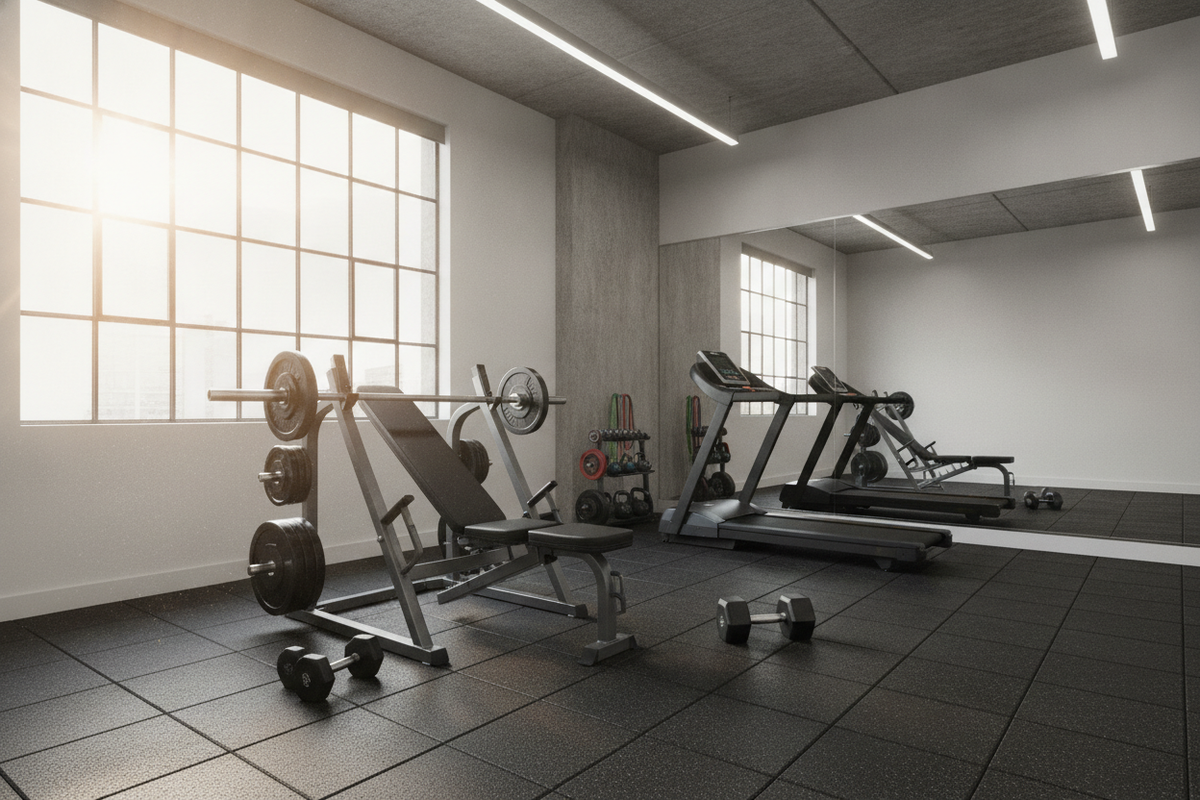
Heavy compound lower-body training exerts concentrated forces against residential floors. Dropping dumbbells, re-racking heavy barbells, or setting down deadlifts can transmit shock directly through tile, hardwood, or bare concrete subfloors. Installing dense protective matting, such as a workout product mat, helps absorb mechanical impact, disperse point loads from squat racks, and safeguard floor surfaces against permanent structural damage.
High-Traction Floor Mat Placement for Heavy Compounds
Lifting footwear requires a stable, non-compressible, and non-slip foundation during deep squats and loaded lunges. Excessive cushioning in conventional soft mats can cause foot instability and ankle rolling under load. High-density gym matting creates a firm base with high surface traction, preventing foot slippage during dynamic stride drills while muffling equipment noise and structural vibrations.
Mat Maintenance and Training Area Safety Guidelines
To preserve both safety and equipment longevity, maintain a clean, organized lifting space:
- Routine Surface Cleaning: Wipe down mat surfaces with a mild detergent solution to remove perspiration, chalk residue, and dust that can reduce surface grip.
- Perimeter Clearances: Ensure ample unobstructed clearance around squat stands, benches, and free weight storage racks to permit clean movement paths during unilateral lunges.
- Moisture Control: Ensure the subfloor beneath large rubber mats remains dry to prevent moisture accumulation or subfloor discoloration over time.
- Equipment Re-Racking: Store barbells, plates, and dumbbells on designated weight trees or racks immediately after sets to eliminate tripping hazards.