Best Home Resistance Training: What Actually Works for Real Results
Are you tired of waiting for the squat rack at a crowded commercial gym, only to realize your basement doesn't have the footprint for a full power cage? Building a functional workout space at home often comes down to balancing budget, footprint, and actual muscle-building potential.
Finding the best home resistance training setup isn't about buying the most expensive gear; it's about choosing equipment that fits your specific biomechanics and floor plan. Whether you are aiming for hypertrophy, endurance, or just functional fitness, we will break down exactly how to curate the best home strength training environment without wasting money on gimmicks.
Key Takeaways
- Prioritize versatile equipment like adjustable dumbbells and heavy-duty bands to maximize limited space.
- Compact functional trainers offer the highest exercise-per-square-foot ratio for intermediate lifters.
- Ensure your flooring can handle dropped weights if you opt for free weights over cable systems.
- Progressive overload is highly achievable at home if you consistently manipulate lifting tempo and tension.
Choosing Your Core Equipment
Adjustable Dumbbells vs. Fixed Sets
When it comes to the foundation of any home gym, adjustable dumbbells are the undisputed champions of space efficiency. While fixed hex dumbbells offer a premium commercial feel, a complete set from 5 to 50 pounds requires a massive rack that eats up valuable floor space. Modern adjustable systems give you the equivalent of 15 pairs of weights in a footprint smaller than a pair of running shoes.
The Rise of Compact Cable Machines
If you have a slightly larger budget, plate-loaded or selectorized cable machines are game-changers. Unlike free weights, cables provide constant tension throughout the entire range of motion, which is incredible for isolating muscles like the chest, lats, and triceps. Look for machines with a 2:1 pulley ratio, as they offer smoother travel and longer cable extensions for dynamic movements.
Space Planning for North American Homes
Garage Setups vs. Spare Bedrooms
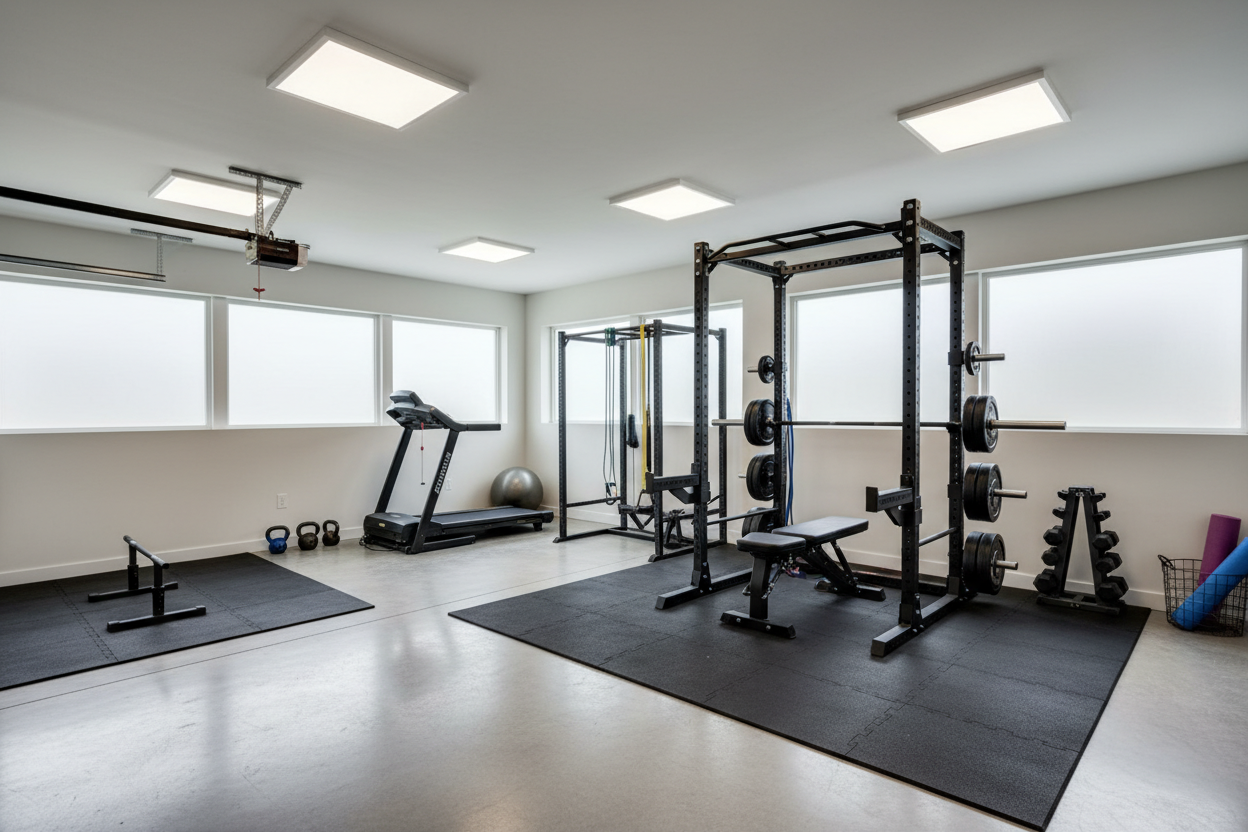
Your environment dictates your equipment. A two-car garage offers the luxury of vertical space, easily accommodating an 84-inch power rack or functional trainer. However, if you are setting up in a spare bedroom or apartment corner, you must account for standard 8-foot ceilings and floor load limits. For indoor spaces, stick to low-impact, high-yield gear like suspension trainers, resistance bands, and kettlebells stored on heavy-duty rubber mats to dampen noise.
From Our Gym: Honest Take
Over the last five years of testing gear in a humid, uninsulated two-car garage, I have learned that not all resistance equipment is created equal. When testing a highly rated set of adjustable dumbbells recently, I noticed the locking mechanism felt slightly loose during heavy goblet squats—a minor annoyance, but worth noting. However, their knurling was exceptional; my chalked grip held solid through heavy sets without tearing my calluses. If you are pushing past 50 pounds per hand, I highly recommend investing in a dedicated stand to save your lower back between sets. Also, don't sleep on high-quality layered latex bands. Cheap molded bands will dry rot and snap, but a premium set has lasted me three brutal winters without losing elasticity.
Frequently Asked Questions
Is home resistance training as effective as a commercial gym?
Absolutely. Muscle tissue doesn't know where you are; it only recognizes mechanical tension and metabolic stress. With the right progressive overload strategy, you can achieve identical hypertrophy and strength gains in your living room.
How much space do I actually need?
For a basic setup utilizing adjustable dumbbells and bands, a 6x6 foot area is plenty. If you plan to add a compact functional trainer or a half-rack, you should ideally have an 8x10 foot space with at least 84 inches of vertical ceiling clearance.
What is the weight limit on standard home cable machines?
Entry-level home cable setups usually max out around 150 to 200 pounds of resistance per side. Commercial-grade home units often feature weight stacks up to 250 pounds, which is more than enough for 95 percent of home lifters.